Holy Land
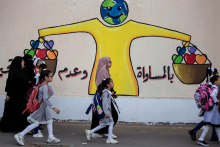
I was amazed at the grassroots leaders, mainly women, working to deliver that desperately needed good news to their communities. Their witness was particularly poignant given the patriarchal context in which they worked. Many of the government officials we met with were men who seemed focused on who would get what in the region’s future; the women we met were empowering people in their communities to create change.

Interpretations of Scripture taught throughout the evangelical world, such as dispensationalism and replacement theology, hold that the repatriation of Jews to the Holy Land is a necessary precursor to Armageddon and the Second Coming of Christ. The creation of the Jewish state, and especially Israel’s seemingly miraculous victory in the Six-Day War, seemed to many evangelicals to be the fulfillment of prophesy. The Second Coming, surely, must be right around the corner.
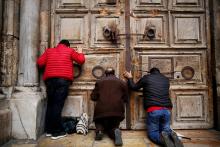
"Of course we apply, but in reality there must be no applying for permits to come to visit your own places."
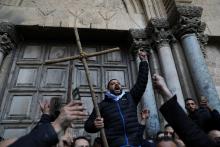
“It is absurd for Jerusalem residents to fund municipal services for the churches … on their own, and for the municipality to be prevented from collecting enormous sums that could significantly improve the city’s development and services,” Barkat said.
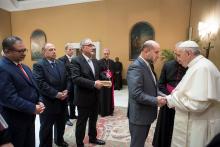
In response to Trump's announcement, patriarchs and heads of all churches in Jerusalem urged Trump to reconsider his decision to relocate the U.S. embassy from Tel Aviv to Jerusalem, reiterating deep concerns of potentially escalating conflicts in a region sacred to Muslims, Jews, and Christians.

“I have a religion — but you will call it blasphemy,” he wrote in a letter in 1865. “It is that there is a God for the rich man but none for the poor … Perhaps your religion will sustain you, will feed you — I place no dependence in mine. Our religions are alike, though, in one respect — neither can make a man happy when he is out of luck.”

“This magnificent grace, this expansive grace, this ‘Amazing Grace’ calls me to reflect. And it calls me to pray. It calls me to ask God for forgiveness, for the times that I’ve not shown grace to others, those times that I’ve fallen short.”
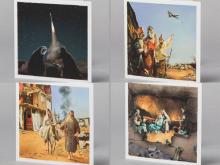
Don’t expect a peaceful scene of Mary, Joseph, and baby Jesus when you open a Christmas card from Doctors of the World.
The British branch of the humanitarian group has opted to set the characters of the creche in the midst of Mideast crises. On one card, Mary and Joseph are leaning over the baby Jesus, as a missile traverses a starry night.
“Christmas is a time people contemplate the world,” the group said in its online introduction to the cards. “Doctors of the World’s cards seek to remind the public that this year war has forced millions from their homes, and they really need our help.”
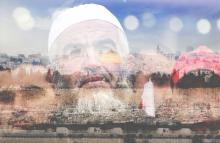
Through my work with The Global Immersion Project, I have spent a significant amount of time over the years cultivating relationships among both Israelis and Palestinians as we partner together in cultivating a narrative of reconciliation. As is often the case when we approach a people or place with the hopes of being/bringing the needed change, I have been the one most changed by my friends and colleagues who reside in the Middle East. Behind so many of the subconscious stereotypes and prejudices I had acquired earlier in my life I began to experience the richness of friendship and brotherhood among people I had previously “known” only through the latest sound bite.
Something I have learned in the classroom of real life relationships with Jews, Christians, and Muslims in the Holy Land is that our theology in the West has direct implications for the everyday lives of those in the Middle East. Often ignoring the remarkable movements of peacemaking, reconciliation, and collaboration that are sprouting like mustard seeds of hope across the Holy Land, we often choose only to amplify of the violence, discord, and disintegration of the region.
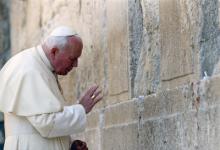
It sounds a little far-fetched and for some purists perhaps unthinkable: A pope, a rabbi, and a sheik decide to travel to the Holy Land and follow in the steps of Jesus.
The Argentina-born pope will be accompanied by colleagues Rabbi Abraham Skorka and Sheik Omar Abboud, both from Buenos Aires. It is the first time a pope’s official delegation has included members of other faiths on an overseas trip.

Having just gotten home from guiding another The Global Immersion Project Learning Community deep into the lives of the unheralded heroes in the Holy Land to learn from their often untold stories, I am processing emotions, thoughts, and reflections that will soon bud into a renewed set of practices at home and abroad. I have now been to Israel/Palestine quite a few times, and it would be easy to think the experience becomes mechanical or normal or whatever. Well, for me, that simply hasn’t been the case. We encourage our participants to enter the experience in the posture of a learner rather than a hero. I try to do the same, and in doing so, am continually convicted, challenged, and inspired by our remarkable friends and peacemakers embedded within this conflict.
Here are 7 learnings that have risen to the surface since landing back on home soil:
Secretary of State John Kerry brought his argument for a two-state Israeli-Palestinian peace to the annual AIPAC conference this week, and whatever else we might know, we know this: Many evangelical Christians didn’t like it.
Or at least that’s what we’re told by some Christian leaders and their political allies. Supporting Israel’s government by opposing compromise with the Palestinians is a permanent plank in American evangelical political thought. “God told Abraham that he would bless those who bless him and the nation of Israel,” the thinking goes, “and curse those that curse Israel.”
But could it be that the truth is more complicated?
What if the loudest evangelical voices don’t represent the complexity of our community? I raise these questions as an evangelical who is fully committed to supporting the struggle for security, dignity, and freedom for Israelis and Palestinians. And I’m not alone.
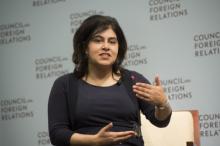
The highest-ranking Muslim in the British government on Friday called on Western governments to do more to protect besieged Christian minorities across the world, particularly in the Holy Land where they are now seen as “outsiders.”
Baroness Sayeeda Warsi, the government’s minister for faith and the first Muslim member of a British cabinet, said religious freedom is a proxy for human rights and must not be an “add-on” to foreign policy.
“A mass exodus is taking place, on a biblical scale,” she said in a speech at Georgetown University. “In some places, there is a real danger that Christianity will become extinct.”

IN HER JEWISH school in Montreal, Ronit Avni learned the tragic history of her people. Her Canadian mother and Israeli father had met in the ’60s when her mother was living in Israel and working as a folk singer, often performing for Israeli troops. Her older sister was born in Tel Aviv, but the family settled back in Montreal in the mid-’70s before Ronit was born.
Not strictly religious but committed to the values of Judaism, Ronit couldn’t help but ask probing questions as she listened to the stories of the birth of the modern state of Israel in 1948. Am I hearing the whole story? How do Palestinian perspectives differ from what my educators and community leaders are teaching? How can we transform this situation from a zero-sum equation to one that respects the dignity and freedom of all?
Years later, having graduated with honors from Vassar College with a degree in political science after studying theater at a conservatory in Montreal, Ronit trained human rights advocates worldwide to produce videos as tools for public education and grassroots mobilizing.
By the time I met Ronit a few years ago, she had narrowed her worldwide focus to the Israeli-Palestinian conflict, where her heart was most deeply drawn. She is the founder and executive director of Just Vision, an organization dedicated to increasing media coverage and support for Palestinian and Israeli efforts to end the occupation and conflict without weapons of violence.
During the last several years, my engagement in the Holy Land has been significantly shaped by Ronit. Her film Encounter Point, about Israelis and Palestinians who have lost family members, land, or liberty to the conflict yet choose forgiveness and reconciliation rather than revenge, gave me hope that peace can emerge from pain.
LIKE MANY Palestinians forced from their homes during the 1948 war, relatives of Jordan’s Sen. Haifa Najjar carried the keys to their Palestinian homes with them as they fled. These keys, passed down through generations, are powerful symbols of Palestinian ties to the land that international law considers theirs—even as their hope for return wanes.
As a Christian appointed by King Abdullah II to Jordan’s upper house of Parliament, Najjar is active in the education, environment, cultural, and legal sectors of the government. She is also superintendent of the Anglican-run Ahliyyah School for Girls and Bishop’s School for Boys in Amman, Jordan.
Within the mix of the 500,000 Palestinians who relocated to Jordan because of the Israeli War of Independence—or Nakba, “the catastrophe,” depending on who you ask—was a vocal minority of Palestinian Christians who joined their ranks with the existing Jordanian Christian community. Prior to 1948, Christians accounted for nearly 20 percent of the population of what is now Israel/Palestine. Today that figure is less than 2 percent. Even more dramatic are declines in the West Bank cities of Ramallah and Bethlehem. Christian populations are nearly extinct in these locations compared to their respective majorities of 90 and 80 percent prior to 1948.*
“They moved not as immigrants; they were initially thinking it was a temporary thing,” says Father Nabil Haddad of the Melkite Catholic Church in Amman. “It is similar to what Syrians are thinking right now when crossing the barbed wire, not the checkpoints, between south Syria and north Jordan.”

Mr. President, just like the many other visitors that we receive here in this land, we would do our best to overwhelm you with our cultural hospitality and our traditions. I would seize this opportunity to not only welcome you to visit Bethlehem, but also to welcome all U.S. citizens to visit my small city.
I invite you, Mr. President, to be in my city within the nation that has a dream of liberty — a dream that goes in rhythm with all nations’ right of self-determination. We have embraced, as other nations, our pursuit of democracy, human development, and security. We have tumbled through our pursuits and have made mistakes, and because like all humans, as part of our human nature, we slip. We have built, learned, developed, and made our existence known to all nations.
Mr. President, I hope that in your visit you would not only enjoy the blessings of the Holy Land, but be encouraged to return and experience this city to its fullest. After you finish your presidency you will be able to visit without a big security escort and you will enjoy wandering the old streets and spending time in the old city of Bethlehem when you come back with your family.
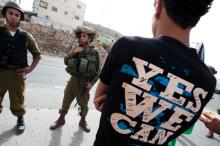
President Barack Obama will be visiting Israel and Palestine in March. I call on you to write to Obama and tell him that if he is coming to engage Israelis and Palestinians in talks that will lead to a just peace, he is then welcome. Otherwise tell Obama to stay home.
Tell Obama that the world will be watching his upcoming visit and people all over our planet will look to his visit with hope and expectation. Tell him not to disappoint humanity by carrying on U.S. politics in the Middle East as usual.
Tell Obama when he visits us here to stand by the values that he reiterates in almost every speech: freedom, independence, equality, and justice for all.
A VARIETY OF EVANGELICAL peacemaking efforts have sprung up in recent years, from the Two Futures Project, which seeks a world without nuclear weapons, to the World Evangelical Alliance’s Peace and Reconciliation Initiative, which seeks to redress the fact that “in our zeal for evangelism, we have often overlooked the biblical mandate to pursue peace.”
This fall, evangelicals from a range of viewpoints gathered at Georgetown University in Washington, D.C., exploring what a distinctive evangelical contribution to peacemaking might look like. The essays below, unless otherwise noted, are taken from the first Evangelicals for Peace conference, a “summit on Christian moral responsibility in the 21st century.” Organizers hope to publish a book with the entire collection of talks. —The Editors
-----
‘All the Easy Jobs Have Been Done’
Standing on a rich tradition of peace and transformation
by Geoff Tunnicliffe
WHY IS PEACEMAKING an important topic for evangelicals? As a global community of 600 million Christians, our churches are confronted daily with the impact of illegal weapons. Our hospitals treat the victims of violence. Our church leaders counsel the traumatized. All forms of conflict negatively impact our development programs. Our aid agencies seek to care for and rehabilitate child soldiers. Our inner-city communities are confronted with the outcomes of gang warfare.
For all of us who say we are followers of Jesus, as we observe or experience the brokenness of our world, it should break our hearts. If we feel the pain so deeply, I can’t imagine what our loving God feels. The One who is called the Prince of Peace. The One who laid down his life, so that we could be reconciled to God and each other.
The World Evangelical Alliance’s engagement in peacemaking stands on the rich traditions of evangelicals who have devoted themselves to being instruments of social change and transformation. We want to say loudly that we evangelicals want to be on the forefront of peacebuilding. All the easy jobs have been done. It’s just the tough ones that are left. It requires clear vision to face these challenges.
We as evangelicals are committed to working together with those in and outside our community for the good of all. May God empower us through the work of his Spirit to be his ambassadors of peace and reconciliation.