Holy Land
WASHINGTON — It’s an idea that feels particularly poignant this Thanksgiving: American Jews and Muslims banding together to help the homeless and other needy people.
The interfaith collaboration has been going on for five years, but the recent exchange of rockets between Gaza and Israel is weighing especially hard on both communities this week. That's why a joint session of sandwich making or a group visit to a nursing home has taken on added significance.
“In this time of warfare it was a beautiful experience to see the two come together,” said Haider Dost, a Muslim student at Virginia’s George Mason University who worked with Jewish students to feed the homeless Sunday in Franklin Park, just blocks from the White House.

More than 20 lawmakers and Capitol Hill aides, including one nude congressman, took a booze-fueled late-night swim in Israel’s Sea of Galilee last summer, Politico reported on Monday. Which leaves at least one question: Is skinny-dipping at the biblical site sacrilegious?
Not really, Christian leaders and Holy Land experts said.
“Conservative Christians, obviously, aren't for getting naked in public or drunk anywhere,” said Russell D. Moore, dean of the School of Theology at Southern Baptist Theological Seminary in Louisville, Ky.
“The location of the Sea of Galilee, however, doesn't make the story any more offensive to Christians than it is to the general public,” he said.
The conflict between Israelis and Palestinians is often seen as a conflict between Jews and Muslims. But there are also minority communities of evangelical and other Christians who are caught up in the conflict. This includes Jewish followers of Jesus in Israel who call themselves Messianic Jews and Palestinian Christians in the West Bank. Sadly, the chasm between Messianic Jews and Palestinian Christians is deep. The end-times theology espoused by Messianic Jews can be interpreted in a way that supports the state of Israel at the expense of the Palestinians. At the same time, Palestinian Christians can become so focused on the hardship of living under oppressive military occupation that they forget the justifiable fear of violence that haunts Jewish residents as well.
International Christians, even those who try to honor the dignity of both Israelis and Palestinians, tend to be labeled as siding with one or the other—either with Jews as God’s chosen people or with Palestinians as victims of injustice. In recent years I have been judged by some as leaning too far toward the latter perspective.
In fact, I was severely criticized for speaking at the March 2012 “Christ at the Checkpoint” conference in Bethlehem. Because it was sponsored by Palestinian Christians, some people assumed it was anti-Israel. Prior to the conference, a writer for The Jerusalem Post called me a threat to the state of Israel; and some American Messianic Jews called me a heretic and an anti-Semite.
To be honest, as the conference approached I regretted having agreed to participate. Was it worth the controversy? And what if the conference inadvertently fueled hostility and division? Rarely have I gone into an event so fearful of outcomes and so earnest in praying for God’s intervention.
Ridiculous. Ignorant. Racist. Dangerous.
These are just a few of the terms that flew out of the Middle East this weekend following Newt Gingrich’s unwelcome remarks about Israel and the Palestinians on Friday.
As the Republican front-runner, Gingrich was speaking to the cable TV Jewish Channel and hoping to curry favor with its conservative pro-Israel constituency.
What did he do? He described the Palestinians as an “invented people” and lumped every Palestinian under the terrorist umbrella. There is no difference between Hamas and the Palestinian Authority, he said.
On Saturday night during the ABC Republican debate, Gingrich doubled-down: “They [the Palestinians] are all terrorists.”
A few of the other candidates looked, well, alarmed.
Because this week -- months after the Arab Spring, and after weeks of the growing Wall Street Occupation -- well, in this climate of discontent and dissent as we all begin to wake from our consumer induced coma to see how multi-national corporations control so much more than we can imagine, in a season when tyrants are being over thrown, I simply could not preach a sermon in which I say that God is like an angry murderous slave owning king. Maybe there is a way of finding good news in that but I just couldn't do it.
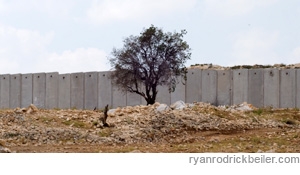 Whenever I give talks on the effects of the Israeli occupation on Palestinian livelihood, the status of nonviolence as a means to resisting the occupation, and how I believe nonviolence is the only way to move forward to resolve the conflict and create a lasting peace between Israelis and Palestinians, one of the first and immediate questions I get from foreign visitors to my office in Bethlehem is, What you said is good, but what about the Muslims? Do they also believe in nonviolence? Do they understand it?" Even if I don't mention religion in my presentation -- and I rarely do -- this question always seems to make its way in our discussions.
It isn't as if the Middle East needed another complication. Tunisia, Egypt, Libya, Yemen -- now Terry Jones? Rev. Jones is a fringe pastor in Gainesville, Florida, who spent about 30 years as a missionary in Europe.
I've been fascinated watching an earlier blog hunker down into a strong debate about Israel and the Palestinians (February 22, "
Bethlehem, West Bank. Evangelicals have never been keen on political protests. Especially the sort that includes rifles and grenades -- in the hands of your opponents.
National Catholic Reporter has an important article about the Kairos Palestine Document endorsed last month by the leaders of 13 Chr