black theology

It was 23 years ago that Rev. Jeremiah Wright delivered one of the most profound and misunderstood sermons in U.S. history. In “Confusing God and Government,” delivered on Palm Sunday in 2003, Wright tells the story of race and war throughout U.S. history, arguing that the country had failed Black and Indigenous populations. Toward the sermon’s climactic end, Rev. Wright stated, “No, no, no. Not ‘God Bless America;’ God Damn America! That’s in the Bible, for killing innocent people. God Damn America for treating her citizen[s] as less than human. God Damn America, as long as she tries to act like she is God and she is supreme!” This moment would cause controversy during the 2008 presidential campaign, when Barack Obama, who attended Wright’s church, was accused of anti-Americanism.
But Wright was right. If the United States, as a nation, has a soul, it is currently hellbound.

I’ve followed Robert Monson’s work for years. Monson is a writer and theologian who focuses on Black theology, contemplation, and disability. He is also one of the first people outside my direct orbit to encourage my writing (not just my reporting), and I’ve always found him to be encouraging, joyful, and thoughtful.
Lately, as I have been reading Monson’s work, I’ve found that he is becoming rather soft. Now, before you think those are fighting words, I’ve thought this because it’s the term that Monson uses to describe himself and his aspirations as a man. He sees softness as an ethic to live into, a way of honoring his personhood and the personhood of others.
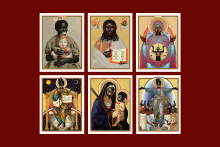
As racist ideas continue to plague U.S. politics, Mark Doox’s Afro-surrealist and satirical graphic novel, The N-Word of God, couldn’t have arrived at a better time.
The book is a visual novel told through depictions of anti-Black images — Black people eating watermelons, Jim Crow caricatures, mammies, and blackface — all stylized in the form of Eastern Christian iconography. This is a style that Doox has termed “Byzantine Dadaism.” Doox’s novel deconstructively takes these caricatures that have historically harmed Black people and reimagines them as symbols of Black resilience and healing, restoring the inherent dignity that belongs to every human being, especially those who have been racialized and subjugated by U.S. anti-Blackness.

I love documentaries. I try to watch a minimum of one per week. I am especially drawn to documentaries like Born in Synanon — a documentary about a rehab community that eventually became a cult — because it wrestles with questions around race and religion. These two subjects are endlessly fascinating to me.
So, when I heard about Faith in Blackness, I knew I would have to see it. In October 2023, one of the executive producers, Josué Perea, invited me to a screening at the University of Washington. The documentary explores the relationship between AfroLatine spirituality and how that spirituality shapes a person’s identity and understanding of the divine.
Across the U.S., a coordinated effort is being made to suppress any history that might be deemed “uncomfortable” to its listeners.
In Oklahoma, the state’s superintendent of public instruction Ryan Walters sparked outrage by saying that teachers could teach about the Tulsa Race Massacre so long as they did not, “tie it to the skin color and say that the skin color determined it.” New legislation restricting the teaching of “divisive concepts” in Tennessee, Georgia, and New Hampshire has teachers fearing they’ll be fired simply for discussing racism or sexism in history.
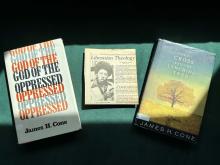
My early suspicion of Cone was reflexive. I had been formed in the intercessory prayer meetings of pious Afro-Caribbean Pentecostalism and naturalized in the halls of white evangelical academia during the so-called “post-racial” years of the Obama presidency. In those churches of my youth, racism was real, “but not nearly as bad as it had been in the past.”

Divine Justice
A Comanche woman eschews gender norms to protect her tribe from fur trappers and alien warriors in the sci-fi horror film Prey. The movie honors Indigenous culture and offers a compelling, brutal picture of divine justice against colonial powers.
Hulu
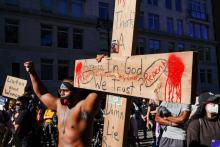
As soon as the pastor began to speak, I rose and turned up the aisle, only looking back once in a small act of self-righteous defiance. I hoped the speaker would catch my gaze and feel convicted over the heresy he preached. Pictures of Black Lives Matter protests scrolled across the screen, confirming in my mind that leaving was the right decision.

Wipf and Stock Publishers confirmed today that it has initiated the removal and ceased distribution of Jennifer M. Buck’s book, Bad and Boujee: Toward a Trap Feminist Theology, after days of criticism directed at the book.

My bookshelf represents a poverty of influence. So for Lent, we — two white middle-class millennial women — decided to fast from white voices and white-dominated media. For 40 days, we’re committing to only read books, watch films, and listen to podcasts written or directed by women of color.
I WAS RAISED in an African-American church, but as an adult I discovered Anabaptism. Since then I’ve sought to learn from both the wider black church and Anabaptist traditions, to the point that I now consider myself an “Anablacktivist.”
Two experiences at my undergraduate Christian college helped propel me to see the significance of these two Christian streams. The first time was a chapel service, maybe a year after 9/11. The speaker, the Catholic priest John Dear, challenged us about U.S. violence and militarism—arguing that these weren’t consistent with the life and teachings of Jesus. I leaned forward in agreement, captivated by his message, feeling that it rang true and faithful to Jesus.
Then I noticed some movement in the darkened auditorium. Droves of students disruptively got up from their chairs and headed straight for the exits, in protest of the speaker and his “subversive” message that refused to affirm everything that the U.S. was doing in the world. I found myself deeply troubled by the defensive response of my (mostly white) Christian brothers and sisters to Dear’s thoroughly Jesus-shaped critiques of U.S. empire.
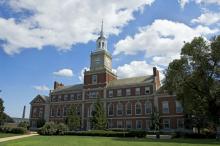
For many pundits and observers, last week’s election proved that a “new normal” has emerged in America: record numbers of women and ethnic minorities were voted into the House and the Senate, and the House will also see its first Hindu representative in January. Voters in Maine and Maryland approved same-sex marriage, and a diverse coalition of social minorities came together to re-elect the nation's first black president.
But for black theologians, the election has also been an occasion to reflect on how the black church faces an identity crisis, losing track of its mission to lead the way in issues of justice and liberation.
“Something happened to the black church after the assassination of Martin Luther King, Jr., in 1968,” said Dr. Gayraud Wilmore, one of the founders of black theology, adding that when King died, it seemed that in black congregations, the enthusiasm for black history and racial identity also died.
And for Wilmore, the last 44 years — even the election and re-election of a black president — have done little to abate this crisis.