Asian American

When Democratic Socialist Zohran Mamdani defeated Andrew Cuomo in New York City’s mayoral primary, the political establishment didn’t quite know what to do.
Headlines described Mamdani’s win as “stunning,” “electrifying,” an “upset,” and even a “miracle.” Right-wing critics responded with predictable vitriol, labeling Mamdani a “communist,” “terrorist,” and a “little Muhammad.” These attacks were aimed both at his politics and his identity as an Indian American, a Muslim, and a socialist.
But what was most remarkable about Mamdani’s successful campaign wasn’t necessarily Mamdani himself. Rather, it was the working-class support behind his campaign that captured people’s attention.

If you drove down Filbert Street in Center City Philadelphia in February 2025, you might notice a few things. The street is not very wide. There’s a train station. And a large, boarded-up building, surrounded by fencing—it used to be a Greyhound Bus terminal. A sign on a pedestrian walkway says “Fashion District.”
Soon, you’d see an “All Traffic Must Turn Left” sign. And since you are traffic, you turn left — and quickly realize you’re in Chinatown. Make another left to Arch Street, and you’ll find Chinese characters on almost every storefront, even on “The Bank of Princeton.” On nearby Race Street, there’s a historical marker that reads:
Philadelphia Chinatown
Founded in the 1870s by Chinese immigrants, it is the only “Chinatown” in Pennsylvania. This unique neighborhood includes businesses and residences owned by, and serving, Chinese Americans. Here, Asian cultural traditions are preserved and ethnic identity perpetuated.
But remember Filbert Street and that boarded-up bus terminal? In summer 2022, the National Basketball Association’s Philadelphia 76ers announced that they wanted to build an 18,500-seat new arena right there, taking up a third of the Fashion District (a shopping mall formerly known as The Gallery), sitting directly above the train station, connecting to the old Greyhound terminal, and removing Filbert Street from the city grid. At the time, the bus terminal was in use, not fenced off — isn’t it funny how things can sometimes work out just how billionaires want them to?
Residents, especially those from nearby Chinatown, almost immediately raised concerns. Two Pennsylvania-based organizations — the Asian Pacific Islander Political Alliance and Asian Americans United — formed a coalition to oppose the building of the arena; about 50 other organizations soon joined. A 2023 survey by the Philadelphia Chinatown Development Corporation found that 93% of business owners and 94% of residents opposed the arena, citing concerns about gentrification, parking, traffic congestion, the deterioration of Chinatown’s culture, and increasing rent and displacement.
Some faith leaders, eager for the jobs new construction might provide their congregants, supported the arena. Many others, including clergy from Black, mainline, and Catholic churches, joined the coalition to protect Chinatown — even though most of their congregations weren’t located there. They were allies. But they weren’t motivated by immediate existential threats to their community.
And then, there was Rev. Wayne Lee.
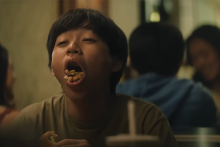
THERE IS SOMETHING horrendous about the politics of being 13 — the raging hormones, the prepubescent brinkmanship; nobody knows what they’re doing, and everyone wants you to think that they do. Such is the case for Chris Wang (played by Izaac Wang), aka Wang Wang, aka Dìdi, aka Half-Asian Chris (he’s not actually half-Asian). Chris is having a bit of an identity crisis.
Director Sean Wang’s Dìdi is a love letter to adolescence rendered with painstaking specificity, a period piece set in his own childhood home of Fremont, Calif., during the era of T9 texting and AOL instant messenger.
It’s the summer before freshman year in 2008 and Chris is getting into shenanigans: skating with his friends, wondering if he should send a :) or a ;) to his crush, and generally feeling emotions nobody else could possibly understand. Plus, his mother keeps arguing with his grandmother and asking if he’s feeling sad — so annoying. And his sister, who sucks, obviously, is leaving for college, but at least she has good taste in music (or rather, she likes the same music as Chris’ crush).
There is such frenetic volatility to early adolescence.
This work of crafting a new narrative for Asian America takes various forms across many locations. It is not linear or systematic, but rather involves the relational work of changing a collective imagination of Asian Americans through both education and experience. Like any story, asserting a new narrative for Asian America requires engaging mind, body, and soul.
A recent report by Stop AAPI Hate, Brigham and Women’s Hospital, and the Asian American Psychological Association found that Asian Americans who have experienced racism are more stressed by anti-Asian hate than the pandemic. Further, it found that 1 in 5 Asian Americans who have experienced racism show signs of racial trauma.
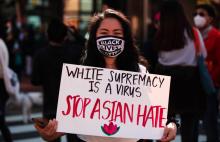
The question is: How do we broaden our bandwidth for advocating with our African American brothers and sisters while also bringing into view what is happening to Asian Americans in this moment? How does this moment continue the entire history of anti-Asian American racism? How can we expose the ways “racial capitalism” has sought to turn “non-white” races against each other?

Now as a mother of a young adult and two teenagers, I believe it is important to share my story so that society is aware that sexual assault occurs frequently, even in Asian American communities. Just because we do not share our experiences publicly does not mean that Asian Americans are immune to sexual violence. Just because we carry the burden for decades doesn’t make our experiences untrue. Just because we do not share our stories doesn’t mean that we need to continue to live in shame.
For many Asian immigrants and refugees, coming to the United States wasn’t fully voluntary, but a result of war and poverty. Just as the Hebrews needed to learn to live as exiles, Asian Americans needed to find a way to make a new home in a new land. While their hardships reflect the difficulty of exile, Jimmy’s and Mary’s familial love and corporate responsibility also model for me how we Christians are to follow Jesus in the midst of this empire.
“I think it’s unfortunate that a lot of Asian Americans don’t know who Vincent Chin is,” one of the respondents says. Make that even more Americans, of every heritage.

There are few things as exhausting, draining, and disheartening as family drama. I’m not talking low-level sibling rivalry over who gets shotgun all the time. I’m talking deep-rooted family issues that go generations back. That kind of family drama shows up in the most inopportune times in the most inappropriate places — at someone’s wedding or funeral, at the family reunion, or while grocery shopping.
But when family drama shows up in the church, it grieves me. It riles me up like nothing else does because it is in my identity as a Christian and Jesus-follower where I am all of who God created me to be and has called me to be — Asian and American, Korean, female, friend, daughter, wife, mother, sister, aunt, writer, manager, advocate, activist. The church is the place where I and everyone else SHOULD be able to get real and raw and honest to work out the kinks and twists, to name the places of pain and hurt, and to find both healing and full restoration and redemption.
So when the church uses bits and pieces of “my” culture — the way my parents speak English (or the way majority culture people interpret the way my parents speak English) or the way I look (or the way the majority culture would reproduce what they think I look like) – for laughs and giggles, it’s not simply a weak attempt at humor. It’s wrong. It’s hurtful. It’s not honoring. It can start out as “an honest mistake” with “good intentions,” but ignored, it can lead to sin.
Fortunately, there is room for mistakes, apologies, dialogue, learning, and forgiveness.
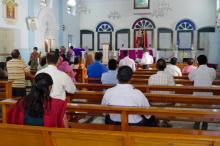
The most comprehensive study of religion and Asian-Americans to date finds them less religious than most Americans, but also far more religiously diverse.
Within that diversity, however, researchers discovered a wealth of spirituality.
“Asian-Americans are really a study in contrasts, with religious groups that are running the gamut from highly religious to highly secular,” said Cary Funk, lead researcher on “Asian Americans: A Mosaic of Faiths,” released Thursday (June 19) by the Pew Forum on Religion & Public Life.
Though a plurality of Asian-Americans are Christian, “it’s a striking difference” compared to the U.S. population in general, Funk said.

Tim Tebow references were a dime a dozen as the 2011-2012 NFL season drew to a close. News media, op-eds, fans, Bill Maher — everyone was talking about the Broncos QB's accomplishments, his unabashed Christian faith, the way he would pray when he scored a touchdown. (See: Tebowing.)
And plenty of people questioned whether or not God was really on Tim's side.
Football season is over, and the lull in “Tebow fever” is forcing more than a few of us to look for similar athletic incarnations of the John 3:16-face painted footballer. So when word got around that the New York Knick’s (until recently) virtually unknown point guard Jeremy Lin is scoring some big points at the start of his professional career AND that he is a committed Christian, the masses have found their new fixation.
But are the comparisons between Tebow and Lin really valid?
Today is my one-year anniversary on vitamin L, and it's finally time to talk about.
I struggle with anxiety and clinical depression, and I take vitamin L -- or Lexapro to be exact -- to treat it. It's been one year since I decided enough was enough. I was tired of being tired. Tired of being sad. Tired of always feeling on edge about almost anything.
Last spring I finally sought out the help I needed all along, and took some concrete steps in overcoming depression and the cultural stigma mental health issues carry within the Asian American, American, and Christian cultures. And that is where I find convergence, because May is Asian Pacific American Heritage Month, and it is also Mental Health Awareness Month. I couldn't have orchestrated it better myself.
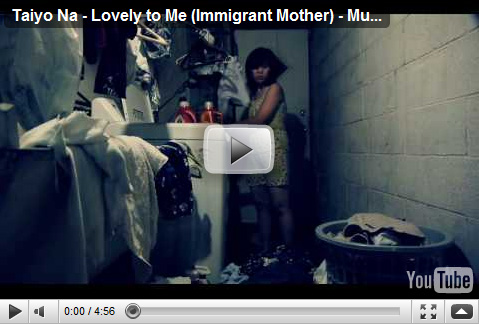
To commemorate Mother's Day, we have this musical tribute to immigrant mothers: "Lovely To Me (Immigrant Mother)," by Taiyo Na.