
It was December of 2000, but I remember the occasion as if it were yesterday.
It was a few days after Christmas during my senior year of college. I was quite nervous, and I wondered how my friends and family would react.
How would my basketball teammates respond? Would my roommates treat me differently? And of course, what about my girlfriend? She had no idea our relationship would take such a dramatic turn.
I could hide no longer. I had to be honest with who I was. And so, after a great deal of delay and long nights of nervous planning, I finally decided to share what I had been keeping secret.
Beginning with my girlfriend, then my parents, brother, sister, and eventually friends, roommates, and teammates, I shared the news: After a significant amount of prayer and discernment, I was no longer planning to attend law school following college graduation, but instead, I wanted to attend seminary in order to become an ordained Lutheran pastor.
As to be expected, I received mixed reactions.
My parents were confused and surprised, as they – like most people – had not perceived me as “religious”," especially not to the point of pursuing ordination. Nevertheless, they accepted the news with delight and affirmation.
In addition, my girlfriend (who is now my wife) was wonderfully supportive. So was my brother, sister, and closest friends.
On the other hand, some others were not sure how to react. My friends – mostly uninterested in religion – wondered about future plans. Basketball teammates were a bit uneasy. And even the campus priest and a few professors had an assortment of reactions. While a number of people were anxious and apprehensive, those within my closest circle of friends accepted the announcement with open arms.
I continue to thank God for such a wonderful web of support.
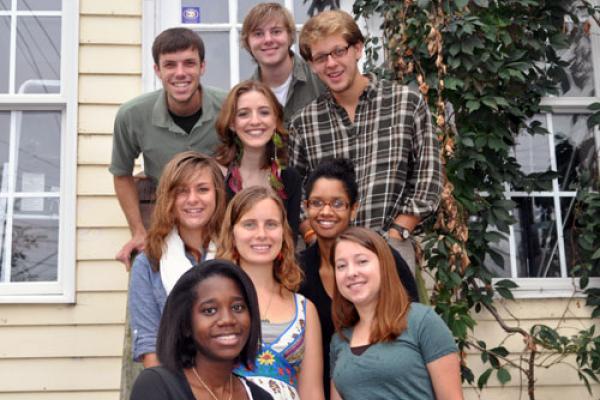
On Tuesday, the religion, policy, and politics project at Brookings and the Public Religion Research Institute (PRRI) hosted a forum to release PRRI's fourth American Values Survey (AVS), a large national, multi-issue survey on religion, values, and public policy.
We sent some of our interns to listen in on the findings. Here's what they thought about some of the issues raised by the report.

#5. Delivery complications: Amy was a real trooper when Mattias was born, but nothing about it was easy. Actually he and I had eerily similar experiences making our way into the world. We both were exactly the same length and weight, we both were faced the wrong way, and both of us were finally delivered by caesarian section, after putting our moms through hours of hardcore labor.
The story I’ve heard is that my delivery was a big part of why my folks decided not to have any more children. Before that, they planned on having more but it was too much to deal with. And let me tell you that I can sympathize. I was in the room both when Amy tried to deliver naturally, and when they cut her wide open and yanked the little peanut out. His face was blue from a lack of oxygen, and his umbilical cord wrapped twice around his neck. Though I’ve never experienced such awe and joy in my life, I also have no desire to relive that sort of terrifying vulnerability.
#4. Postpartum: We didn’t recognize it as such for almost a year, but Amy suffered from pretty severe postpartum depression after Mattias was born. In a phrase, it sucked. I also happened to be running for local political office at the time, which added stress to the situation, but I didn’t know what the hell was going on. It was our first time, after all, and no one really warned us about what to do if your wife has quasi-psychotic images of herself pushing your baby down the stairs. She was so worried she was going crazy that she didn’t tell anyone for fear that they might take Mattias away from her. So instead, she tried to manage it, quite unsuccessfully, on her own for nearly 12 months.
The breaking point finally came one night when we were lying in bed and I laid it all out. I knew something was really wrong, but I had no idea what it was. I could feel her withdrawing farther away from me every day, and I felt like I couldn’t do anything about it.

Note from Jim Wallis: On October 25, Troy Jackson wrote this piece for God’s Politics. He called for a “media fast” on November 2 — today. I thought this was a compelling idea so I am putting it out there again. So Turn Down the Noise: Fast, Pray, and Vote — today or one of the days before the election. Read and heed.
I was a teenager when the rock and roll "documentary" Spinal Tap premiered. Like many in my generation, I love the scene when Spinal Tap member Nigel Tufnel (Christopher Guest) proudly shares with reporter documentarian Marty DiBergi (Rob Reiner) that the band's special amp has dials that go up to eleven:
"You're on ten here, all the way up, all the way up, all the way up, you're on ten on your guitar. Where can you go from there? ... Nowhere. Exactly. What we do is, if we need that extra push over the cliff, you know what we do?" Marty responds, "Put it up to eleven," and Nigel emphasizes the point: "Eleven. Exactly. One louder."
This election season, I have come to believe that Nigel was on to something. You see, here in Ohio we have seen political advertising go "one louder" and receive "that extra push over the cliff." The NOISE is so deafening, I'm convinced the campaigns and super PACs have discovered a way to turn the dial all the way up to 11!

I was standing there on the shore, jeans rolled up, my ankles in the surf.
It was day two of the Rob Bell event and people were surfing.
Yes, surfing.
Rob brings in a couple of surfing instructors and, if you want to, you can rent a board and take a lesson. It's a good time. I watched a lot of people surf for the first time as I stood on the shore ...
watching ...
waiting.
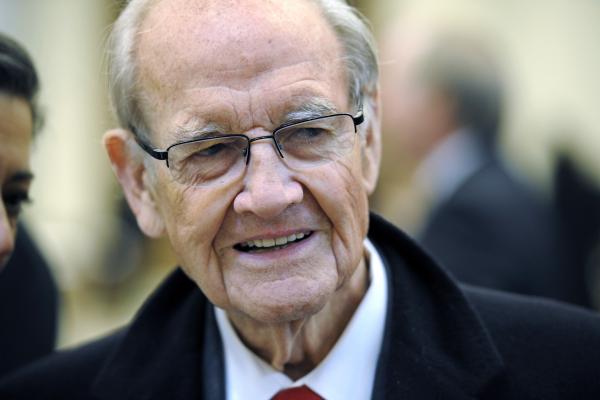
I will miss George McGovern. The former senator from South Dakota and Democratic presidential candidate in 1972 died in a hospice on Sunday, at 90, surrounded by family and friends who loved him.
Indeed, many of us did.
1972 was the first year I was old enough to vote in an election, and McGovern was the first presidential candidate for whom I voted.
To this day, I am more proud of that vote than most of the others I have cast since.
Some of McGovern’s people contacted me while I was still at seminary during the 1972 campaign. They wanted McGovern to have a chance to meet and talk with evangelical Christians, since his own Christian faith was very important to him — being the son of a Methodist minister and even having studied for a divinity degree himself for a while before deciding to go into teaching history. I agreed to help.
They couldn’t understand why most evangelicals at the time were for Richard Nixon, a man who turned out not to be one of the U.S.'s most honest, humble, or deeply religious presidents.
For the next 12 days it’s all about the ground game. With most voter registration deadlines passed, the fight against voter suppression has shifted focus from registration drives to calling banks, car-pools, and calls to vote early.
Bishop Dwayne Royster is Executive Director of P.O.W.E.R. (Philadelphians Organized to Witness Empower and Rebuild), a 37-member interfaith organizing coalition in Philadelphia. Royster is also lead pastor of Living Waters United Church of Christ in Philadelphia. In a recent interview Bishop Royster explained just how vital the fight against voter suppression has been for the people of Philadelphia.
According to a study conducted by the Pew Charitable Trust’s Philadelphia Research Initiative, Philadelphia is the 6th poorest large city in America with a poverty rate that held at 25 percent in 2011. The unemployment rate is higher than the national average at 11.5 percent, and nearly half of all high school students engage in a fist fight at least once in the course of a year. Tensions are high in the City of Brotherly Love.