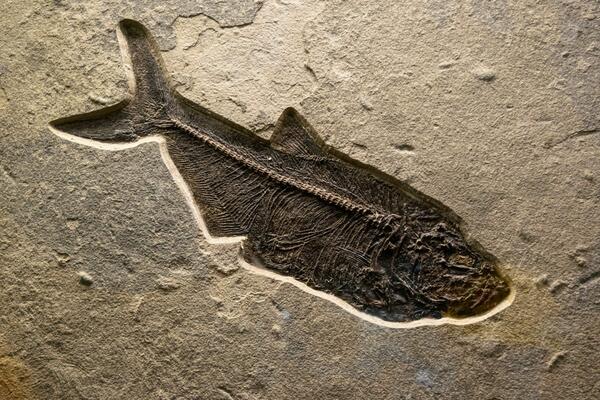
Janet Kellogg Ray is on a mission as an evolution evangelist. Her two prior books, Baby Dinosaurs on the Ark? and The God of Monkey Science, show how she can run with any biblical narrative (Noah’s flood) or historical event (the COVID-19 pandemic), and use these as launch points for crash courses on fossilization, germ theory, and scientific methodology. In her new book, Fish with Feet, she not only places humans center stage in the story of evolution, but also sets out to explore how this impacts a core Christian doctrine enshrining the status and purpose of humans: the image of God.
For many Christians, evolution threatens the concept of the imago Dei because it suggests we weren’t perfectly designed and set apart from animals by God. This is partly why apologetic enterprises like Answers in Genesis and the Institute for Creation Research exist to preserve our divine origins. Otherwise, these groups say we may as well toss out the Bible and act like animals. Fish with Feet challenges creationists directly but is primarily intended for those who grew up under their influence: Christians (deconstructed, deconverted, and otherwise) who grew up with little to no education related to evolution or an old Earth. This certainly works for folks like me, since I was homeschooled on creationism and intelligent design by Abeka Academy.
Whether it’s delineating between prokaryotic and eukaryotic cells or showing how our chromosomes and pseudogenes genetically link us to other species, Ray takes time to define terms and explain natural processes. This sensitivity is especially evident when she pauses to address creationist objections that may pop up in the heads of readers, such as classics like, “Why are there still apes if we evolved from humans?” or, “If we came from fish, how did they sprout legs and walk on land?” All the while, she keeps things fun with her quirky, dry sense of humor.
The image of God is hardly compromised by evolution; rather, it is secured and even expanded by a deeper understanding of evolution. Ray writes that humanity’s worth is found in being chosen by God, regardless of origins or circumstances. These observations in the last two chapters, however, act more as a theological appendix on the image of God than as commentary suffused throughout the book. There, Ray provides a bird’s-eye view of ancient Mesopotamian and Jewish notions of the image of God, which was primarily defined as a functional role bestowed on humanity rather than a unique trait intrinsic to our bodies or behavior.
READ: How Christians Learned the Wrong Story About Leprosy
After all, the latter approach is prone to being weaponized: This happens whenever single people or sexual minorities are told they can only reflect the full image of God in heterosexual marriage. Or when racial minorities are told their physical distinctions attest to a divine design and natural hierarchy that justifies their subjugation. In contrast, Ray writes that “image-bearing is a corporate vocation, given to all. Any gender, any age, anyone along any descriptive spectrum. The geniuses among us and those with intellectual disabilities. The citizen and the immigrant. Our family, our friends, our enemies.”
But she doesn’t stop there. Ray implies that any creature “has the capacity to image God”; Homo sapiens were simply the first. Does this mean other animals could be image bearers?
Ray implies that any creature “has the capacity to image God”; Homo sapiens were simply the first. Does this mean other animals could be image bearers?
It’s a tantalizing proposition—one that shouldn’t offend Christians in light of the strong bonds we form with pets or wild creatures like octopi and chimpanzees. Ray’s reflection on the topic reminds me of C.S. Lewis, who entertained a similar notion in The Problem of Pain. Ray writes that humans are set apart in relationship to God, tasked with “naming, subduing, and ruling the animals”; Lewis took this a step further, suggesting that when humans do this, a pet dog can gain some semblance of the owner’s self or personality. Through the pet’s relationship to its owner, it can be introduced “by Grace, to a whole world of affections, loyalties, interests, and comforts beyond its animal destiny,” Lewis writes. Indeed, humans have directly shaped the evolutionary destiny of canines.
In light of our influence on animal species, Lewis’s essay “Religion and Rocketry” considers what an encounter with nonhuman sentient life would warrant of Christians, warning them first to “stand firm against all exploitation and all theological imperialism.” While Lewis’s hypothetical postulates on extraterrestrial life, his words could easily apply to evolving animal life on Earth. “Our loyalty is due not to our species but to God,” Lewis continues. “Those who are, or can become, His sons, are our real brothers even if they have shells or tusks. It is spiritual, not biological, kinship that counts.”
The striking implications of other creatures adopting the image of God are largely absent from Fish with Feet. I wish, for instance, Ray spent some pages exploring how humans might have an active role in this process in how we care for and bond with animals. Since Ray demonstrates how all life (including plants and bacteria) shares primordial history, other questions follow: How do we understand our role as stewards of this planet, knowing it’s already gone through several mass extinctions? Where and how is God at work in the mechanisms of creation with human variation (e.g., ethnicities and sexuality) since “all of our genetic variance comes from mutations”? This sort of theology and praxis is left for the reader to ponder and pursue further.
Nevertheless, Fish with Feet compels Christians to acquire a rudimentary understanding of evolution; “our research and understanding of modern medicine, anatomy, physiology, agriculture, genetics, conservation, and ecology” hinges on it. Yet we live in a time when our political leaders regularly sow distrust in these fields’ experts. As Ray points out, at least a third of Americans still reject evolution and more than half of public school teachers hesitate to cover human evolution. These percentages continue to dwindle with time, but in the meanwhile, anti-science/intellectualism remains a large factor in the church’s decline.
Crucially, books like Fish with Feet show how science and theology can coexist as two avenues for understanding the wonders and mysteries of God. In one of her strongest asides, Ray explains how evolution shapes how we see God’s love. Citing Luke Janssen, a scholar of medical science, biochemistry, and theology, she explains how God’s love is not just a relational force but a totalizing law of the universe—one that brings together the materials and mechanisms of the universe. We see “attraction and building, cooperation, [and] sharing” at every level of existence, including our own through our drive to connect with communities, families, friends, and the divine. In that sense, astronomer Carl Sagan was onto something when he said, “We are a way for the cosmos to know itself.” Being image bearers is another way to see how love is universal; if God resides in us and moves through everything, then, as Ray writes, “we have a job to do.”

Joey Thurmond is a writer specializing in Christian sexual ethics, pop culture, and faith.
Did this article have an impact on you? Tell us how! Whether you’re moved to take action, have a question, or want to share a comment (good or bad), we value your feedback!