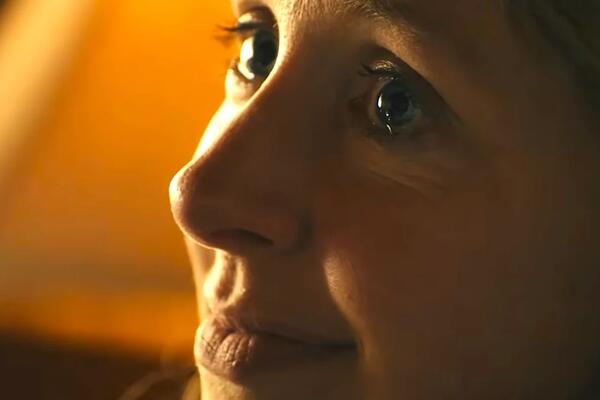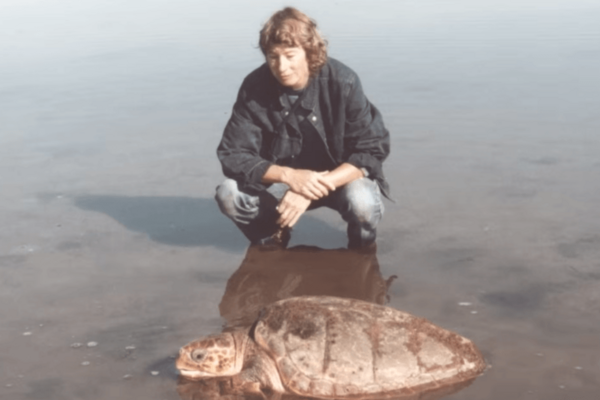
Editor's note: Mary Oliver: Saved by the Beauty of the World is now in select theaters and premieres on PBS on August 25. To find viewing options near you, visit the film's website.
I was a Mary Oliver skeptic for a long time. The first time I read “The Summer Day,” with its lines about feeding sugar to grasshoppers and considering your “one wild and precious life,” I found it preposterously sentimental. At the time, I resented being told it was more honorable to spend my time strolling through fields and hand-feeding bugs than to pursue my preferred activities of browsing library bookshelves and hovering over record store discount bins.
Then, a few years ago, I was helping my uncle water his garden when I noticed something out of the corner of my eye. There, balanced on a hosta leaf, was the biggest grasshopper I’d ever seen, about the size of a field mouse. I knew, without a doubt, God had made that grasshopper. More than anything, I wanted to feed it some sugar. That was the moment Oliver’s poetry finally clicked for me—a divine nudge to notice the world’s natural beauty and its intricate systems.
As the new documentary Mary Oliver: Saved by the Beauty of the World attests, every Oliver fan has a similar story of being struck by her work, whether it’s an instant appreciation or one that moves from eye-rolling to respect to outright love. Sasha Waters’ film makes the case for Oliver as a writer, adds helpful context to her work, and provides complexity and depth to its portrait of Oliver as a person. Whether you’re a fan or a skeptic, you’ll come away having learned something about poetry, cultural history, and the natural world.
Waters switches between Oliver’s biography—her childhood in Ohio, her life with photographer Molly Malone Cook in Provincetown, Mass., and her decades-long road to mainstream success—and thoughts on Oliver’s work from colleagues, contemporaries, and fans. There are words of adoration from high-profile admirers (Stephen Colbert can’t read “The Summer Day” on camera without crying), and stories of how haters eventually became fans themselves (writer and activist V, formerly Eve Ensler, made fun of Oliver’s poetry until “The Journey” encouraged her during her cancer treatment).
The most unexpected of these talking heads is cult filmmaker, artist, and “Pope of Trash” John Waters, who befriended Oliver and Cook in Provincetown. For those viewers who think of Oliver as a naive hermitlike mystic constantly communing with nature, the Pink Flamingos director’s sharply funny commentary offers both a confirmation and a rebuttal of that image. He laughs about the time Oliver was bitten by a beaver while helping them build a dam (“That’s what you get!” he recalls telling her), and is quick to say that for all her mindful ways, Oliver was also tough, honest, and resilient—a “sh-t-stirrer,” in his words, who smoked like a chimney.
READ: 10 Quotes From Mary Oliver, the Patron Saint of Paying Attention
Many of the poets interviewed here also offer nuanced insight into the strengths of Oliver’s poetry that go beyond the Oprah-friendly affirmations often associated with her work. Author and poet Jason Reynolds shares an incredible analysis of “Was it Necessary to Do It?” from Oliver’s 2012 collection A Thousand Mornings. Reynolds compares Oliver’s outrage at the crushing of an ant (“I tell you that ant is very alive! Look at how he fusses at being stepped on”) to the historical experience of minorities in America: routinely stepped on and over, underestimated, and powered by a tenacious will to survive. That perspective surely applies to Oliver herself, an out gay woman whose career didn’t reach terminal velocity until she was nearly 50.
While elements of Mary Oliver: Saved by the Beauty of the World lean into the poet’s wide popular appeal, the film tries as much as possible to complicate that narrative. One element that gets lost in that attempt is Oliver’s enduring stamp on progressive Christianity. Oliver’s love of nature and her professions of self-love and care for others—found in lines like “attention is the beginning of devotion” or “You do not have to be good / You do not have to walk on your knees / for a hundred miles through the desert, repenting”—offer a space both for people of faith who live in wonder at God’s complex creation and who are burned out by dogmatic expressions of belief.
Her communion with the natural world, and the spiritual significance she found in it, was born of a painful childhood, and of an adulthood that often required grit and ingenuity to get by.
The most we get of Oliver’s own spirituality is a brief attempt to attend church after Cook’s death that didn’t take. Any other observations look toward the secular mindfulness end of the spectrum often occupied by folks like Oprah and Maria Shriver (both featured here). This feels like a missed opportunity, not to mention an oversimplification of Oliver’s relationship to spirituality that the rest of the movie otherwise takes pains to avoid.
For the most part, however, Waters’ documentary makes an admirable effort to explain Oliver’s power, and to draw in new readers. As many of the film’s interviewees explain, Oliver’s poetry is deceptively simple, and so was the way she lived her life. Her communion with the natural world, and the spiritual significance she found in it, was born of a painful childhood, and of an adulthood that often required grit and ingenuity to get by. As the film shows, her true mastery of the poetic form goes beyond the pastoral images her work conjures. The real power is in the lessons and hard-won moments of presence that peek between her lines.

Abby Olcese is a freelance film critic and writer based in Missouri. You can find her on Twitter @abbyolcese.
Did this article have an impact on you? Tell us how! Whether you’re moved to take action, have a question, or want to share a comment (good or bad), we value your feedback!