IN A STRIKING photo from August 2015, three kayakers on the Animas River near Durango, Colo., float in a plume of mustard-yellow water. They happened to be on the river the same morning that Environmental Protection Agency workers accidentally ruptured a retaining wall at the abandoned Gold King Mine upstream, sending 3 million gallons of wastewater contaminated with metals into southern Colorado’s rivers. According to the House Committee on Natural Resources, “EPA’s disaster dumped hundreds of tons of pollutants into a river that flows across four states—affecting farmers, treatment systems for safe drinking water and livelihoods, but no one has been punished.”
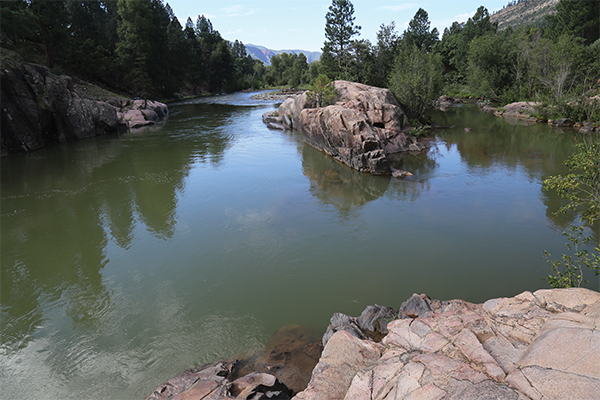
One year after the spill, Diné photographer and anthropologist Teresa Montoya captured the exact spot where the photo of the kayakers was taken. Though the bright yellow had faded, the water remained heavily contaminated. Montoya was on a journey along the river’s path to document the impacts of the Gold King Mine spill in Navajo communities downstream.
I went to a recent exhibit of Montoya’s photos at the Block Museum of Art in Evanston, Ill., called “Tó Łitso (Yellow Water),” marking 10 years after the disaster. Some photos were beautiful and haunting, like a misty slope of pine trees with rust-red acid mine discharge flowing down. Along with photos and sound recordings, Montoya collected four Nalgene bottles full of contaminated water from the Animas and San Juan rivers.
Downstream in Shiprock, N.M., in the Navajo Nation, the river is both a life-sustaining resource and a carrier of memories and stories. Pre-spill contamination levels were already bad, given the hundreds of years of mining in the area, but after the water turned yellow, crops of corn, melon, and squash withered.
“What do you photograph when harm is no longer spectacular?”
In Regarding the Pain of Others, Susan Sontag writes about how photographs have power in shaping our understanding of catastrophe. “For photographs to accuse, and possibly to alter conduct, they must shock,” she writes.
The photos of bright yellow water are truly shocking. More than 10 years later, that yellow hue has faded but contamination remains. The Animas and San Juan rivers remember; they still carry the trace of mining pollution and toxic spills.
During an artist talk at the museum, Montoya spoke about this idea that contamination has to be visible to be real or believed. “What do you photograph when harm is no longer spectacular?” she said.
How do you photograph the 30% of Navajo Nation households that lack running water and countless other invisible, silent ways harm continues to happen every day? When photos can no longer shock us into action, perhaps portraits of community can motivate change.
Uplifting Indigenous knowledge and resistance, Montoya photographs relationships and community and dignity. In Shiprock, she photographed Diné farmers steaming corn. Under a twilight sky, she captured an old water tank with the words “water is life” painted on it, blue water flowing from a ceremonial basket. In another photo, at the Gold King Mine Spill Resilience Walk, locals hold signs that say: “The river unites us,” “Water is life,” and “Pray for San Juan River.”
These photos invite me to consider how I might walk alongside those who are hurting and resisting—both in shocking circumstances and, once the shock wears off, in the everyday struggle.

Cassidy Klein is a journalist, writer, and editor based in Chicago. Find her work at cassidyrklein.weebly.com.
Did this article have an impact on you? Tell us how! Whether you’re moved to take action, have a question, or want to share a comment (good or bad), we value your feedback!