IN 1969, I was in second grade at St. Ignatius Catholic School. First grade was a breeze. I loved Sr. Linda. She wore a modified habit and brought a guitar to class. Second grade was more difficult. We had to prepare for my first confession and first Communion by memorizing the catechism answers. Then we were tested to prove that we understood what we were getting into (as much as a 7-year-old can grasp sin, repentance, forgiveness, and transubstantiation).
Unfortunately, I failed the test. I missed one question: What is the Trinity?
My only thought was that I wasn’t graduating to third grade. And, more importantly, I wasn’t going to receive the host at Mass. This, in particular, was devastating for me.
The whole brouhaha landed me and my parents before Sr. Elizabeth, the school principal. She was a Holy Names nun, just like my aunt. Sr. Elizabeth was my ecclesial interrogator. She wore a full habit and was terrifying to me. My dad was a kind of devil’s advocate, testing alternate paths to accepted truths. Just so you know, the correct and accepted definition of the Trinity (at that time and place) was: “The Father, Son, and Holy Spirit; three in one.” My answer? “The Trinity is a holy mystery.” (I stand by that definition today.)
In the ecclesial summit between Sr. Elizabeth and my dad, they discussed Vatican II changes, fresh ways of teaching catechism, the theological wisdom of children, and the limits of standardized tests. Both agreed that the Trinity is indeed an impenetrable Christian mystery. I was allowed to return to class, make my first Communion, and matriculate to third grade.
I learned early that the Catholic sisters I knew were the wisdom-bearers of the church. They are also close to those who are suffering.
Rep. Jim McGovern, also taught by Catholic sisters, learned a similar lesson. As a congressional staffer in 1989, he led an investigation into the murder of six Jesuit priests, their housekeeper, and her daughter in El Salvador. He uncovered that the Salvadoran soldiers responsible for the murders were trained in the United States. Many of his key contacts were Catholic sisters. Several times I heard McGovern utter his hallmark phrase when investigating human rights abuses: “Listen to the nuns.”
The Catholic sisters I knew were the wisdom-bearers of the church.
Are we listening to the nuns now?
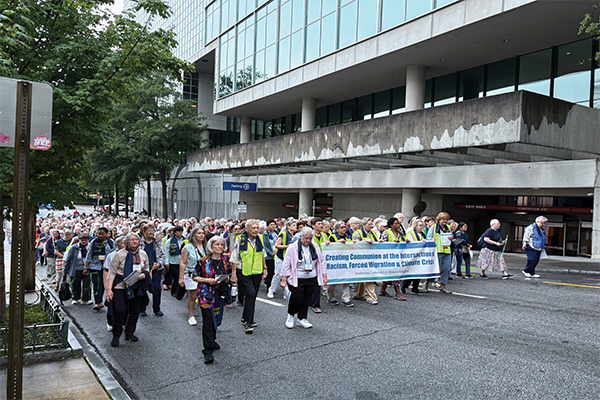
Last August in Atlanta, as part of an annual meeting of the Leadership Conference of Women Religious, 400 vowed religious Catholic women and collaborators made a one-mile pilgrimage down Peachtree Street to pray. They prayed at a park for environmental thriving, a school for an end to racism, and a parking garage for an end to forced migration.
Public prayer brings the witness of our beliefs into spaces “where silence can often feel like indifference,” Sr. Annmarie Sanders, IHM, told me about her participation in the Atlanta pilgrimage.
Sanders, who works for LCWR, said, “Praying with others in public spaces deepens my commitment to the work of making the world a better place for all.”
These women take seriously a Christian mandate to understand the deep theological, spiritual, and ethical implications of our political context. They also approach the suffering created by political or social change from a contemplative stance.
A contemplative stance requires grounding in silence to slow our minds and hearts, listening and noticing how God is nudging us, forming foundational questions that integrate our knowledge, emotions, and values, and allowing our contemplative stance to discern our actions and direct our energies. Every day.
Developing a shared contemplative stance, rooted in a God of inexpressible mystery, keeps vibrant our belief that how we act together in the world matters. Salvation of our messed-up world is already in the works. God is inviting us to join the “coalition of the willing”—those willing to humbly recognize our human limits; to listen, theologically and ethically; to discern creative responses to old injustices; to risk failure; and to engage God in the silence.
My ecclesial interrogator, Sr. Elizabeth, died last summer. She was a Catholic sister for more than 70 years. She ran Catholic schools on the West Coast and later developed palliative care programs for several Catholic hospitals. She died “with her boots on”—still praying, serving, challenging, and laughing. May I have even a small portion of her spirit.

Rose Marie Berger, a Catholic peace activist and poet, is senior editor of Sojourners magazine. She is author ofBending the Arch: Poems.
Did this article have an impact on you? Tell us how! Whether you’re moved to take action, have a question, or want to share a comment (good or bad), we value your feedback!