Our Right to Organize Is in Danger

'Boycott' is a call to mobilize against destructive legislation before it becomes — or supersedes — precedent.

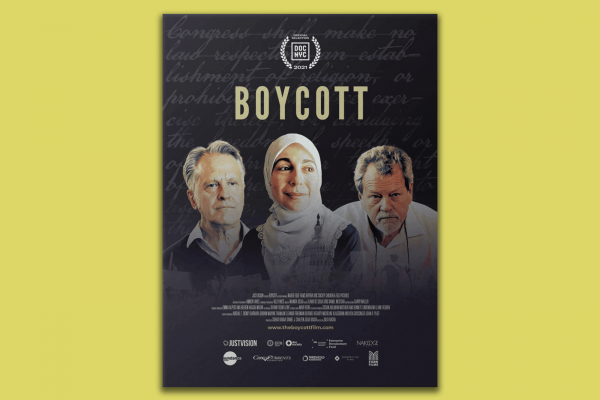
Boycott, directed by Julia Bacha / Just Vision

FROM THE BOSTON Tea Party to the Montgomery bus boycott, expressing patriotic dissent by withdrawing support from goods, services, people, or structures has long been an integral part of our American democracy.

So, when Alan Leveritt (publisher of the Arkansas Times newspaper), Mikkel Jordahl (an Arizona attorney who provides legal services to incarcerated people), and Bahia Amawi (a Texas public school speech pathologist) were asked in separate incidents to certify that they would not “engage in boycotts of Israel” as a condition of doing business with or being employed by their states, they were troubled. Leveritt, Jordahl, and Amawi each decided to defend their First Amendment rights and push back on legislative efforts that have the potential to outlaw peaceful political boycotts related to a variety of issues.

Their stories are central to Just Vision’s new documentary, Boycott, which exposes the wave of anti-boycott legislation and executive actions in 33 states since 2015. These laws require Americans to give up their right to support the Boycott, Divestment, Sanctions (BDS) movement, a campaign formally begun in 2005 in Palestinian civil society to urge the international community to leverage economic influence to encourage the Israeli government to address its human rights record. (Some Israeli officials and others claim that BDS efforts challenge Israel’s right to exist and are inherently antisemitic.)

The film exposes the inner workings of state legislatures and the entanglements of freedoms, political lobbying finances, and foreign policy while it also highlights the efforts of these three Americans, with the assistance of the American Civil Liberties Union, to protect rights that have been the bedrock of U.S. democracy since 1791.

Many of the anti-BDS boycott pieces of legislation are drafted and lobbied for by the American Legislative Exchange Council (ALEC), a conservative activist group that creates template legislation that is passed on to state representatives. According to the film, ALEC’s fill-in-the-blank templates for limiting boycotts related to Israel need only a few alterations to target the rights of U.S. citizens to protest other issues, such as those involving powerful corporate players, including the fossil fuel, mining, and firearm industries.

“The power of boycott is the power of collective organizing,” said director Julia Bacha at a Washington, D.C. Boycott screening and discussion. “The attempt to take that power away from Americans was significant in history and will continue to be in the future. We are trying to preserve this strategy—this tool—for social justice movements today and for social justice movements in the future.”

While the right to boycott was codified through Supreme Court cases such as NAACP v. Claiborne Hardware Co. (1982) and supported in both Amawi’s case in Texas and Jordahl’s in Arizona, Leveritt’s position—after initially being upheld by the 8th U.S. Circuit Court of Appeals—was appealed by the state of Arkansas and is, as of this writing, still under review. 

Boycott argues that, for U.S. citizens, the most effective recourses to influence the government are voting and choosing to withdraw time, labor, and money until things change. It exposes the laws, lobbyists, and other entities that seek to limit not just our speech, but our thinking. Most important, Boycott is a reminder of the power of the people to protect our rights and a call to mobilize against destructive legislation before it becomes—or supersedes—precedent.

This appears in the July 2022 issue of Sojourners