“This world is intricately stitched together, boys. Every thread we pull, we know not how it affects the design of things,” muses William H. Macy’s Arn Peeples, an aging tree logger in Train Dreams. Throughout their ongoing work on the construction of the Spokane International Railway, laborers like Arn occasionally ruminate on their place in a broader human tale of hubris and glory, though they don’t have all the answers.
Indeed, the world is intricately stitched together. And the same could be said about the film itself, though, moment by moment, it gives the feeling of a wandering walk in the woods. Much like Arn, director Clint Bentley and screenwriter Greg Kwedar seem aware of their lack of answers—but find asking the questions worthwhile anyway.
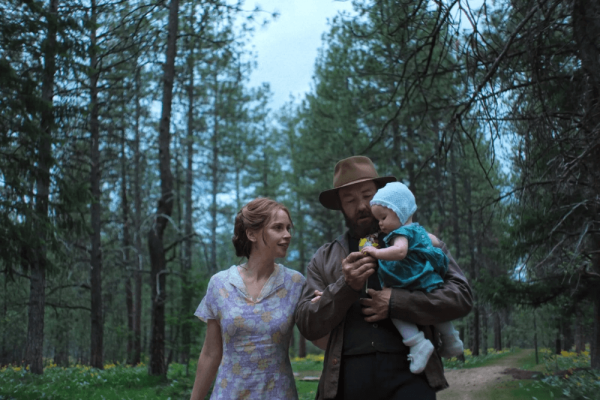
Based on a 2011 novella by Denis Johnson, Train Dreams follows the story of Robert Grainier (Joel Edgerton), an earthy, somewhat enigmatic homesteader who spends much of his life working with other men putting down railroad tracks and chopping down timber in the Pacific Northwest. Between the intense stretches of physical labor, Grainier gradually builds a home with his wife Gladys (Felicity Jones) and young daughter Katie.
This premise might be enough to entice your historical curiosity; the film, set in the early 1900s, works well as an intimate portrait of the hardworking—and largely nameless—men who built the very fabric of American society with the sweat from their brow and much sacrifice. Still, Train Dreams often feels more cosmic and even spiritual than merely historical. Sudden and inexplicable tragedy pervades the film. It starts early when Grainier is orphaned at a young age, and continues when a Chinese immigrant on his railroad worksite is attacked and thrown off a bridge by an angry mob of white men. Grainier, who was too confused and shocked by the brutality to stop it in time, continues, for years, to be haunted by his own inaction. In the moment it happened, all he could do was ask questions: “What’d he do?” “What’s he done?” “What’d he actually do?”
Grainier’s questions are primal ones. When tragedy strikes others or ourselves, we often yearn most to find a reason for it all—to explain the pain by casting it as a result of karma, divine judgment, or cause and effect. “What did he do?” is the same question posed by the unhelpful friends in the book of Job, searching for a reason that Job is being punished by God rather than accepting their lack of certainty about the bigger divine picture. And as more mysterious tragedy and confusion continue to strike Grainier throughout his story, he too echoes Job’s painful cry: “Why?”
READ: Sojourners’ Top Movies of 2025
I asked the director, Clint Bentley, about this parallel to the Book of Job in an interview last month. He told me, that while he hadn’t previously thought about the comparison to Job, the comparison makes sense to him. “We have these things that happen in our lives that completely upend our lives, and it’s hard to find a reason or rationality in them ... surely there’s a meaning to this suffering, somehow there must be,” he said. “I don’t have the answer. Whoever wrote the book of Job didn’t have the answer either, to my memory of it.” Bentley is right; when God finally speaks to the question of Job’s suffering near the end of the book, God doesn’t offer any specific answers, just more mystery that goes beyond our present understanding. As Bentley recollected it: “It’s just like, ‘Well, these things happen.’”
It’s not all misery and heartbreak, though. Train Dreams is a beautiful film, in both image and spirit, and for as many trials befall Grainier, there are just as many strange miracles. A Native American shopkeeper who shows up at Grainier’s lowest to offer a meal and sit in his pain. Three puppies who appear as companions out of the blue. A solitary forest surveyor who finds that her experiences and Grainier’s are strikingly alike. Grainier’s many precious stretches spent with his wife and daughter in the home they’ve created together, his daughter’s contagious delight and curiosity running wild in the fields and streams. Like a poem or a collection of memories, these experiences seem to exist all at once in the film, an effect that Bentley views as very intentional: “We all exist in this moment, but every other moment in our life also exists with us in this moment . . . And so [we were] trying to use the edits to suggest that, in a way. Kind of like, you’re carrying everything with you, and you don’t always realize the import of a specific moment in your life until later looking back on it.”
All told, Train Dreams is filled with precious moments of human connection in a rapidly changing world. And it’s a world that has telling parallels to ours: mass deportations and anti-immigrant sentiment are rampant in Grainier’s time much like our own, and the widespread industrialization of America (and pillaging of her oldest forests to do so) carries striking resemblance to the environmental impact and existentially consequential rise of AI today. Regardless of how Grainier feels about the way the world is going, he’s not in a position to stop the wheels of the locomotive speeding toward ever-profitable progress. What, then, is his place in the midst of it all?
“The world needs a hermit in the woods as much as a preacher in the pulpit,” the forest surveyor (Kerry Condon) remarks to Grainier midway through the film. Train Dreams does not claim to know the answers to life’s biggest questions, but the film intuits that we all have some humble role to play in the great drama unfolding. Screenwriter Greg Kwedar told me, “I think there is an evolution in the film to, without defining it, a deep spirituality.” “Why do bad things happen? Why do beautiful things happen to us? ... The purpose of human life is to be shared and have community and have relationships, as well as a wonder for this world that we live in and the things that we know and that we don’t know. And I think if anything, the power of the movie is that it’s not seeking to name it; it’s seeking to express the sensation of it in its feeling.”
What do any of us do to deserve the bad things that happen to us? The mystery of the reason for our pain and heartbreak is an eternal question. But the truth is that the same question could be posed the opposite way: What do any of us do to deserve the good things that happen to us? Perhaps our joys are just as inexplicable and undeserved as our tragedies.
Perhaps our joys are just as inexplicable and undeserved as our tragedies.
Over the course of Train Dreams’ 1 hour, 42-minute runtime, we watch Grainier get brief glimpses of his wider world from several different vantage points: first a bridge, then a lookout post, and finally even from a tiny airplane. Living in time is a mystery, a long walk through the woods where the path rarely feels perfectly clear. But someday, perhaps, we will see the meaning of our pilgrimages from a greater distance. Now we see through a glass darkly; someday we shall see face to face. On that day, we will finally see the forest over the trees.

Georgia Coley is a documentary filmmaker and culture writer living in Nashville. She writes about the intersection of trans experience and theology at her Substack, Georgia In Her Mind.
Did this article have an impact on you? Tell us how! Whether you’re moved to take action, have a question, or want to share a comment (good or bad), we value your feedback!