Fannie Lou Hamer was a prophet from the Delta.
Cover Story
Edwin King 12-01-1982
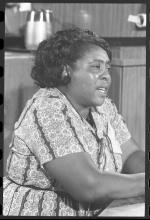
Image by Warren K. Leffler / Library of Congress Prints and Photographs Division
June Johnson 12-01-1982

In early June of 1963, when I was 15 years old, a group of us including Fannie Lou Hamer and Annelle Ponder of SCLC went from Greenwood, Mississippi, to a voter education workshop in Charleston, South Carolina.
Jean Vanier 1-01-1982
I live with 10 men and women who are very poor. None of them can talk; only six can walk. All of them have a very limited level of understanding. But each one has a heart.
John Michael Talbot 12-01-1981
Francis' extraordinary gift was his humility. I believe it was this gift which made him such an effective peacemaker.
Alain Richard 12-01-1981
My first encounter with Francis of Assisi occurred when I was just finishing my studies and embarking on a promising future.
Louis Vitale 12-01-1981
Francis Bernadone gave birth to a charismatic movement that swept the world of his time.
Kenneth R. Himes 12-01-1981
He was called "Il Poverello," the little poor man. The religious poverty of Francis is prominent in his rich legacy to the world, but it is often misunderstood.
Colman McCarthy 12-01-1981
When we think about St. Francis, let's not overlook Pietro Bernadone. He was the father of the saint, the Assisian merchant who took the brunt of his son's conversion.
Robert Coles 12-01-1981
When my brother and I were boys we heard a great deal about St. Francis from a dear friend of ours, for whom poverty was, in itself, the highest of virtues.
E. Glenn Hinson 12-01-1981
Francis of Assisi stands as a symbol that peacemaking is a thinkable endeavor even in a war-wracked world such as ours.
Joan Chittister 12-01-1981

Jim McIntosh / Flickr / (CC BY 2.0)
This article originally appeared in the December 1981 issue of Sojourners. To subscribe, click here.
If ever the 20th century has been given a key to the secret of wisdom in a crazy world, it is in Francis. But so distorted are our values, so limited our vision, so self-centered our society that it's Francis who comes out looking mad.
His own society, even his own father, thought he'd lost his mind.
But our society is not much for loving lunacy either. We romanticize it perhaps, but we certainly do not promote it. As a youngster in the local Catholic school, I learned that Francis gave up a high position in the army and the family business to live with the poor. Frankly, I questioned that, too. I never told Sister, of course. Saints were saints, after all, and not to be criticized. But I had already learned from subtler sources that the purpose of life was to get ahead, to buy things, to be patriotic, to be independent and proper and strong. Now I'm beginning to understand, I think: While we're all talking wisdom in this wasted, wacky, warring world, Francis of Assisi is a key to understanding it that nobody wants.
Ronald Reagan went to Cancun to give the starving countries of the world the 19th-century American industrial answer: If you work hard enough you, too, can be rich. That's no Francis of Assisi speaking. Francis would give things away. In abundance. That's a key apparently that nobody in their right minds considers sensible.
Alexander Haig went to Europe to convince the Western allies that the politics of terror were benign. That wasn't Francis of Assisi speaking. Francis would take off his sword, give away his cloak, do good to his enemy. Without limits. That's a key you can't even give away.