You Will Know Them by Their Fruits—and Their Rulings

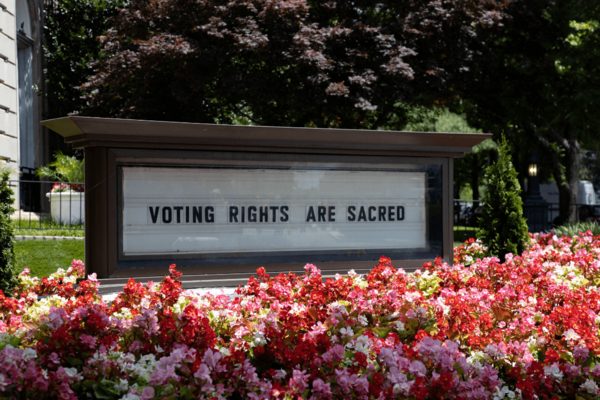
A sign reads 'voting rights are sacred' next to the Supreme Court in Washington, D.C. on June 24, 2021. Photo by Bryan Olin Dozier/NurPhoto via Reuters Connect

A recent ruling from the U.S. Supreme Court reminded me of Jesus’ words at the end of the Sermon on the Mount: “Watch out for false prophets,” Jesus says. “They come to you in sheep’s clothing, but inwardly they are ferocious wolves. By their fruit you will recognize them” (Matthew 7:15-16).

Last week, in Louisiana v. Callais, the court voted 6-3 along ideological lines, rendering the Voting Rights Act practically meaningless. When it was passed in 1965, the act was the crowning achievement of the Civil Rights Movement. The law created enforcement mechanisms to uphold the 15th Amendment and prevent states from discriminating against Black and other minority voters. Section 2, the specific provision weakened by the court last week, prohibits voting procedures—including districting maps—that hinder voter participation on the basis of race. In 1982, Congress amended this section, making it easier to challenge voter district maps that, intentionally or otherwise, diluted the power of minority voters.

Politicians should not choose their voters; voters should choose their leaders.

Since then, Section 2 has been a key tool for challenging and preventing racially discriminatory election practices. It paved the way to create new voter “majority-minority” districts in which communities of color have real voting power; candidates preferred by these communities were able to win elections, sometimes for the first time in decades. Now, the court’s recent decision “renders Section 2 all but a dead letter,” as Justice Elena Kagan wrote in her dissent. We find ourselves at a funeral for the crowning achievement of the Civil Rights Movement.

I don’t always lament Supreme Court decisions, but this one felt egregiously personal. My own heroes, including Rep. John Lewis and so many others in the Civil Rights Movement, risked their lives in peaceful protests to awaken the nation. Their courageous activism culminated in the passage of the Voting Rights Act. They ended efforts that denied Black Americans their right to vote—violence, intimidation, poll taxes, grandfather clauses, and literacy tests—and gave the nation something that more closely resembled real, inclusive democracy.

For me and others in the Black church, the court’s decision is an affront to our forebears and to the core values of our faith, including the belief in the inherent dignity of every person. When you have had to fight for basic rights such as the freedom to vote, you become hypervigilant about any effort to overturn or weaken these sacred rights.

To add insult to injury, the legal rationale behind the ruling feels morally bankrupt, if not outright deceitful.

As Kevin Morris of the Brennan Center points out, the majority opinion is based on the “not factual” premise that there are no longer disparities between Black and white voter turnout:

“Pointing out that Black and white turnout reached parity in ‘two of the five most recent Presidential elections,’ Justice Samuel Alito assured Americans that racial disparities in voting are no longer a problem. But Alito’s claim represents egregious cherry-picking, as he was not referring to recent elections, but to those in 2008 and 2012—the years that Barack Obama ran for president. In the three most recent presidential elections, the trend shows exactly the opposite.”

Building on this faulty premise of equal voter participation, the court’s ruling significantly intensifies the burden of proof required to challenge race-based gerrymandering from demonstrating discriminatory effects to proving racist intent. Proving intent is notoriously difficult; as a result, the ruling sets a new and almost impossible bar.

260506 - Taylor, voting rights, protesters signs Lewis.png

Voting rights activists protest outside the U.S. Supreme Court as the court prepares to hear arguments in a case challenging Louisiana's congressional map in Washington on October 15, 2025. (Bill Clark/CQ Roll Call/Sipa USA via ReutersConnect)

However, less than three years ago, in Allen v. Milligan, the same court reached a very different decision. In a nearly identical case, the court ruled that Alabama’s redistricting plan violated Section 2 and required the state to create an additional majority-minority district to ensure fair representation. Chief Justice John G. Roberts Jr. wrote the majority opinion, relying on the 15th Amendment and previous court rulings to uphold Congress’ power to “outlaw voting practices that are discriminatory in effect.” The decision preserved the ability of courts to require race-conscious redistricting to protect minority voting power.

So what changed? In the past few years, the court has shifted toward a “colorblind” approach in which any decision—from college admissions to the workplace to voter maps—that treats race itself as a form of racism. This approach considers racist efforts to disenfranchise Black voters a vestige of the past and ignores ongoing efforts to suppress Black voting and weaken Black voting power and representation. As the court sees it, Louisiana’s Black-majority districts aren’t necessary to ensure minority voters have an equal say in democracy. Instead, these districts are a form of pro-Black racial discrimination that violates the Equal Protection Clause—and, in the court’s view, unconstitutional.

Which brings me back to Jesus’ words about fruits revealing character and intent. Whatever the justices may say, let’s consider the effect of their ruling: With the Voting Rights Act now out of the way, Republican politicians can carve up voting district maps to dilute Black and other minority voters’ representation, a move that will help Republicans cement more seats in Congress. Republican leaders—including those in Louisiana, Florida, Mississippi, and Tennessee—are already racing to court to disband majority-minority districts, opening the floodgates of an arms race of racialized gerrymandering. In Louisiana, Gov. Jeff Landry has gone as far as stopping a primary election already underway to redraw maps to increase the number of safe Republican seats.

It doesn’t have to be this way: Imagine if, instead of trying to disperse and weaken minority votes, Republicans tried harder to compete for those same minority votes—a change that would likely require a shift in rhetoric, policy priorities, and outreach. Instead, this Supreme Court decision will embolden Republicans to hold onto power not by appealing to a broader set of voters, but by redrawing maps to further dilute Black and brown voting power. This weakens minority representation and derails our pursuit of a more inclusive, multiracial democracy.

Throughout our nation’s history, we have had to fight to extend the right to vote and ensure fair representation. These efforts didn’t stop with the passage of the 13th, 14th, and 15th amendments—ending slavery, establishing birthright citizenship, and preventing racial discrimination in voting, respectively. White supremacy continued to mutate, finding new ways to suppress voters and deny fair representation. Whatever wolves in sheep’s clothing say, recent efforts to contract the electorate and weaken Black voting power are deliberate efforts to further entrench white supremacy.

The good news is that we still have power to prevent further harm. Fortunately races that determine the Senate are immune from partisan and racial gerrymandering. The fight to uphold the inherent dignity of Black and brown voters is just getting started, and it’s a fight that affects and should include everyone. In state legislatures, courts, and at the ballot box, we can be clear: Politicians should not choose their voters; voters should choose their leaders.

Civil rights leaders secured passage of the Voting Rights Act more than 60 years ago with their blood, sweat, and tears; we must now continue the struggle for voting rights and fair representation with ours as well. While the Callais decision can feel like a Good Friday moment for the promise of multiracial democracy, the decision does not have the last word. It is now on us to supercharge our organizing and activism through nonpartisan voter registration and “get out the vote” drives, voter protection efforts, and resistance to a new wave of redistricting efforts and harmful laws such as the SAVE Act. Through these and other efforts, we can redeem our democracy and help our nation make real the promise of liberty and justice for all.