News

Attorney General Pam Bondi announced on Thursday morning that the FBI had arrested at least two leaders of a demonstration inside Cities Church in St. Paul, Minn., protesting one of the church’s pastors works for Immigration and Customs Enforcement.
The FBI arrested Nekima Levy Armstrong, a civil rights lawyer and activist in the Twin Cities, and Chauntyll Louisa Allen, a community organizer and schoolboard member, according to Bondi’s posts on X. Bondi called Levy Armstrong a key organizer of the “coordinated attack on Cities Church in St. Paul, Minnesota.”
“WE WILL PROTECT OUR HOUSES OF WORSHIP,” Bondi wrote, adding a prayer hands emoji.
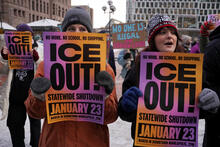
Clergy and labor leaders in Minnesota are calling for a “Day of Truth and Freedom” on Jan. 23, during which Minnesotans do not shop, work, or go to school. The “pause,” leaders say, is intended to highlight the ongoing violence of Immigration and Customs Enforcement agents in the state. “What is happening here in Minnesota is a horror that we’re living through, but we’ve been organizing in preparation,” said Minister JaNaé Bates, co-executive director of ISAIAH, a faith-based collective organizing the day’s events. “It’s not completely a shock.”
An ICE agent’s Jan. 7 shooting of unarmed mother Renee Nicole Macklin Good has become a flashpoint that sparked protests around the country. Bates said the federal agency has been escalating aggression in the Twin Cities for months. On Jan. 18, CBS News reported that there were 3,000 ICE and Border Patrol agents deployed in Minneapolis—five times the size of the city’s police force—making it the nation’s largest ever deployment of immigration officials. Bates said that as the community has resisted ICE’s presence through patrols, social media awareness campaigns, mutual aid networks, and accompaniment of immigrants to work and school, the Trump administration has escalated retaliatory pressure, threatening to send active-duty Army troops. On Jan. 9, U.S. Department of Agriculture Secretary Brooke Rollins notified Gov. Tim Walz and Minneapolis Mayor Jacob Frey that her department would suspend $120 million in food assistance funds to the state, giving it less than a week to produce proof that it had not committed widespread fraud.

Faith-based refugee resettlement organizations are raising alarms that Immigrations and Customs Enforcement is detaining lawfully resettled refugees in Minnesota, in an operation one resettlement official called “shameful and unpatriotic.”
“This is a five-alarm fire,” Myal Greene, president and CEO of World Relief, said in a press release. “These are not the ‘worst of the worst;’ these are innocent children and families who fled the worst wars and persecution imaginable, who were invited by the American people to become Americans under the terms of American law.
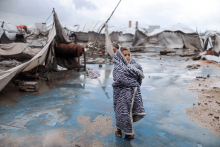
Disintegrating refugee tents, babies freezing to death, and extreme malnutrition are samples of the horrid conditions aid workers with the American Friends Service Committee have been witnessing in Gaza as they and other organizations provide the bulk of health and human services in the decimated region. But soon even those services could be gone. Under new registration requirements from the Israeli government, 37 aid organizations are set to be expelled from the region in March.
“It’s a red flag. It’s a shining light that says things are going to get worse,” Kerri Kennedy, AFSC international associate general secretary, told Sojourners. Kennedy oversees the 100-year-old nonprofit’s work in Gaza. AFSC and dozens of other aid groups have protested the new registration requirements and warned that their expulsion is a harbinger of things to come. “I can’t imagine the horrors and the lives that will be lost,” she said.
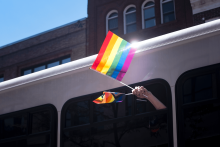
While many people enter the new year after spending time with families over the holidays, many incarcerated people enter the new year feeling an exacerbated sense of isolation. While outreach ministries, prison chapels, and other forms of spiritual care offer lifelines, many incarcerated LGBTQ+ people—especially Christians—find accessing this care more challenging.
Pastor Que J. Thomas, senior pastor of The REEL Center of Atlanta, and a formerly incarcerated transgender man, spoke to just how significant these obstacles often are.
“Spiritual care is definitely vital, but it was not a safe place,” said Thomas, who was incarcerated in the Georgia state penitentiary system from 1999 through 2015. “If you were a known LGBTQIA person on that compound, the warden and superintendent would not allow you to participate in religious services.”
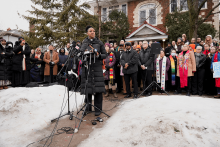
After an Immigration and Customs Enforcement agent shot and killed Renee Nicole Macklin Good, faith leaders in Minneapolis joined demands that ICE leave their city and repent.
“We have our demands. Hundreds of clergy across this state who have gathered together across faith traditions are standing with the rest of Minnesotans to say not again,” Minister JaNaé Bates Imari, co-executive director of ISAIAH, a multiracial interfaith nonprofit, told a crowd of Minnesotans at a press conference.
The press conference, organized by ISAIAH, drew more than a hundred leaders from numerous faith traditions, representing the breadth of the city’s religious communities. ISAIAH presented its demands: That ICE agent Jonathan Ross be arrested, charged, and prosecuted for killing Good; that ICE immediately cease its surge in operations in the state; and that Congress investigate the Department of Homeland Security.
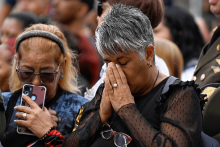
After the U.S. military’s abduction of Venezuelan President Nicolás Maduro, faith leaders are processing deep feelings of conflict, both with Maduro and with the U.S. intervention.
Rev. Ricardo Corzo Moreno is a Presbyterian pastor living in Caracas, Venezuela’s capital. Moreno’s apartment building is approximately one mile away from an air force base in La Carlota that was bombed in the attack. He described how shocked and terrified his neighborhood as bombs started dropping and planes flew at low elevation over their buildings.
“After everything ended ... it was a total silence. Nobody went out in the street; everyone stayed in their buildings. For the next 24 to 48 hours, Caracas became like an empty city,” Moreno said. “A lot of churches here in Caracas, they decided to cancel Sunday service because people were afraid that something would start happening in the population.”

The Department of Homeland Security’s move to suspend funding for Catholic Charities of the Rio Grande Valley—and to seek an unusually long ban on future federal grants—is prompting concern among Catholic leaders and immigration advocates who see the action as part of a broader effort to curtail faith-based humanitarian work at the U.S.-Mexico border.
CCRGV, a South Texas nonprofit led by Sister Norma Pimentel, has been given 30 days to respond to DHS’s proposed debarment, which would shut the organization out of most federal funding streams for six years.
The suspension, which applies only to the South Texas organization, not to Catholic Charities USA or other diocesan agencies nationwide, would be a major blow to CCRGV. The charity, which operates the Humanitarian Respite Center in McAllen, Texas, has been a major recipient of DHS funds through the Federal Emergency Management Agency’s Emergency Food and Shelter-Humanitarian program and its newer Shelter Services Program.

The church has a funny sense of time. When everyone else is looking at Spotify Wrapped and other year-in-reviews, the Christian liturgical calendar has already turned the page, insisting a new year is already here. You’d be forgiven for thinking of Advent as an end-of-year marker, but as any theology nerd will remind you, Advent is the first season in the church’s annual cycle, not the last. Which is to say: The church starts the new year not with champagne or fireworks, but with a season of waiting.
In the Northern Hemisphere, this year-end/year-beginning coincides with colder days, longer nights, and bare trees. And it’s in this moment—when it’s gray and freezing and most things look dead—that Christians make a daring claim: This bleakness all around us is not the end, but a beginning. The new life God promises begins in the dark.

As Zohran Mamdani prepares to take the New York City mayor’s office, he’s tapped several NYC faith leaders to work on his transition team, centering affordability and day-to-day needs of New Yorkers.
Mamdani’s election was one of the most successful in recent memory. Mamdani, who entered the race as a relatively unknown upstart, defeated former Gov. Andrew Cuomo in a primary and general election—becoming the first candidate since 1969 to earn over one million votes. Over a month after Mamdani’s victory, much of the excitement behind his campaign has yet to waver.
Mamdani’s transition team, made up of 17 advisory committees and more than 400 people helping to advise his incoming administration, received more than 50,000 applications. Among those selected to facilitate his transition are at least 18 faith and religious leaders from a range of traditions.
Of the Christian leaders listed, the denominations represented include Baptists, Seventh-day Adventists, and Episcopalians, spread across committees focused on housing, youth and education, and community safety. Those faith leaders told Sojourners they looked forward to working with the Mamdani administration.

A high-level Vatican commission voted against allowing Catholic women to serve as deacons, maintaining the global Church's practice of all-male clergy, according to a report given to Pope Leo and released on Thursday.
The commission, in a 7-1 vote, said historical research and theological investigation “excludes the possibility” of allowing women to serve as deacons at this time but recommended further study of the issue.
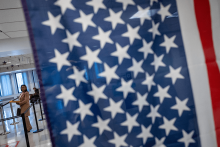
In late November, a child care worker at The PLACE, a refugee center in Amarillo, Texas, reported to work with a worried look on her face. She asked Brady Clark, whose community development nonprofit helps run The PLACE, if the latest announcement from the Trump administration would affect her family. She was referring to a memo from U.S. Citizenship and Immigration Service announcing it would re-interview all refugees admitted under President Joe Biden and beyond—an estimated 233,000 people.
The USCIS memo, dated Nov. 21, said the agency will terminate the refugee status of people already in the U.S. if they are found not to meet refugee criteria. The memo claims the Biden administration potentially prioritized expediency, quantity, and admissions over quality interviews and detailed screening and vetting.

U.S. President Donald Trump’s administration has ordered a broad review of all refugees who entered under former President Joe Biden, an internal U.S. government memo seen by Reuters said, an unprecedented move that could reopen cases of thousands who sought U.S. protection.
The order would apply to about 233,000 refugees who entered between Jan. 20, 2021 and Feb. 20, 2025, according to the memo signed by U.S. Citizenship and Immigration Services Director Joe Edlow. It also orders a halt to all processing of applications for permanent residence for refugees who entered under Biden.

The United States Conference of Catholic Bishops has issued a rare condemnation of President Donald Trump's immigration crackdown and advocated for “meaningful immigration reform.”
“We are troubled by threats against the sanctity of houses of worship and the special nature of hospitals and schools,” the bishops said in a special message, the first of its kind in 12 years.
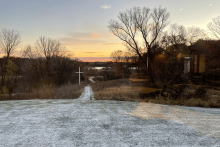
In early November, a group of faith activists gathered to discuss the future of the Catholicism and feminism.
The Women-Church Convergence, a historic coalition dedicated to justice in social and ecclesial structures, hosted 14 women and nonbinary people from across the country at Mount Olivet Conference and Retreat Center in Minnesota. As the organization begins to sunset, the gathering discussed how to make sure younger Catholic-rooted feminists are supported in their work.

Lights, camera, action, pope?
About three dozen Hollywood stars will meet Pope Leo this weekend, including actors Cate Blanchett, Chris Pine and Adam Scott, the Vatican said on Monday.
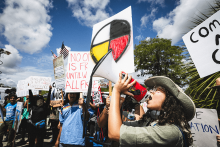
They’re out there, deep in the Florida Everglades every Sunday evening—rain or shine—holding signs, singing songs, and praying.
Since it opened at the beginning of July, Florida’s migrant detention center dubbed "Alligator Alcatraz" has sparked a slew of controversy surrounding its existence, including multiple lawsuits from environmental and civil rights groups seeking to shutter the detention camp.
With pending legal challenges and now a government shutdown, the future of the controversial facility remains uncertain.
But one thing has been constant: Florida faith leaders have shown up week-after-week throughout it all.
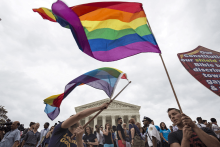
The Supreme Court rejected on Monday a bid by a former Kentucky county official to overturn its landmark 2015 ruling legalizing same-sex marriage nationwide, as the justices steered clear of the contentious case some 3.5 years after its conservative majority reversed abortion rights.
The court, which has a 6-3 conservative majority, turned away an appeal by Kim Davis, a former Kentucky county clerk who was sued by a gay couple after refusing to issue any marriage licenses after the 2015 decision recognized a constitutional right to same-sex marriage. Davis has said same-sex marriage conflicts with her religious beliefs as an Apostolic Christian.
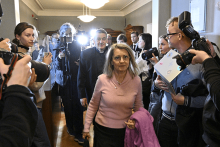
On Thursday, Oct. 30, Finnish politician Päivi Räsänen had her day in court. Again.
Räsänen, a former interior minister, and Lutheran Bishop Juhana Pohjola, are being adjudicated for alleged hate speech after Räsänen tweeted a Bible verse questioning her church’s participation in a Pride event and co-authored a booklet with Pohjola outlining her beliefs on marriage and sexuality. Prosecutors claimed both constituted hate speech. Though Räsänen was twice acquitted in lower courts in Helsinki, the case will now be decided by the Finnish Supreme Court.
Beyond Finland, the case is just one moving part in an evolving, broadening battle over free speech that is escalating across the Atlantic.

Jesus may have heard words of wisdom from his mother Mary, but she did not help him save the world from damnation, the Vatican said on Tuesday.
In a new decree approved by Pope Leo, the Vatican’s top doctrinal office instructed the world’s 1.4 billion Catholics not to refer to Mary as the “co-redeemer” of the world.
Jesus alone saved the world, said the new instruction, settling an internal debate that had befuddled senior Church figures for decades, and even sparked rare open disagreement among recent popes.