Blessed are the peacemakers, for they will be called children of God (Matthew 5:9). As followers of Jesus, this beatitude from the Sermon on the Mount offers a moral compass for how we treat our neighbors, including those in other nations. Jesus isn’t calling us to be passive; he’s calling us to actively make peace. I’m reminded of the Hebrew and Greek words for peace, shalom and eirene, which evoke a sense of repair or a “setting right” of what is broken. Jesus modeled this active pursuit of peace in his own life. Born into a community occupied by violent, imperial powers, Jesus rejected the logic of might-makes-right and instead ushered in something more powerful: God’s promised reign of justice, righteousness, and love. Today, that kind of restoration often requires combating the fear, hatred, hubris, and greed that so often undergird conflict.
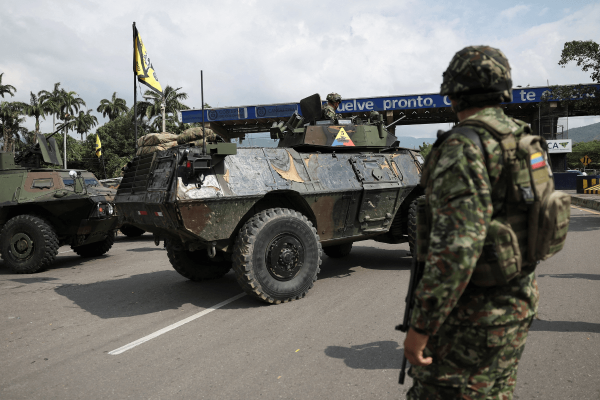
Jesus’ call to be peacemakers feels especially urgent given that this year began with a literal bang: On Jan. 3, the Trump administration launched a military assault on Venezuela to abduct and arrest President Nicolás Maduro and his wife, Cilia Flores. At least 80 Venezuelans were killed by an attack that did not have congressional approval, violated international law, and set a dangerous precedent for a presidency characterized by extending and imposing U.S. power and influence on other countries through military force. Most significantly for us as Christians, the administration’s actions in Venezuela signal a further U.S. retreat from a commitment to protect human dignity, freedom, human rights, and peace.
To be clear, Maduro himself was not committed to upholding human rights either; he was a brutal dictator who has inflicted profound harm to the people of Venezuela. The 2025 Human Rights Watch report on Venezuela documents Maduro’s horrific record of unlawful killings, enforced disappearances, torture by security forces, and subversion of the 2024 election. Yet Maduro’s removal by U.S. military action does not advance human rights for the people of Venezuela: António Guterres, the secretary-general of the United Nations, said the actions had violated the U.N. Charter and could lead to even greater instability and repression in Venezuela. We are already seeing early signs of this; The Washington Post reported that Venezuela’s government was detaining journalists, arresting citizens, and sending “armed gangs” to suppress any public support for Maduro’s removal.
Trump’s justification of the attack has been muddled at best: In the lead-up to the late-night military mission, the administration continually told Congress and the American people that they were blowing up Venezuelan boats (unlawfully, I might add) to stop alleged narcotics trafficking, while Trump’s aides were pushing for an end to Maduro’s regime. After the attack, the administration justified its military mission as a law enforcement action to bring an indicted criminal to justice. Neither explanation holds up considering that just last month Trump pardoned the former president of Honduras, who had been convicted in the U.S. for his role in smuggling 400 tons of cocaine to the U.S.—the same alleged charges leveled at Maduro and his wife. Instead, the strike appears motivated by greed for oil and the idolatrous intent to dominate the Western Hemisphere. On Saturday, Trump said that the U.S. will “be in charge” of Venezuela. Secretary of State Marco Rubio, on the other hand, has claimed the U.S. will seek to work with the existing government, led by the newly sworn-in Vice President Delcy Rodríguez, as long as the government is compliant with U.S. interests. Both approaches violate the sovereignty of the Venezuelan people and keep the same repressive Chavista government in power; absent is any support for a democratic political transition in which the Venezuelan people could support opposition leaders such as Edmundo González, the rightful winner of the 2024 election, or Nobel Peace Prize winner María Machado. Also absent is any support for the Venezuelan people, including the 600,000 Venezuelans in the U.S. whose Temporary Protected Status the administration revoked.
Trump has made it clear that securing access to Venezuelan oil—not setting the stage for a fair election—is his first priority. Trump has benefitted greatly from oil money and made his intentions crystal clear in a post Tuesday on Truth Social declaring that “the Interim Authorities in Venezuela will be turning over between 30 and 50 MILLION Barrels of High Quality, Sanctioned Oil, to the United States of America. This Oil will be sold at its Market Price, and that money will be controlled by me, as President of the United States of America, to ensure it is used to benefit the people of Venezuela and the United States!”
READ: ‘America First’ Resurrects the Logic of Crusades in Venezuela
As Christians, we’re called to live our lives, including our public lives, in a way that embodies biblical values. Among these values is a commitment to affirming imago dei, the recognition that every human being is equally made in God’s image (Genesis 1:27). These values also include a presumption toward peace, seeking to model the call of the prophet Isaiah to crush our swords into plowshares (Isaiah 2:4). Again, peacemaking isn’t about the absence of conflict, but rather actively pursuing justice and reconciliation: making things right. In matters of foreign policy, this kind of peacemaking looks like supporting diplomacy and multilateral efforts to strengthen democracy—not imposing it through bombs or military coercion while shamelessly campaigning for a Nobel Peace Prize. Peacebuilding looks like the kind of stabilization and democracy-building work that the U.S. Agency for International Development performed before Trump dismantled it last year—the kind of work Venezuela will desperately need in the days to come.
In opposition to biblical peacemaking, the administration’s new National Security Strategy alarmingly expands upon the 1823 Monroe Doctrine, asserting a new U.S. goal of dominating the Western Hemisphere to advance U.S. security and economic interests. Trump’s recent threats toward Colombia, Cuba, Mexico, and most recently Greenland are dangerous signals that the administration seeks to behave even more as an imperial power.
The good news is that only a third of the U.S. populace expresses support for Trump’s military strike. Several congressional resolutions specifically condemning attacks on Venezuela have failed, but only narrowly; a bipartisan group of U.S. senators has introduced a war powers resolution to block further military action against Venezuela without congressional authorization. This is an inflection point in which Congress can reassert its war powers and serve as a check on imperial power; if we fail to check this kind of intervention in Venezuela, the administration may use it as precedent for future military actions in other countries. We must call on Congress to exercise its constitutional powers to halt further military action and violations of Venezuela’s independence.
We should especially be aware of how U.S. imperialism and Christian nationalism so often bleed into each other. If you believe the United States is a nation chosen by God for a special purpose in history, you’re much more likely to support the aggressive militarism. We need to recognize that type of military power worship as idolatry and reject it in favor of our steadfast support for advancing human dignity, freedom, and peace. Now is the time to actively “seek peace and pursue it” (Psalm 34:14).

Rev. Adam Russell Taylor is president of Sojourners and author of A More Perfect Union: A New Vision for Building the Beloved Community. Follow him on Bluesky @revadamtaylor.
Did this article have an impact on you? Tell us how! Whether you’re moved to take action, have a question, or want to share a comment (good or bad), we value your feedback!