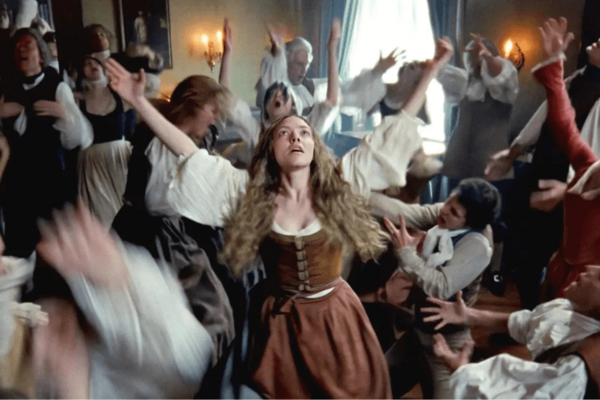
I’ve never seen spiritual ecstasy put to screen in quite the unvarnished manner as director Mona Fastvold’s The Testament of Ann Lee. The film follows the life of Ann Lee (Amanda Seyfried), tracing her ascension to matriarch and religious leader of the Shakers, a religious sect in the 18th century. Fixtures of the Shakers’ expression of faith include religious rhapsody, often manifesting with their members shaking, shouting, dancing, and singing as a way to express prayer and communion with God.
Lee’s theology may be questionable to those who cling to orthodox views of Christianity. Known by the Shakers as Mother Ann Lee, the trailblazing leader was regarded as the female manifestation of God’s dual nature (i.e., the female equivalent of male divinity) and was regarded by her followers as the second incarnation of Christ. Yet the community Lee strove to create was one of radical inclusivity and belonging—a lesson churches today could stand to learn from.
For Fastvold, it was this element of belonging that drew her to the character of Lee, even if she disagreed with other aspects of the Shaker founder’s theology, such as its commitment to celibacy. “It was fascinating to discover this religious community that was so progressive, and it made me think: We should remember what happened. We have roots in this type of hospitality,” she told Sojourners.
I interviewed Fastvold when she was in Chicago last year for the Chicago International Film Festival. We spoke about celibacy as an act of liberation, the importance of creating a film about female leadership in today’s context, and how, in some way, all of her films are about faith.
The Testament of Ann Lee is now playing in theaters.
Zachary Lee, Sojourners: Cinema for me, has always been an artform of reclamation, and this film very much acts as that.
Mona Fastvold: It’s interesting because when I first stumbled upon her, I thought, “Oh, I’m sure this must be a known part of American history.” It turns out it’s not true at all. All people knew about the Shakers was the fact that they had good design sensibilities and made furniture. I think people also get the Quakers and Shakers mixed up.
The Shaker’s work is one of the cornerstones of American design, but there’s more to them. When I was doing research, I was fascinated that there was this feminist historical figure in America that we know almost nothing about. She’s about to be erased from history, and I really did want to lift her story and examine it. Especially right now, I wanted to explore: What is female leadership?
Looking at Mother Ann, I thought: Is the answer to that “mothering?” Is motherhood a form of leadership? What does it mean to be a mother as a leader? What I settled on was this idea of allowance for grace and nurturing. It means to allow space for people to have different opinions and ideas, and to allow your children to experiment and find their path. I thought this was a beautiful concept. Ann’s dream of utopia is flawed, but there’s certainly a lot of beauty and a lot of grace in her experiment that I wanted to lift up and look at.
I’m happy you brought up the imperfection of it, because one of the most humorous scenes of the movie to me was seeing Ann’s husband, Abraham Standerin’s (Christopher Abbott) horrified expression when he hears that Ann is going to make celibacy a cornerstone of the Shaker movement. Sexual repression and religion tend to go hand in hand. What was your approach to weaving in these moments of humor—that poke fun at these imperfections—while also trying to maintain respect and reverence for your subject?
It was a really fine balance that I needed to navigate carefully. I never wanted to make fun of them, but I did feel like there was room for levity and humor because, at times, what the movement was doing was absolutely absurd. I’m not a Shaker, and I’m not preaching what they were preaching at the time. I did want to have a conversation about this celibacy element, especially because of what you outlined about the connection between that idea and religion.
READ: Our Most Anticipated Films of 2026
I wanted to explore Ann Lee’s sexuality. I wanted to understand her journey and how, because of her trauma, she went on this journey where she viewed celibacy as an idea of freedom. Because the Shaker community believed so much in confessing and talking about their sin, my interpretation of this community was that the Shakers were a movement where you could be whatever you wanted to be. To have that freedom, though, Ann chose to remove sexuality to create autonomy for women. This was a time when women were considered their husbands’ property, and some men had placed more value on their horse than their wife, because it would have been easier to replace the wife than a horse.
I think for Ann, when constructing her utopia, her removal of sexuality was a desperate attempt at autonomy. That was my interpretation of where her decision came from. Her trauma is probably a big part of it as well. She had to give birth at home without any support, and the cost was most likely death. I wanted to depict this journey, but not deny her of her sexuality, and explore this in a way that I felt I could relate to as a woman. It definitely is complicated to impose celibacy on everyone around you. It is interesting, though, how much you get done if you don’t do it. [Both Laugh]
I think for Ann, when constructing her utopia, her removal of sexuality was a desperate attempt at autonomy.
People can put all of their pent-up energy into their work.
Exactly. The Shakers made some incredible inventions. There were also “winter Shakers,” those who would join the faith for six months and then leave again. The children the Shakers adopted were always asked if they wanted to stay in the faith or not. So in this movement, it wasn’t this sect where people could never leave. I do think it’s interesting that we’re in a time where we’re seeing a lot of feminists being portrayed as hypersexual and really sex positive, but when we look at Ann Lee, who says, “You know what? I’m going to erase [sex] from my life. Zero part of my identity is in relationships with men.” That’s terrifying to a lot of men of that time.
Your film highlights how Ann’s denial of the flesh was also rooted in disappointment with the flesh: She loses all four of her children in their early infancy.
I think that due to that immense trauma, her only way out of it was to say, “I will mother the world. I will mother everyone and be everyone’s mother.” I think that’s quite beautiful, isn’t it? To say, “I’m going to take this love that I don’t know what to do with … a love that is killing me, and transform that into a safe space for everyone to express their love differently.” That’s a beautiful sentiment. You can say, “Oh, maybe Ann just had horrible postpartum depression,” and that this conviction came from a psychotic break. You can also say, though, that she had this depression, but then was moved by the Holy Spirit to create a space to put her love that she had too much of and didn’t know what to do with.
READ: They Denied Themselves Indulgence in Everything—Except Their Art
There are also several key sequences in the film that you don’t linger too much on, but they come together to create this portrait of radical inclusivity in the faith community Ann was cultivating. When Ann first arrives in New England, she critiques slave owners, and the Shakers also choose to work and trade with the Native Americans around them. Why did you think it was important to include these elements?
Ann’s not a savior. She’s just saying, “Anyone can come.” The Shakers worked closely with Native Americans because they were amazing at drying and storing seeds. They were also her neighbors, and so I read anecdotes about the Shakers and Native Americans exchanging goods and learning from each other. Supposedly, Ann was outraged by any sort of lack of empathy. She led her faith and lived her life by that. The community she made was so wildly progressive. It was fascinating to discover this religious community, and it made me think: We should remember what happened. We have roots in this type of hospitality. Wouldn’t it be interesting to draw from that in dialogue with Ann’s interpretations of the Bible?
At the Venice Film Festival press conference, you talked about how there have been hundreds of Shaker songs, and you picked ones that fit the narrative. What was your criterion when deciding what best fit with the narrative?
I wrote the script first, although I was listening to the music and doing a lot of research on sheet music, as well as old recordings of Shakers. I was in placeholders for where the songs would be in the script. The songs are all expressions of prayer. They’re not tunes we sing; the songs are moments of cathartic, sometimes desperate prayer. With the composer, Daniel Blumberg, we went on a deep dive and listened to the songs, and it was very intuitive which ones we felt called to us and felt right.
Daniel would work on adapting it for the film while also being respectful to the tradition. At the same time, this is folk music, and since the music is being passed on, we can take liberties because it’s sung from one person to the next, and we’re the ones doing the singing now, and hopefully passing it on to the next generation.
As intuitive as the process is, it also involves a little bit of magic. Of all the songs available to us, there are moments where we’d listen to one and then say, “This is William’s song.”
My favorite is “All is Summer”; something about the combination of Amanda’s vocals and the ship setting clicked.
That’s a combination of two hymns, actually. Daniel and I also created three original songs, and those were based on the script. “Clothed by the Sun” was based on the Shaker text. Daniel and I sat on our friend’s floor, and those original songs were the first things we worked on. I started ringing this little bell that I had acquired.
In the ship sequence, I read that you and choreographer Celia Rowlson-Hall had to ensure everyone was moving in a very specific way to make it seem like you are all on a ship with waves, when in reality, someone’s off to the side throwing water.
Exactly. I couldn’t build a giant ship. The camera would go in one direction, and the actors would go in another. I would be off camera, saying, “left, right.” There’s some faith required, where you’re telling your collaborators, “I know this is silly, but trust that it will turn out OK.” Filmmaking is built on constant acts of trust. Most of it does feel ridiculous. When you’re working on this film, you have to say, “Here are my arms. Come do the trust fall. I got you and know what I’m doing.” [Laughs]
As a filmmaker, how do you balance stewardship and fidelity when telling someone else’s story? For example, I know you took time to visit Ann’s grave before making this film.
I was asked if I had been to her grave when I was at Woodstock, showing the film there at the Hancock Shaker Village. I have friends and family who are there, and Amanda Seyfried lives there. For me, visiting Ann’s grave was a moment of asking for permission. I was saying to her, “I am going to be in dialogue with you about your story and what you were trying to achieve. I hope that’s alright.” It wasn’t so much about saying, “I am going to tell your story,” but rather “I’m going to be in conversation with what you did.” That’s the speculative element of this project; I’m saying, “I am part of this conversation now, too.” I’m putting myself and my perspective into it, and asking, “What does your story mean to me now?”
You can’t separate that. You’ll always be part of it. Even if you’re saying, “I want to be 100% faithful,” you will rub off on it, and you will steer it in one direction or another just by omitting something and including something else.
The end of your film also lists that there are two Shakers left, but I think their members have now increased to three.
I dated that ending crawl of the film at the very last minute. My producer said, “Oh, should we change the crawl?”
Who knows, maybe more people will become converts after this film. I recalled something you and Brady had shared about working on The Brutalist. Production stopped and started on that project four times before it got made. You were also going to work with Thomasin McKenzie on a different project before that fell through; now you’ve worked with her on The Testament of Ann Lee. You’ve made a way where there’s been no way, so I’d be curious about the role of faith in your creative process.
[Brady and I’s] movies are really about faith … they’re about people trying to create impossible things, impossible projects … we write about it a lot, don’t we?
There’s a parallel to trying to make independent and arthouse films with unique stories, of course. It’s a hard pitch to producers and financiers to make a musical about the founders of the Shakers. With this story, I had to tell it. I felt deeply compelled, and I decided I was going to do it no matter what. I just started shooting it in little bits and pieces. Amanda and I were working for a year leading up to this, specifically on the dialect, because no one knew exactly what the Mancunian dialect was at the time, so we had to base it on a ton of research … My team and I really wanted to honor the craftsmanship of the Shakers through the craftsmanship of the film.
What speaks to me about Ann is her mad, unwavering faith in her project and the dream of this utopian society. I can relate to her as an artist in that she was striving to create something.

Zachary Lee is a former online editorial assistant at Sojourners and part of the inaugural Sojourners Journalism Cohort. You can find him on Letterboxd @zlee729.
Did this article have an impact on you? Tell us how! Whether you’re moved to take action, have a question, or want to share a comment (good or bad), we value your feedback!