28 Years Later: The Bone Temple is the newest installment in a horror franchise that continues to demonstrate how gut-wrenching terror can invite viewers to ponder questions about politics and human nature. The Bone Temple, directed by Nia DaCosta and currently playing in theaters, will certainly make you scream your guts out, but it will also invite you to consider: What is my ultimate concern?
For those who have seen the previous three films, some of these questions will be familiar territory: Will humanity’s violence ultimately lead to a societal and environmental collapse? What does it mean to be human? Why do some humans label others as “non-humans”? But The Bone Temple is asking new questions, a lot of them revolving around spirituality and whether there is ultimately a benevolent (or malevolent) deity. Previous movies in this series—especially 28 Years Later (2025), which preceded The Bone Temple—gestured toward religion, but DaCosta’s installment puts religion front and center, and then turns things up to 11.
READ: In War-Fueled Societies, We’re All Zombies
The Bone Temple is set 28 years after the worldwide outbreak of a virus that infects humans, causing them to become enraged and consume human flesh. Those uninfected by the Rage Virus struggle to preserve their humanity and their sanity. Because the Rage Virus, which has completely decimated the British Isles, has no known cure, the entire archipelago is quarantined. The international community has placed warships in the surrounding waters, effectively making the region a cemetery-prison.
Intriguing art feeds off of real life. How do people survive in the post-apocalyptic world of The Bone Temple? The same way you and I survive in our pre-apocalyptic setting: We tell ourselves stories. Some of these stories are based on history, some are based on myth; some stories speak to our better angels (Androcles and the Lion; The Lord of the Rings), and some prey on our worst demons (Adventures in Odyssey; the crusades). But all stories—whether religious or secular—are reliant on human interpretation, are constantly at risk of being misused, and possess a unique ability to spur us to act in the real world.
One of the prevailing stories in the world of The Bone Temple is that “the infected” have ceased to be human. The non-infected are hyper-vigilant about avoiding the infected, as the virus can be easily transmitted via bodily fluids such as saliva or blood. But for some, it’s not enough to simply avoid the infected.
For the villainous and charismatic Sir Lord Jimmy Crystal (Jack O’Connell), the infected are demons who must be killed and sent to his father. Those who remember the opening and ending scenes of 28 Years Later (2025) will recall that the last time Jimmy saw his father, who was a vicar, it was the day of the outbreak. Jimmy, just a child then, hides away in his father’s church, holding tight to his dad’s crucifix. Hiding in the bowels of the church, Jimmy witnesses the last surviving member of his family become part of the infected horde. “Father,” young Jimmy says through tears, “why have you forsaken me?”
As someone who is a pastor’s kid and has a dark sense of humor, I’ve taken to telling myself that The Bone Temple is really just a film about the trauma of PKs. Jimmy’s trauma leads him to accept a dark and twisted story about the world, one that he leverages to manipulate others into following him with cult-like devotion. Because Jimmy witnessed his father leading the horde, he believes that his father is actually “Old Nick” or Satan. The reason for the Rage Virus, then, in Jimmy’s telling, is this: “Old Nick saw that the world of man had failed and knew only disharmony.” To solve this, Old Nick released his demons (the infected) into the world to claim it as his dominion. As Satan’s son, Jimmy believes he has been specially appointed to recruit disciples to travel the land and “deliver souls” to his father through acts of murder and sadism.
As someone who is a pastor’s kid and has a dark sense of humor, I’ve taken to telling myself that 'The Bone Temple' is really just a film about the trauma of PKs.
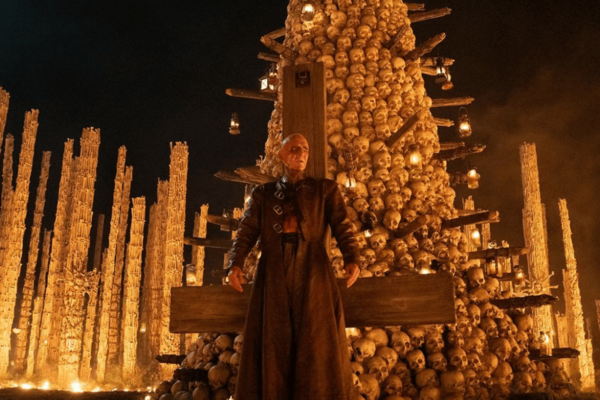
In The Bone Temple, Jimmy’s story and the way it influences his actions are contrasted with the story and actions of Dr. Ian Kelson, who is played by Ralph Fiennes, reprising his role from 28 Years Later (2025). Just as in the previous film, Kelson continues to build his gargantuan ossuary—a literal reminder that we all must die—using the bones of both the infected and non-infected to create a memento mori. For Kelson, who is a man of science and empathy, the state of the infected does not erase their humanity but simply puts the terror and beauty of our existence into perspective. “Kelson is a humanist,” DaCosta told Harper’s Bazaar in January. “He’s like, there’s no God, there’s no devil, but there’s us and that’s beautiful.” What becomes obvious in The Bone Temple is that the story Kelson tells himself pushes him to adopt a radically empathetic understanding of who should be included in that “us.”
I can foresee a scenario where some youth pastor—the type who wears expensive sneakers, calls God “daddy,” and enjoys taking church kids to “hell houses”—refers to scenes from The Bone Temple to make some contrived sermonic point about “Satanism” being the scourge of the earth. But The Bone Temple is not meant to be read as a biting critique of Satanism or even a ringing endorsement of secular humanism. Instead, The Bone Temple presents a prescient question to us: If the overarching story of your life fails to push you and others to act with empathy, should such a story be internalized?
In our pre-apocalyptic time, there is a real-world death cult, and it is not being led by Satanists but by Christians. Christians are the ones telling a story that allows them to give glory to God after making cuts to Medicaid, literally putting millions of Americans’ lives at risk. Christian pastors are the ones openly advocating for theocracy, justifying the murder of abortion providers, and supporting the death penalty for LGBTQ+ people. And while Jimmy has seven disciples in the movie to help him conquer the world for his father, in real life, Christians are trying to conquer the “seven spheres of influence” to gain dominion over the earth for their father. And last but not least, it’s not Satanists leading the charge to abandon empathy, but Christians.
The post-apocalyptic genre’s popularity, I suspect, has everything to do with our collective anxiety that we are perpetually on the brink of the world’s end. So, when we watch The Bone Temple, we’re doing research. We’re looking for a glimpse into the future, something to help us gird ourselves against the coming brutality. But traces of that brutality are already among us. How’s that? Look no further than the stories we tell ourselves. The ultimate question, especially for Christians, is whether we can come up with better stories before it’s too late.

Did this article have an impact on you? Tell us how! Whether you’re moved to take action, have a question, or want to share a comment (good or bad), we value your feedback!