moral imagination
IN PEACEBUILDING AND THE ARTS, practical theologians Theodora Hawksley and Jolyon Mitchell ask readers to imagine peace: “It is all too easy to reach for clichés” — doves or peace signs come to mind — or “to think of peace as a sort of absence, a not-happening.” In our violent world, we readily picture conflict and injustice, but not peace or conflict transformation. The arts help us fill this empty space, revealing the true nature of peacebuilding as “an ongoing, dynamic process, a journey that sets human relationships on the road to life.” Through bolstering the moral imagination, the arts rehumanize dehumanized contexts.
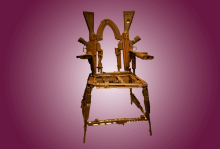
Mitchell explains how the arts give us “realistic visions of how to create peace” and foster “an environment in which the ‘moral imagination’ can be cultivated.” He shares the example of Mozambican Anglican Bishop Dinis Sengulane, who, in the mid-’90s, established the Transforming Arms into Tools project after the end of Mozambique’s long civil war. This project asked local artists to “glorify peace” through refashioning decommissioned weapons into art. Compelling works such as “Throne of Weapons” (2001) and “Tree of Life” (2004) emerged: metallic sculptures made from assault rifles welded together in a way that preserved the outlines of the weapons. The “Throne of Weapons” has a back, arms, seat, and legs made clearly from the barrels, triggers, and heels of AK47s. The viewing experience is a dance between the parts and the whole, which underscores the meaning of the project itself. The sculptures represent the specific horrors of the past and broader hope born from peacebuilding. Displayed in public places in the U.K., these works have served as a caution against gun violence and an inspiration to activist-artists across the globe.
IN THEOLOGIAN STANLEY Hauerwas’ influential book A Community of Character, he highlights the role narratives play in the formation and identity of a community. Stories have a descriptive function but also a formative function. Stories describe key events in the life of a community and preserve that community’s history. They also shape the community’s worldview and character. Stories influence the community’s ethos and commitments. They drive its actions. Gospel stories testify to the nature of Jesus’ mission and the ethos and commitments of the early church. They foreground Jesus’ character traits, which help shape our own ethical outlook and enable us to imagine an alternative moral space in society.
We live in a fraught political context where Christian identity has become a contested moral space. It’s a space increasingly shaped by dangerous nationalisms that celebrate oppressive power and that depict God in ways that provide theological justification for consolidation of power over others. However, the lectionary texts this month challenge just such depictions of God. They lift up the image of a God who suffers with the suffering rather than a triumphant God exercising domination. They feature characters, including Jesus, who insist that it matters what stories we tell and how we tell them.
What stories do we tell about the church today and how do we tell them? Do such stories shape our legacy as Christians and our moral imagination? How do we continue to tell those stories faithfully and meaningfully, allowing them to shape our lives, even in an era when many Christians are attracted to stories of a militant, oppressive God rather than to God’s motifs of justice?
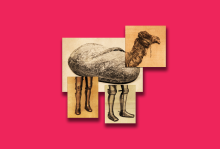
IMAGINE YOURSELF IN a darkened theater. At center stage sits a woman, child on her lap, both wrapped in tonal greys. A tiny stream of light falls from above. Off left, large animals shift their weight on floorboards, chuff-chuffing their breath; foreign tongues murmur them calm. Off right, the only sound is of metal rasps running repeatedly down the length of blades; random sparks flare off the cutting teeth. This is Epiphany. Everything is waiting to happen. We know the narrative detail: Mary and Jesus, a manger, the Magi’s star-trekking journey with camels and gifts to honor a “newborn king” (while Herod, like Pharaoh, plots a bloody offense). But Epiphany is a season for paradigm shifts. What if we scramble the details? Imagine this. Off left, the chuff-chuffing of foreign tongues come not from men calming beasts, but camels praying as they approach the child, the spiritual waterhole for the world. The camels have not brought kings or astrologers, but a guild of bakers, who extend platters of fresh bread toward the child. At center, the woman wrapped in a cloak of ultraviolet leans back on her stool: She has given birth to a star, filling them both with light. At her side stands a human child. He gazes off right. The sound of rasps and swords, boots and shouted commands fascinate him. Slowly, the child lets go his mother’s hand, relaxes his throat muscles, measures his breath. In a world of bread and circuses, he has made brothers of soldiers. He is a sword-swallower and eats their pain.
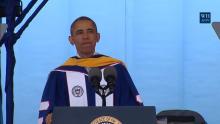
President Obama delivered a commencement address on May 7 at Howard University, one of the nation’s premier historically black colleges.
In his speech, sprinkling jokes throughout, Obama encouraged the graduates to be proud of their achievement and hopeful about their future, but he also offered them some of his wisdom about how to change the world.
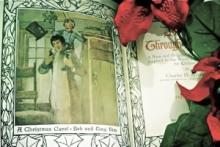
The Ghost of Christmas Past showed Scrooge a total of five visions. It is only the last two which are dark. The first three show the seeds of Scrooges own repentance.
The first vision shown to Scrooge by the Ghost of Christmas past is that of a young Scrooge reading alone, neglected by his peers, just before Christmas. Scrooge, watching his old self, begins to cry.
“What’s the matter?” asked the Spirit.
“Nothing,” said Scrooge. “Nothing. There was a boy singing a Christmas Carol at my door last night. I should have given him something: that’s all.”