99 percent
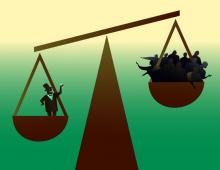
This week, there was a lot of commentary about the State of the Union, the title of the president’s annual January speech before a joint session of Congress. I thought it was one of Obama’s best addresses recently because he focused on what is real for this country — growing economic inequality where only a few are doing “spectacularly well” while many families are still struggling just to get by.
The wife and mother from one of those families wrote the president a letter that seemed to have moved him, so he lifted up her “tight-knit family” trying to get through “hard times,” as she sat up in the gallery next to first lady Michelle Obama. Her family became a parable for the nation that is starting to do better economically but still faces hard choices that the president sought to address with very practical suggestions to support what he called “middle class economics."
Obama’s proposals for shifting tax breaks from the very wealthy to the middle class, to make possible child tax credits, days for sick leave, assistance with child care, and some relief from expensive educational costs are all proposals not likely to be supported by the new Republican Congress. But the speech begins to set what could be a long-term agenda to deal with our massive economic inequality — finally. Even the Republicans now might have to face up to the increasingly visible, embarrassing, alarming, and morally indefensible gaps between a small elite and the rest of the country.

Our church community in Salt Lake City has been going through a series titled “Love God, Love Neighbor.” We’ve been going through Jesus’ famous response to the question, “What must I do to inherit eternal life?” Jesus of course turns the questions back to the man asking, “What is written in the law?” the man responds by saying, “Love the Lord your God with all your heart, soul, and mind, and love your neighbor as yourself.” It appears the man who asks the question — described as either a lawyer or expert of religious law — does not like Jesus’ response very much and so he asks another question. “And who is my neighbor?”
Jesus’ response to the question is perhaps one of the most well-known parables in the Bible: that of the Good Samaritan. But the question, “Who is my neighbor?” is a question we must still wrestle with today, as distressing and upsetting as it most definitely will be.
Who is my neighbor? If we are to examine the parable of the Good Samaritan it appears that Jesus wants to make it clear that our neighbors are everyone, especially — perhaps even specifically — our enemies. So another way of asking the question is, “Who is my enemy?” When I confront the question on a personal level, I realize that even though my neighbors or enemies are perhaps atypical from the norm, I am still called to love them.
Who are my enemies? For me, it’s simple really. My enemies are politicians, Congress, rich people, Wall Street Bankers, rich Christians, and the most hated form of all: “rich, white, Christian politicians.” I jest, but it’s not too far off.
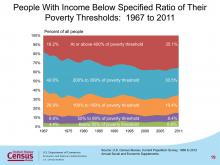
The U.S. Census Bureau released its 2011 poverty report this morning, reporting that 46.2 million people were living in poverty, amounting to 15 percent of the population. Neither was significantly different than 2010. All major demographic categories – white, African-American, Hispanic, Asian – were also essentially the same as last year.
The number of children and the elderly in poverty remained the same.
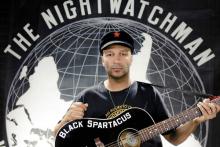
IF YOU EVER wondered what you would get if you crossed Woody Guthrie with Jimi Hendrix, you might want to check out guitarist and activist Tom Morello, also known as The Nightwatchman, whose work combines very modern flurries of feedback and distortion with old-school Popular Front politics. Last year, Morello played a prominent role in the occupation of the Wisconsin state capitol in support of public employees’ unions, and this May Day he led a “guitarmy” through the streets of New York, singing “This Land Was Made for You and Me” in support of Occupy Wall Street.
Morello first made his name playing with Rage Against the Machine, a 1990s band that blended a potent Molotov cocktail of rock, rap, and revolution. For most rock stars, getting political means promoting Amnesty International or Greenpeace, but Rage’s favorite organization was the Mexican revolutionary Zapatista Army. After Rage fell apart, the guitarist had another successful band, Audioslave, fronted by former Soundgarden singer Chris Cornell. Audioslave was a great rock band, but it lacked a political agenda. Morello is a great rock guitarist, but one with a political science degree from Harvard who said he finished his degree because he wanted to “learn how to get my hand on the levers and be an effective revolutionary.” So simply making cool noises couldn’t possibly keep him satisfied for long. Soon Morello was turning up for open mic nights at folkie clubs, disguised as his alter ego, The Nightwatchman.
The Nightwatchman’s singing made it pretty clear why Morello had always worked behind a front man. He often sounds like an unfortunate cross between Woody Guthrie and Lou Reed. But The Nightwatchman found his niche in political contexts, such as Madison and Wall Street, where the point was to get the people singing. This new role on the street has also given a new direction to Morello’s music. Last fall he released a Nightwatchman album, World Wide Rebel Songs, that included a full rock band and found Morello beginning to integrate the Hendrix and Woody sides of his musical personality.
CHUCK COLLINS’ new book does exactly what an introduction to wealth inequality and all its faults needs to do: summarize without oversimplifying, and provoke dialogue and action about the urgent problem of what Collins memorably dubs the U.S.’s “inequality death spiral.”
Newcomers to the topic will find a concise overview of how wealth inequality has skyrocketed since 1980, how a small elite has changed the rules to enable still higher inequality, the many seen and unseen ways that’s a problem for us all, and the beginnings of a solution. Those more familiar with the subject can benefit from Collins’ overview, well-selected statistics, and well-honed, direct turns of phrase. Those who want deeper reading will find excellent footnotes at the end of the slim volume. Everyone will find her experience livened by the stark words Collins quotes from people identifying as part of the 99 percent—and those who are part of the 1 percent.
Collins’ many years as an advocate against inequality show in the book’s graceful balance: It emphasizes the usefulness of the 99 percent-vs.-1 percent idea, while also making clear that neither side is monolithic. He acknowledges very real economic, class, and racial divisions among the 99, but makes a compelling case against letting those differences be the basis of divide-and-conquer political strategies: “It is important that the 99 percent see that they have some important common ground, rather than be peeled into a hundred subgroupings.” And Collins, who himself grew up in the 1 percent, refuses to demonize it or to accept the demoralizing falsehood that it is unified against those below. Rather, he quotes multiple allies within the economic elite, while decrying how “a small segment of the 1 percent—with an organized base in Wall Street’s financial institutions—has worked over many decades to rig the rules of the economy” in the areas of “taxation, global trade, regulation, and public spending.”
You probably have a gallon of milk in your fridge. It might be fat free, soy, or maybe even 1 percent. Most of us drink milk in some form. But how long does it take for us to 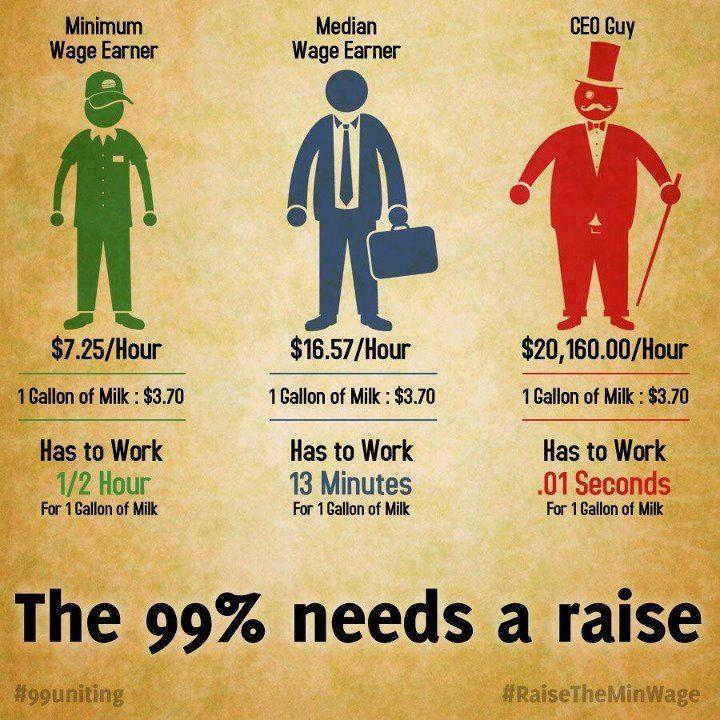 earn enough to buy it?
As part of their ‘Raise The Minimum Wage’ campaign, 99 Uniting produced this telling infographic, comparing how long it takes a minimum wage earner, a median wage earner and ‘CEO Guy’ to earn a gallon of milk. It makes for some sad and frustrating reading …
Salon's Editor-at-Large, Joan Walsh writes:
"Thanks to OWS and the work of writers like Stiglitz, 2012 was supposed to be the year America rediscovered and tackled economic inequality. Time magazine closed 2011 by naming OWS its top story of the year, a pretty big honor for a movement that only revved up in the year’s final quarter. But that’s how much its “We are the 99 percent” framing seemed to change the political debate."
Read her full article here
 Earlier this month, I boarded a train with my brother-in-law and headed to Chicago to protest the 2012 NATO Summit. If you are asking "why protest?" you can find a substantial list here.
Security had been ramped up and no food or liquids were allowed on the train. We met some fellow protesters during the trip and when we arrived at Union Station we hustled to make it to Grant Park on time. In transit to the park the sun was already warming our necks and I found myself reaching for the small tube of sunblock that I had stashed in my pocket.
We arrived in plenty of time to catch the pre-march rally at Petrillo Bandshell. Many stories were shared by fellow activists from around the world. The air was humid, yet vibrating with the passion of thousands as we prepared to march together for peace.
Amidst a swirl of percussion the crowd was chanting: "We are unstoppable! Another world is possible!"
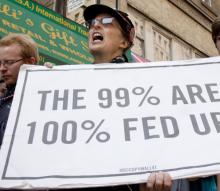
Several days ago a document, the “GlobalMay Statement,” showed up in my email inbox. In the statement, it is explained that “this is an attempt by some inside the [occupy] movements to reconcile statements written and endorsed in the different assemblies around the world. The process of writing the statement was consensus based, open to all, and regularly announced on our international communications platforms, that are also open to all. It was a hard and long process, full of compromises. This statement is offered to people’s assemblies around the world for discussions, revisions and endorsements.”
One of the things which struck me was how strong the statement is on the climate and environmental crises. The first sentence of the first general point says that, “The economy must be put to the service of people’s welfare, and to support and serve the environment, not private profit.” Four of the ten bullet points under that first general point deal in some way with environmental issues.
For The Nation, Ari Berman argues that President Obama must hold Wall Street accountable:
It’s easy to forget that the 1 percent, while overwhelmingly powerful in our political system, are by nature a tiny minority of voters. Thus, Obama’s core message should be about ensuring fairness and expanding opportunity for the 99 percent. But he won’t have the credibility to make such a message stick unless he jettisons what has been the albatross around his administration’s neck—the closeness between Washington and Wall Street.
Learn more here

Our health care system is not arbitrary. It does not operate by a set of principles that are beyond comprehension. We govern it. We participate in its capitalistic maneuvering and its political favoring. My family has health insurance in part because we have been given advantages due to racial identity, family networking, and being part of the 1 percent. All of these things have worked specifically in my favor to save the life of my dear mother. None of this is fair.
When I praise God for my mother’s enduring health, it is impossible not to think of how many others have indirectly contributed to this success. And to wonder if we have also indirectly contributed to their failures.

For Salon, Natasha Lennard worries that falling interest in the Occupy movement could have repercussions for the debate on inequality:
As evidenced by the lack of stories about the May Day general strike last week, the mainstream media’s interest in Occupy Wall Street has waned. It’s a shame because, as a new report indicates, Occupy has been central to driving media stories about income inequality in America.
Read her full article here
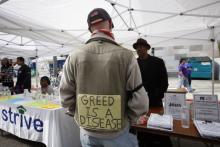
Christianity Today’s film This is Our City is provocative because of its gritty, grounded honesty. This is not a film about political pundits who banter back and forth exchanging policy talking points. No. This short film reveals the lives and thinking of two very ordinary people, their deep faith in Jesus, and how that faith is leading them to engage two of the most consequential grassroots movements of our time. These two movements share one beautiful thing in common; they are groundswells of ordinary citizens reengaging their democratic civic duty—to let their messages by heard and considered in the public square.
D.C. Innes rightly points out in his reflections that the film’s title, “Liberty or Justice for All,” and its structure seem to pit the virtues of liberty and justice against one another. Within the first minute of this nearly seven-minute film, liberty is clearly the motivation for Emmett Bailey’s Virginia Tea Party involvement, while the motivation for Pam Hogeweide’s Occupy Portland involvement is clearly “justice.” And both subjects say their involvement is an outworking of their faith.
It was a record year for U.S. farmers in 2011, with farm income topping $100 billion. This includes sales of $22 billion in fruits and nuts and $21 billion in vegetables and melons — crops that rely on immigrant farm labor.
But even as U.S. farmers prospered in 2011, those working on farms had less to celebrate.
The nation’s agricultural mecca — Fresno Country, California — had the state’s highest agricultural sales ($5.9 billion) and its highest poverty rate – 27 percent. More than 36 percent of the county’s children were poor, also the highest rate in the state. As one agricultural expert puts it, “High farm sales and high poverty rates often go together.”
Low wages, the seasonal nature of agricultural work, and, for many, unauthorized immigration status make it difficult for farm workers and their families to escape poverty. Farm workers’ high poverty rates aren’t totally attributable to immigration status, but it’s certainly one of the causes: 71 percent of all hired farm workers in the United States are immigrants, and about half of them are in the country illegally.
Consensus decision-making can make an old-style Senate filibuster seem purposeful and engaging.
There has been a lot of anger levied at the very wealthy since the Occupy movement began back in September. There is no doubt that much of this anger is justified – righteous indignation, if you will.
The ways that people have become extremely wealthy have often been corrupt or immoral, whether or not they are technically "legal." Part of the reason that the Occupy movement sprang up was because people felt that there were different rules for "us and them." People who lost millions of dollars in what was effectively high-stakes gambling were pardoned with little more than a slap on the wrist, while regular families lost everything in a crisis they had no hand in.
As I say, there has been, and still is, much anger. But out of that anger must come something new, something tangible and real.

Ron Paul Defends The 99 Percent: ‘It’s A Very Healthy Movement’; SWAT Raids, Stun Guns, And Pepper Spray: Why The Government Is Ramping Up The Use Of Force; GOP Needs To Address Immigration In A 'Humane' Way; Gap Between Rich And Poor Widening Across The Developed World, As Bankers And Executives Reap More Income; Challenges At The Cutting Edge Of Fighting Global Poverty; Baby Boomers Heading Back To Seminary; Worst Year Ever For Greenhouse Gases.

The Defining Issue Of The 2012 Presidential Race?; We've Got Christmas Wrong, Think Tank Reveals; Interracial Couple Banned From Kentucky Church; In Pictures: How Many Adults Believe In God?; Why Has Inequality Gone Up So Much?; New Bible Includes the Word "Immigrant," Brings Moral Clarity; Sacrifice Yourself To The Golden Calf Of Capitalism.
A new poll out from the Public Religion Research Institute and Religion News Service shows that just about the same number of American’s feel that Occupy Wall Street shares their values as does the Tea Party.
The split comes down partisan lines but is also generational. Eighteen-to-thirty-nine year olds are much more likely to feel that Occupy Wall Street shares their values then does the Tea Party.
What will be of great interest to watch over the coming months is the overlap between concerns of both movements. For example, neither group is a fan of the bank bailout and express an overwhelming feeling that elected officials aren’t responsive or accountable to those who elected them. I’m not arguing they will join forces any time soon, but they still could find a few areas of agreement.
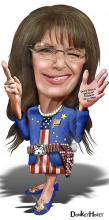
What convinced me that common ground might be possible was another unlikely event, I read a column by Sarah Palin that I liked.