Venezuela
WHEN DONALD TRUMP sat down in the Oval Office with four reporters from The New York Times for two hours in January, he was asked if there were any restraints on his global actions. “Yeah, there is one thing,” the president replied. “My own morality. My own mind. It’s the only thing that can stop me.” That unvarnished truth came as many were wondering what was signaled by Trump’s military operation in Venezuela to extract President Nicolás Maduro and his wife, Cilia Flores, and what to expect next. The answer? It was a prototype, and we should expect more.
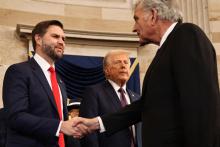
On Dec. 17, 2025, evangelical minister and Republican political activist Franklin Graham led a Christmas worship service at the Pentagon, where he preached about God being a “God of war.” I find it to be one of the most bizarre Christmas sermons ever given, but it was telling.
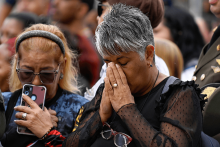
After the U.S. military’s abduction of Venezuelan President Nicolás Maduro, faith leaders are processing deep feelings of conflict, both with Maduro and with the U.S. intervention.
Rev. Ricardo Corzo Moreno is a Presbyterian pastor living in Caracas, Venezuela’s capital. Moreno’s apartment building is approximately one mile away from an air force base in La Carlota that was bombed in the attack. He described how shocked and terrified his neighborhood as bombs started dropping and planes flew at low elevation over their buildings.
“After everything ended ... it was a total silence. Nobody went out in the street; everyone stayed in their buildings. For the next 24 to 48 hours, Caracas became like an empty city,” Moreno said. “A lot of churches here in Caracas, they decided to cancel Sunday service because people were afraid that something would start happening in the population.”
During his life, Otto Maduro, the late Venezuelan sociologist and liberation theologian, lamented how the majority of Latin Americans were being treated to “fatten the bank accounts” of a small minority. This deeply troubled Maduro. As he wrote in his 1982 Religion and Social Conflicts, “I cannot submissively cross my arms in the face of certain allegedly ‘Christian’ attitudes and traditions that appear to me to be an antievangelical instrumentalization of the church in the service of social injustice.”
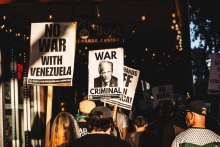
The Trump administration is blowing boats to pieces off the coast of Venezuela.
At different points this year, I’ve been left with the unsettling feeling that I don’t have the emotional bandwidth to fully process—let alone respond to—all of what’s happening. Early in the year, we all acknowledged that this overwhelmed feeling was by design, part of the Trump administration’s “flood-the-zone” strategy, intended to weaken and divide its opposition.
I’ve been wrestling with this in light of the attacks the Trump administration is orchestrating in Venezuela. On one hand, I’m perplexed at why such a costly, unlawful, and frankly evil operation isn’t garnering louder public outcry; on the other hand, I know there is so much else on people’s minds. It’s not that we don’t care about it all—from Chicago to Palestine to Sudan to so many other places where we know there’s urgent suffering—but there’s only so much outrage we can process before weariness takes over.
And yet I can’t ignore what’s happening in Venezuela
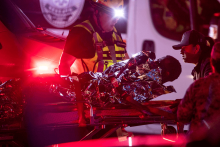
At least 39 migrants from Central and South America died after a fire broke out late on Monday at a migrant holding center in the Mexican northern border city of Ciudad Juarez, apparently caused by a protest over deportations, officials said on Tuesday.
THE DAY A massive electrical blackout plunged Venezuela into darkness, my neighbor Juan Carlos was finally heading back to seventh grade.
It had been four months since he had entered a classroom. His teachers had been missing since November, their $8 a month salary not covering even the commute. Doing the math, I realized that my two hens earned more with their daily eggs.
Leaving his darkened school, Juan Carlos headed straight to the potato field. I watched from the porch as he dropped to his knees to rastrojear—rake the field with his hands to uncover spuds missed in the harvest. The field’s owner turns a blind eye to kids searching for food this way.
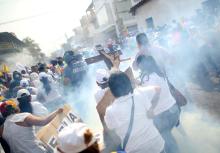
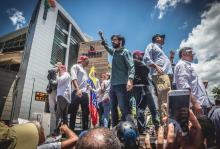
The clashes occurred as Venezuelan opposition leader Juan Guaido, who most Western nations recognize as Venezuela's legitimate leader, gave a personal send off to an aid caravan from the Colombian city of Cucuta.
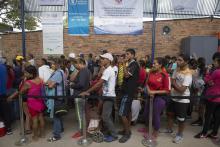
Around 42,000 Venezuelans cross Cúcuta’s border bridge every day, some fleeing with bags hoisted on their backs and others like Godoy, simply trying to get food and medicine. The exodus has overwhelmed aid organizations like Red Cross and the United Nation’s refugee agency, whose facilities have been filled to the brim in places like the Cúcuta border. More and more migrants flock to the city every day, especially now as political conflicts between Venezuelan President Nicolas Maduro and new opposition leader Juan Guaidó have reached a head.
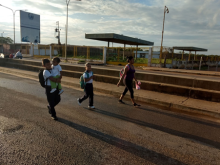
At the hectic border crossing between La Guajira department in Colombia and Zulia state in Venezuela, there are a surprising number of kids in school uniforms – niños pendulares, or pendulum kids.
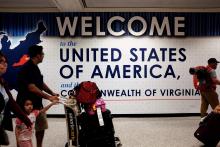
The current ban, enacted in March, was set to expire on Sunday evening. The new restrictions are slated to take effect on Oct. 18 and resulted from a review after Trump's original travel bans sparked international outrage and legal challenges.

"I've personally backed off from direct political involvement," Robertson said. "I've been there, done that. The truth of the matter is politics is not going to change our world. It's really not going to make that much of a difference."
Tonight, PBS's Frontline will air "The Hugo Chavez Show: An illuminating inside view of the mercurial Venezuelan president, his rise to power, and the new type of revolution he seems to be inventing -
Venezuelan Vice President José Vicente Rangel (left), in a meeting with religious representatives from the United States, took up the delegations proposal that Venezuela stop sending soldiers to the School of the Americas (renamed the Western Hemisphere Institute for Security Cooperation) at Ft. Ben