U.S. Conference of Catholic Bishops
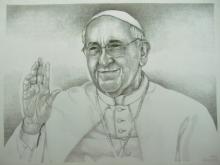
When the nation’s Catholic bishops gather on Monday for their annual fall meeting in Baltimore, one of their chief duties will be choosing a new slate of leaders to guide the American hierarchy for the next three years.
But the more than 200 prelates will also be looking over their heads — and maybe their shoulders — to the Vatican to gauge what Pope Francis’ dramatic new approach means for their future.
If Francis has made one thing clear in his nearly nine months on the job, it is that he wants the church to radically change its tone and style, starting at the top. The pontiff has repeatedly blasted careerism among churchmen and ripped “airport bishops” who spend more time jetting around the globe — and to Rome — rather than being pastors who go out to their flock and come back “smelling of the sheep,” as he likes to put it.
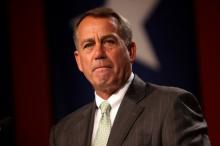
As a law extending workplace protection to gay, bisexual, and transgender workers makes its way through the Senate this week, there’s a shift in the political air: Arguments that stand purely on religious grounds are no longer holding the same degree of political sway they once did.
The rhetoric from Republican and conservative opponents of the Employment Non-Discrimination Act is moving away from the morality of the bedroom and into the business sphere. More politicians are fighting ENDA as a bad economic move, not as a break with the Bible.
ENDA would “increase frivolous litigation and cost American jobs, especially small business jobs,” Speaker John A. Boehner said in a statement released Monday, which made clear the Senate bill is dead on arrival in the GOP-controlled House.
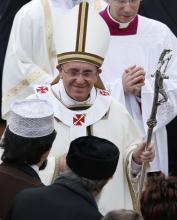
In an unusual move, the Vatican has asked the world’s bishops to quickly canvas the faithful for their views on topics like gay marriage, divorce, and birth control ahead of a major meeting of church leaders set for next fall.
But it’s not clear how or whether the American bishops will undertake such an effort, or if they will only send their own views to Rome.
The letter from the Vatican to New York Cardinal Timothy Dolan, president of the U.S. Conference of Catholic Bishops, was dated Oct. 18 and it asked that a series of questions be shared “immediately as widely as possible to deaneries and parishes so that input from local sources can be received” in time for a February planning meeting in Rome.
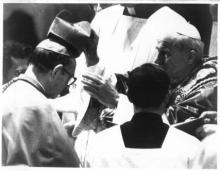
The election of Pope Francis in March heralded a season of surprises for the Catholic Church, but perhaps none so unexpected – and unsettling for conservatives – as the re-emergence of the late Chicago Cardinal Joseph Bernardin as a model for the American Catholic future.
While there is no indication that Francis knows the writings of Bernardin, who died in 1996, many say the pope’s remarks repeatedly evoke Bernardin’s signature teachings on the “consistent ethic of life” – the view that church doctrine champions the poor and vulnerable from womb to tomb – and on finding “common ground” to heal divisions in the church.
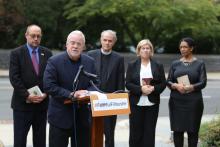
Under a cloudy and drizzly sky, across the street from the U.S. Capitol, David Beckmann read passages from the prophet Isaiah.
“Comfort, comfort my people, says your God,” read Beckmann, president of Bread for the World and one of several Protestant and Catholic leaders who gathered Wednesday to launch “Faithful Filibuster.”
The effort is intended to remind members of Congress that the government shutdown is hurting poor and vulnerable people.
Conservatives are rallying around a House bill designed to protect religious people who advocate for traditional marriage — a belief, they say, that is held in increasing contempt.
But supporters of same-sex marriage say the bill actually protects the discriminators — individuals and nonprofits that would deny gay people benefits or services simply because they are married to a same-sex partner.
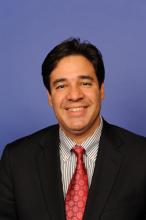
More than 60 House members — mostly (but not all) Republican — have signed on to the Marriage and Religious Freedom Act, which was introduced Sept. 19 by Rep. Raul Labrador, R-Idaho, who came to Congress in 2010 on a wave of support from the conservative Tea Party.

Fundraising for the flagship anti-poverty program of the U.S. Catholic bishops is slowly recovering after being battered by the recession and sharp attacks on its mission.
Officials at the Catholic Campaign for Human Development said that when 2012 collections are tallied after June 30, the program will match or slightly exceed last year’s mark of about $9.5 million. While that is still significantly down from the $12 million that the nationwide campaign was netting a few years ago, the upward trend is reassuring.
“We are pretty optimistic,” said Ralph McCloud, director of the CCHD. McCloud said he was still cautious, given the uncertain nature of the economy, but added that “if things keep going the way they have been, we could see a bit of an upswing.”
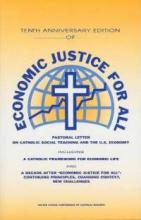
It’s worth remembering that in 1986, 25 years ago, the bishops at their annual meeting approved a pastoral letter on the economy, “Economic Justice for All.” It was, and still is, a powerful statement of Catholic social teaching on the “important social and moral questions for each of us and for society as a whole” that are raised by our economic life. It’s a letter that the entire church, Catholic or not, should read and affirm.
In an opening section, “Why we write,” the bishops ground their letter: “The life and words of Jesus and the teaching of [God's] Church call us to serve those in need and to work actively for social and economic justice. As a community of believers, we know that our faith is tested by the quality of justice among us, that we can best measure our life together by how the poor and the vulnerable are treated.”
Last week, Congress refused - for a second time - to fund the Bush administration's demand for a new nuclear weapon system, the Reliable Replacement Warhead (RRW). However, cutting funding for the RRW is one of those big moves destined to generate little fanfare.
It is a little too technical and incremental to be heralded as a decisive step towards nuclear abolition, and yet the RRW program - which over the next decade or so would have upgraded the core workings of all U.S. nuclear [...]