pope
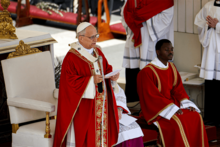
Pope Leo said on Sunday that God rejects the prayers of leaders who start wars and have “hands full of blood”, in unusually forceful remarks as the U.S.-Israel war with Iran entered its second month.
Addressing tens of thousands in St. Peter’s Square on Palm Sunday, the celebration that opens the holy week leading up to Easter for the world’s 1.4 billion Catholics, the pontiff called the conflict “atrocious” and said Jesus cannot be used to justify any wars.
“This is our God: Jesus, King of Peace, who rejects war, whom no one can use to justify war,” Leo, the first U.S. pope, told crowds in brilliant sunshine.
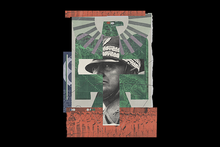
DURING ONE MEMORABLE scene in Mussolini: Son of the Century, a critically acclaimed series about the rise of Benito Mussolini currently streaming on MUBI and Apple TV, the fascist leader finds his wife, Rachele, in a church, praying for the recovery of their sick child. An avowed, outspoken atheist, Mussolini tells her to direct her pleas to the doctors treating him instead. When ignored, he looks up at the ceiling and asks God to prove God’s existence by smiting him—a request which, to Mussolini’s self-satisfaction, goes similarly unanswered. Outside, the couple is greeted by a crowd shouting “Duce,” or leader. Bathing in the public’s adoration, Mussolini spreads his arms, his pose mirroring the cross atop the church behind him.
Mussolini’s desire to rival and replace Christianity is not a fabrication or exaggeration on the part of the TV series, directed by filmmaker Joe Wright and based on a well-researched historical novel of a similar name by Italian author Antonio Scurati. Fascist leaders frequently compared their movement to the Catholic Church, describing themselves as prophets and saints while referring to their followers as believers and worshippers. In a way, the party apparatus didn’t just look or sound like religion; it was a religion, custom-made for an age when Christianity was rapidly giving way to atheism.
Although Mussolini’s 20-year reign came to a brutal end during World War II, when he and his mistress were executed in front of a similarly jubilant crowd, his legacy has survived. To this day, this early fascism serves as a blueprint for conservative and neo-fascist movements across the world, from the United States to Italy itself. Looking at what happened when Mussolini rose to power more than a century ago will help us understand what’s happening today.
As President Donald Trump ordered federal troops into Chicago to assist with deportation efforts, immigrants and their advocates found an ally in Pope Leo XIV. A native of the city, the new pope urged U.S. bishops to confront the government’s escalating targeting of migrants.
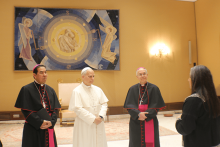
After a private audience with Catholic leaders from El Paso, Texas, at the Vatican, on Oct. 8, Leo said he would like the U.S. Conference of Catholic Bishops to issue a formal statement. His appeal followed recent comments questioning the consistency of some American Catholics’ moral stances: “Someone who says that ‘I’m against abortion, but I’m in agreement with the inhuman treatment of immigrants in the United States,’ I don’t know if that’s pro-life.”
Alongside Bishop of El Paso Mark J. Seitz, Hope Border Institute, a grassroots organization rooted in Catholic social teaching, presented the pope with a stack of letters from immigrant community members. The letters expressed both the worries and hopes of migrants in today’s political climate and were received with emotion, said Astrid Liden, Hope’s communications officer.
Over a grainy international phone call, I could hear people singing at St. Peter’s Square as I spoke with BBC journalist Mark Lowen about Pope Francis. It was April 21, and I, along with two other queer Catholic advocates, Max Kuzma and Simon Fung, were reflecting on what Francis had meant for each of us and our hopes for the future of the Catholic Church.
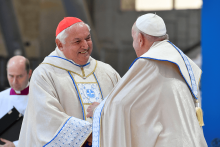
An old Italian saying warns against putting faith, or money, in any presumed front-runner ahead of the conclave, the closed-door gathering of cardinals that picks the pontiff. It cautions: “He who enters a conclave as a pope, leaves it as a cardinal.”
But here are some cardinals who are being talked about as “papabili” to succeed Pope Francis, whose death at the age of 88 was announced by the Vatican on Monday.
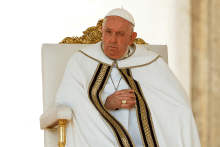
Before he was hospitalized for double pneumonia, Pope Francis was battling firm resistance from some of his own cardinals about how to plug a widening gap in the Vatican’s finances.

Directed by Oscar-winner Edward Berger (All Quiet on the Western Front), Conclave begins when the pope dies unexpectedly. To elect the next pontiff, the College of Cardinals convenes in the Vatican, entering total seclusion from the outside world until a majority vote can be reached. But if God is working through the cardinals, so too is something darker: ugly hunger for power and bitter ideological divide.
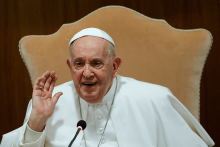
The pope has again used a highly disparaging word against gay people for which he had already apologized last month, ANSA news agency said on Tuesday.
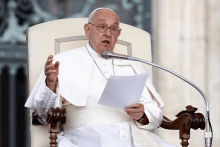
Pope Francis, widely quoted as having used a highly derogatory word to describe the LGBTQ+ community, did not intend to use homophobic language and apologizes to anyone offended by it, the Vatican said on Tuesday.
When Pope Francis called for a global ban on surrogacy during a foreign policy address last month, non-Catholics, especially those in the United States, may have felt the subject came out of nowhere. Surrogacy is medically and legally regulated in the U.S. as an intervention recommended by the American Society for Reproductive Medicine for those who do not have the ability to become pregnant or carry a pregnancy to term. But the pope’s concern was beyond the ethics of procreation, as he positioned his pronouncement within the context of a global economy and exploitation of women.
“A child is always a gift and never the basis of a commercial contract,” Francis said. “At every moment of its existence, human life must be preserved and defended; yet I note with regret, especially in the West, the continued spread of a culture of death, which in the name of a false compassion discards children, the elderly and the sick.”
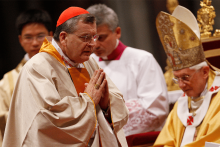
Pope Francis has removed some of the Vatican privileges of conservative American Cardinal Raymond Burke, including a large, subsidized apartment and his salary, a senior Vatican official said on Tuesday.
Hundreds of Catholic institutions around the globe have announced plans to divest their finances of oil, gas, and coal to help fight climate change since Pope Francis published his landmark encyclical on environmental stewardship in 2015 urging a break with fossil fuels.
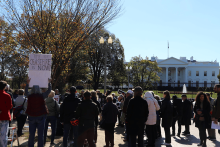
Fifty protesters gathered for a “pray-in” in Lafayette Square on Thursday afternoon, holding signs directly facing the White House that said, “Catholics say ceasefire now.”
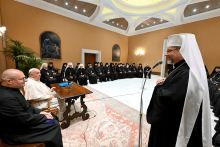
Ukraine’s Eastern Rite Catholic bishops bluntly told Pope Francis at a meeting on Wednesday that some of his comments about Russia had caused great pain and were being used by Moscow to justify a “a murderous ideology.”
Pope Francis has a respiratory infection and will need to spend “a few days” in hospital for treatment, the Vatican said in a statement on Wednesday
Almost four years after Pope Francis issued tougher measures against sexual abuse in the Catholic Church, the Vatican announced on Saturday expanded and clearer rules
Nicaraguan President Daniel Ortega has ordered the closure of the Vatican Embassy in Managua and that of the Nicaraguan Embassy to the Vatican in Rome, a senior Vatican source said on Sunday.
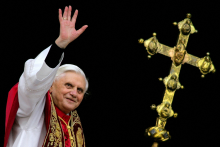
Former Pope Benedict, who in 2013 became the first pontiff in 600 years to resign, died on Saturday at age 95 in a secluded monastery in the Vatican where he had lived since stepping down.
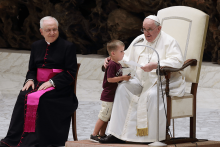
Pope Francis was delighted when a young boy stormed onto the stage during his general audience on Wednesday, in which he addressed the topic of dialogue between young and old people.
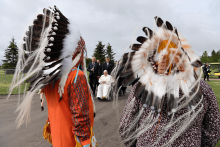
Pope Francis on Monday made good on a promise to apologize to Canada’s native people on their home land for the Church’s role in schools where Indigenous children were abused, branding forced cultural assimilation “evil” and a “disastrous error.”