immigrant rights
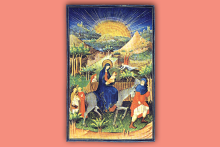
UPON READING THE news that the U.S. deported hundreds of migrants to El Salvador, I felt ill. Neri José Alvarado Borges had studied psychology and worked in a bakery. Luis Carlos José Marcano Silva is a barber with the face of Jesus tattooed on his stomach. As the daughter of an immigrant, I wept, thinking of their fear and families’ grief. In the face of a government that thrives on cruelty, we need resources that help us preserve our human capacities for hope, courage, and compassion.
Recently, I’ve found comfort in paintings from books of hours, a form of prayer book popularized in Europe in the 1200s to make contemplation simpler for the laity. These paintings, known as “illuminations,” are distinctive and, according to the Metropolitan Museum of Art’s Wendy Alpern Stein, include “some of the greatest paintings and drawings of the late Middle Ages and early Renaissance.”
Once the most published texts of their time, books of hours were often bespoke, commissioned by monarchs and aristocrats and crafted by luminary artists of the day. Each unique book of hours contains a liturgical calendar, gospel excerpts and psalms, and “The Hours of the Virgin,” which Stein calls “the heart” of the form, “a series of prayers and praise for the Virgin Mary [recited] at the eight canonical hours.” The books were made and written by hand. The illuminations include beautiful borders, often of botanical elements like ivy or flowers that decorate the edges of each page. Passages of text begin with an ornately decorated and framed capital letter. And the illustrations that complement the prayers and readings are drawn with vibrant colors and metals like gold and silver.
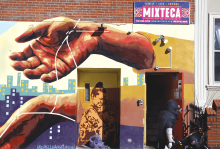
WE SEE HIGH levels of stress and anxiety in immigrant communities. At Mixteca, we provide direct services for immigrants, like “know your rights” and legal clinics, but we incorporate mental health components. People may be waiting to meet with the lawyer, and we have little packages with lavender, a stress ball, something you can smell, touch, and hear to activate the five senses. We get feedback from the community like, “I don’t know why, but I feel better when I meet with my lawyer here.” We create spaces where the community feels safe, or safer than other places.
I don’t know if we are safe at this point. People ask, “Can I send my daughter to school?” [We see] kids whose parents were deported struggling to make a living. People ask “Can I go to the hospital and have my surgery? I need it, but I don’t want to get deported.” Others say, “I’ve been in this situation for many years. Immigrants are under attack every day from the day I got here.”
Being here in the front line, it’s heavy on us as well. Imagine listening to one person and then the next one, and the next. As an immigrant, I feel honored; this is what I want to do with my life. I don’t have to push my team to take care of others, but I have to push them to take care of themselves, because I know that is the hardest part for us. I burn palo santo. It was used by my grandma to clean a space. The smell really helps me to center. I usually do it in the morning, or any time I feel like the day is really heavy: Just burn my palo santo and bring my ancestors, my abuela and whoever needs to be here to support with the heaviness of the work.

For the ninth year in a row, Sojourners honors Women’s History Month with an article highlighting revolutionary women shaping the church. This year’s list includes theologians, filmmakers, illustrators, musicians, pastors, and academics. Our nominees engage in diverse work, but these women are united through a fearless pursuit of justice. They lead through empathy. They build community. They fight against rising tides of hopelessness in our world with messages of radical and inclusive love.
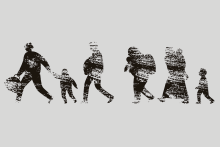
I KNEW ALMOST immediately it was bad news.
“Maria was separated at the border from her auntie,” my friend said in a phone call. “We don’t know where she is. Her auntie was sent back to Mexico and we think is being held by a drug cartel. They separated them under Title 42.”
I felt sick. Four-year-old Maria (not her real name) and her aunt were fleeing violent circumstances. They arrived at the U.S.-Mexico border to exercise their legal right — protected by both international and U.S. law — to request asylum, as other members of Maria’s family had done prior to the COVID-19 pandemic.
In March 2020, everything changed. The Trump administration, through the Centers for Disease Control and Prevention (CDC), invoked a rarely used subsection of public health code called Title 42 to close U.S. borders to asylum seekers and unaccompanied children under the guise of preventing the spread of COVID-19. It made that decision against the advice of many public health experts, including some within the CDC, who agreed there was no public health rationale for a ban on asylum seekers as a group. Though the border remained open to truckers, temporary workers, students, and others, border agents turned back asylum seekers to Mexico or their home country.
According to a report by The Intercept, the agents took Salazar behind an abandoned Walmart where they shackled him and emptied his pockets before transporting him to the South Texas Detention Complex in Pearsall. Once there, Salazar says he was taken to a room where the FBI probed him for information and told him his immigration status had been revoked because he was a “bad person.” When he refused to talk to them, he was transferred to the Webb County Detention Center in Laredo, Texas.
The Teamsters' decision to actively protect immigrants stems from one of its members, Eber Garcia Vasquez, 54, was deported in August to Guatemala with no criminal record and two pending green card applications for him and his family.

The sweep comes in the wake of nationwide ICE raids of nearly 100 7-Eleven stores that resulted in dozens of arrests less than a month ago.

An ICE officer told the Daily Camera that Jurado’s detainment is not related to Encalada Latorre’s immigration status or her taking sanctuary. But some, including Encalada Latorre and Janette Vizguerra, a prominent immigrant rights leader who was previously in sanctuary, believe that this is a tactic to put pressure on Latorre to leave sanctuary.

Last month, a 10-year-old undocumented girl who was traveling by ambulance to a hospital in Texas was stopped by Border Patrol agents who then trailed her to the hospital, guarded her during gallbladder surgery and then took her into custody. She was released 10 days later after a national outcry.
Today is a day of hope for immigration reform. More than 500 immigration activists and faith leaders have gathered in Washington, D.C. to call on Congress to act on immigration reform. They represent the tens of thousands of you reading SojoMail today who, over the past few years, have taken action on immigration reform.