
I’ve been listening to Solomon Ray’s music on and off for the past few weeks. Ray, for those unaware, is an artificially generated “Mississippi-made soul singer” created by self-proclaimed “TPUSA contributor” Christopher “Topher” Townsend topping the Christian and Gospel charts.
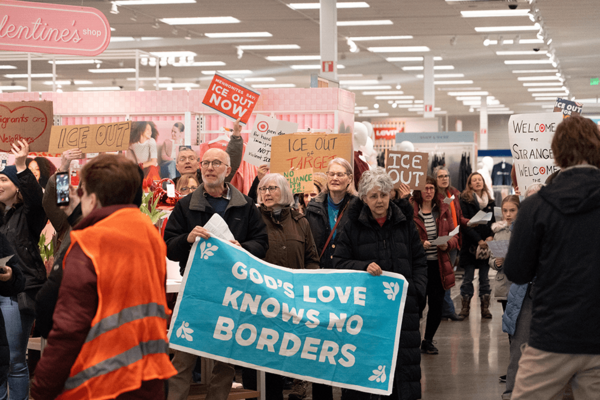
When Mennonite Action formed to oppose the U.S. support for Israel’s occupation of Palestine, they never imagined they’d soon be opposing occupation in their own backyard. As federal immigration forces descended on Minneapolis and other cities across the nation, Mennonite Action worked to defend their neighbors, oppose unjust immigration policy, and educate Anabaptist participants on the connection between Christian Zionism and Christian Nationalism.
Since establishing itself with just seven volunteers meeting virtually, Mennonite Action has grown to five paid staff members, four volunteer leaders, and now holds national leadership retreats annually. After its November 2024 retreat following the presidential election, the group felt that public action against new immigration enforcement would be necessary. Sarah Nahar, the staff supervisor and a member of the Mennonite Action steering committee, said the leadership team and staff worked on solidifying organizational language while remaining steadfast in their commitment to public action in support of Palestinians.
“There are deep, intertwined mechanisms of power and oppression operating in the U.S.-Israeli occupation of Palestine, and many of us in the room knew that,” Nahar said. “One of the things that we worked really hard to do in that meeting was to talk about how this wasn’t a transition or a shift.”

Too often, our dominant approaches to poverty see people as objects of aid or control rather than as individuals with agency. We overlook and underestimate people, and in doing so we stifle enormous human potential.

After I saw that President Donald Trump had ordered attacks on Iran, I thought about the passage in 1 Samuel in which the Israelite elders get fed up with being run by a series of judges and ask for a king. The prophet Samuel, after praying over the matter, urges them to rethink the request, reciting a laundry list of all the things a king will do to the people.

It might seem like the mission to abolish Immigration and Customs Enforcement is unique, but there are important parallels between this movement and the 19th-century fight to abolish slavery. As we seek to follow the gospel and make a new world, it is worth turning to abolitionists from the 19th century as we look for examples of how to win the fight against tyranny and wickedness, even if it takes longer than our lifetime.
The Fugitive Slave Act of 1850 required U.S. marshals in free states to capture people who were attempting to liberate themselves from slavery. While the act was meant to assuage the Southern malcontent at the admission of California as a free state in the same year, it prompted widespread protests in Northern cities from abolitionists who sought to prevent the enforcement of what they saw as a fundamentally evil law.

I thought about skipping President Trump’s State of the Union address, but out of a sense of civic duty—or perhaps misplaced hope—I watched it anyway. In what became the longest such address in U.S. history, Trump’s joint address to Congress devolved from political theater into vicious partisan baiting and derision.

In the summertime, the light darts through the slits in the blinds all gold and sudden—no gentle fade through purple and blue and gray to get you used to the idea of another day. I wake and listen to Dan breathe next to me. We stopped setting an alarm a long time ago.
Somewhere between 8 and 9, when the songbirds have settled down, I formulate my excuse:

I remember a distant past, almost too faint to recall with clarity. That season, so long ago, marked by the COVID-19 pandemic, has since been eclipsed by the pressing concerns of our day. We now live with the backdrop of global shifts, political instability, war, and domestic turmoil. But when I think back on that time, one overwhelming emotion returns with acuity: a deep concern for the safety of my friends and loved ones. Unfortunately, that same fear has crept back with suffocating weight due to rising measles cases in the U.S. But this time, the demographics I am most concerned with are not the elderly or those with preexisting conditions. I am most concerned for the most vulnerable among us: our children.
Since the first documented case in South Carolina in October 2025, the state has reported 979 cases, and the numbers are rising. The surge in outbreaks threatens to reverse the Centers for Disease Control and Prevention’s declaration that measles was eliminated in the United States in 2000. At this rate, we are on the verge of losing elimination status. The moral crisis deepens with reports that two detainees in an Immigration and Customs Enforcement detention center have tested positive for measles.

I’ve dedicated a major part of my life and career to the cause of foreign aid, so it was heartbreaking to see it scorned and set back by the Trump administration. And yet, this heartbreak pales in comparison to the needless suffering loss of life and careers caused by the administration’s reckless and cruel dismantling of the U.S. Agency for International Development and evisceration of foreign aid.

As artificial intelligence-generated songs and musicians multiply across streaming platforms, Contemporary Christian music audiences and creators are reckoning with the technology’s meaning for the booming genre, the opaque industry, and the very heart of Christian music.
In November 2025, Christianity Today reported on Solomon Ray—an AI-generated artist who boasts 499,000 listeners on Spotify. But Ray is not the only CCM AI artist garnering thousands of listeners. Minimal artist descriptions, quick release schedules, no contact methods, no website, and no tours or physical appearances are all indicators of potential AI-generated artists, and CCM has no shortage. Smaller accounts still have thousands of monthly listeners, including the likes of Jaxon Maverick Phoenix at over 39,000, The River Sons 59,000, and Glory in the Ruins 68,000.
Their music is nothing elaborate and draws firmly from the CCM tradition: “I’ve read the words, I know they’re true but some days they feel far from view / I’m still holding on to what you said, even when the lies scream loud instead,” are some lyrics to “Faith Over Fear,” by The River Sons. The band’s page description is equally vague.