My life’s work centers on solving problems of poverty in ways that enable human dignity. Our systems — both our financial system and our system of traditional charity — are not designed for dignity. Markets are designed for profit; they are powerful, yet they often overlook and sometimes exploit low-income people. Top-down approaches to charity and aid are designed to provide short-term help but often create dependency, which is the opposite of dignity.
I learned these lessons experientially — from working on Wall Street in the 1980s, then starting Rwanda’s first microfinance bank. I saw it, too, in the forces that caused good people to do terrible things in the Rwandan genocide. Human beings thrive when we know we matter, when we have choice over our decisions and a sense of agency.
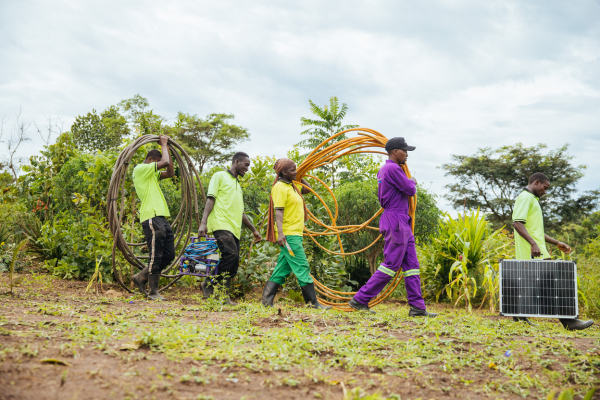
Those early lessons motivated me to found Acumen in 2001. I wanted to build an institution that creates solutions with and for people, not top-down programs designed afar. The idea was unconventional: raise philanthropic capital and invest it — patiently — in entrepreneurs serving low-income communities. Instead of giveaways, we would make long-term investments in businesses delivering things people need: energy, food, healthcare, education and housing in places where governments and traditional aid were falling short.
Too often, our dominant approaches to poverty see people as objects of aid or control rather than as individuals with agency. We overlook and underestimate people, and in doing so we stifle enormous human potential. I saw this pattern again and again in traditional aid — cookstoves, mills and other devices distributed “to help” without asking people what they wanted or needed. Many of those programs failed because they started with assumptions rather than listening.
We at Acumen start with patient capital. We use philanthropy to support investments that may take 10 to 15 years to mature. The purpose is to give entrepreneurs time to build trustworthy, viable companies. We measure success in human terms as well as financial ones: Are people better off? Do they have more choice? More income? More resilience?
The average customer served by Acumen’s companies lives on a few dollars a day. They live in markets where infrastructure is weak, distribution is hard and risk is real. There are trade-offs between risk, return and impact, and we try to be honest about that. But we have also learned that when the right entrepreneur with the right character is paired with the right kind of capital — patient, risk-tolerant and grounded in values — new markets can emerge to serve people who have long been left out.
In the past 25 years, Acumen has invested hundreds of millions of dollars in enterprises that have reached more than 700 million low-income people in clean energy, agriculture, education and health care. Our best companies are those that earn trust by continually showing up, listening to voices unheard, fighting the status quo and executing with operational excellence. In time, both founders and those they serve transform.
I think of a grandmother in rural Kenya who bought a simple solar lantern. She didn’t want charity; she saved up to be a customer. When I asked how the product could be improved, she immediately offered suggestions. She saw herself as a partner. The company had to earn her trust, and she had earned the right to give feedback. In that exchange were the seeds of mutual dignity.
The work often reminds me of a murmuration, the way thousands of starlings move together in the sky, responding to one another in real time. No single bird directs the pattern, yet the whole shifts together. Real change for people living in poverty works in a similar way. It doesn’t come from one institution acting on others, but from many people — entrepreneurs, customers, investors, communities — each with voice and agency, shaping solutions together. When people are seen and heard, their individual choices add up to movements that are more resilient than any plan designed from afar.
The opposite of poverty is dignity, or the freedom, choice and the power to influence one’s own life. Basic needs matter, but if solutions strip people of agency, we may meet needs while undermining dignity. Today, we also see how climate change is disproportionately impacting the most vulnerable, pushing people back into poverty and deepening uncertainty. That makes dignity even more important. When farmers have tools that increase income and stability, they can withstand shocks. When systems are designed from a place of shared humanity, they become more resilient and more humane.
The work ahead for all of us trying to solve problems of poverty is not simple. It requires humility, creativity and a willingness to rethink risk — not just financial risk, but social and moral risk as well. We have plenty of money in the world. What we lack is the courage and will to deploy it differently.
The question I keep coming back to is: What is the risk of not daring? When we invest in people who have been overlooked and underestimated, we build a world where more people have the freedom and choice to shape their own lives. That’s something worth fighting for.
To learn more about how patient capital works in practice, I invite you to watch Journey of a Dollar to see what becomes possible when a dollar is invested by Acumen.
Jacqueline Novogratz is the founder and CEO of Acumen, a global organization that fights poverty and builds dignity through patient investment in companies and leaders.