“We work in the dark — we do what we can — we give what we have. Our doubt is our passion and our passion is our task. The rest is the madness of art." - Henry James from The Middle Years
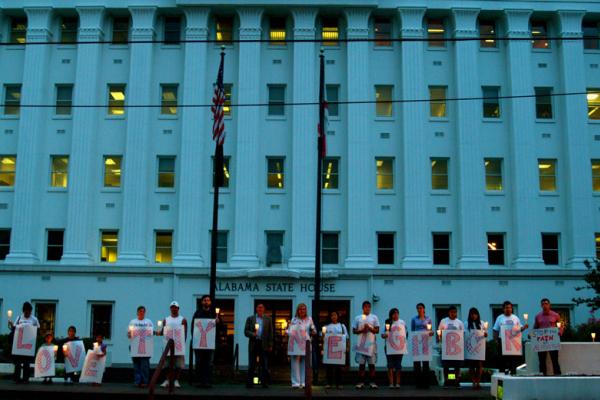
Here we are today, caught in an economic slump, finding ways to once again dehumanize those that we encouraged to come. The very people who have harvested our food, built our homes and served us over the past 30-plus years, we now declare criminals.
In my beloved Alabama, where 3 percent of the population (largely Hispanic) is estimated to be undocumented, our state government has created the harshest and most egregious anti-immigrant laws in the country. Rep. Micky Hammon and Sen. Scott Beason, sponsors and writers of HB56, stated that these laws would create an atmosphere of “self deportation.” I can only wonder how Native Americans might feel about that concept.
HB56 — passed by the legislature and signed into law by Gov. Robert Bentley in June 2011 — has now been replaced by HB658. The stated purpose of the new legislation was to simplify HB56 and make enforcement less complicated. In the process, stricter guidelines and harsher treatment were incorporated while simplification was ignored.
I am compelled to look at this law as a child of God within the Christian faith, accepting that all people in this world are my brothers and sisters, created by the God who breathed life into me and into them, making us one family.
Pope Benedict XVI is set to visit Philadelphia in 2015 for the Vatican World Meeting of Families. This event, which happens once every three years, is a time of discussion and fellowship around issues like the definition of marriage, contraception, and abortion.
Read more about the Pope's visit from USA Today's Faith and Reason page.
 An interesting review of David Ignatius' new book in The Atlantic, which suggests that:
The question that President Obama, who has admitted direct, routenized involvement in creating the drone 'kill list', should ponder is what will happen as the barriers to entry on drone technology fall enough so that an adversary's drones can be deployed against U.S. and allied forces and interests.
Read more here
A fascinating opinion piece by Thomas Edsall on The New York Times' Campaigns Stops blog:
Is capitalism compatible with Christian values? By two to one, 53-26, Democrats believe that capitalism and Christianity are not compatible. Republicans, in contrast, believe there is no conflict, by a 46-37 margin. Tea Party supporters are even more adamant, believing that capitalism and Christian values are compatible by a 56-35 margin.
Read the full piece here
A treat from Andrew Sullivan's The Dish as he interviews E.J. Dionne on his latest book, Our Divided Political Heart: The Battle for the American Idea in an Age of Discontent:
Watch the full interview and read Andrew's take on it here
 Who is targeted for killing in U.S. drone strikes? Counterterrorism adviser John Brennan claimed in his recent speech that:
"when considering lethal force we ask ourselves whether the individual poses a significant threat to U.S. interests. This is absolutely critical, and it goes to the very essence of why we take this kind of exceptional action. …We are not seeking vengeance, rather we conduct targeted strikes because they are necessary to mitigate an actual ongoing threat, to stop plots, prevent future attacks and save American lives."
But Greg Miller reported Sunday in The Washington Post
"The quickening pace of the U.S. drone campaign in Yemen this year has raised new questions about who is being targeted and why. A review of strikes there so far suggests that the Obama administration has embraced a broader definition of what constitutes a terrorism threat that warrants a lethal response.
In more than 20 U.S. airstrikes over a span of five months, three “high-value” terrorism targets have been killed, U.S. officials said. A growing number of attacks have been aimed at lower-level figures who are suspected of having links to terrorism operatives but are seen mainly as leaders of factions focused on gaining territory in Yemen’s internal struggle."
A former high-ranking counterterrorism official said that targets must still be a “direct threat” to U.S. interests. “But the elasticity of that has grown over time,” he added.
Fifteen dead in Pakistan on Monday:
The third US drone strike in as many days in Pakistan has raised the three-day death toll in the aerial attacks to at least 27, according to Pakistani intelligence officials. Monday's strike in the Hesokhel village of North Waziristan's tribal areas, was said to have targeted a hideout for fighters, officials said. The latest strike, which officials said had killed 15 people, was the seventh in a span of less than two weeks.
At least 10 die in Sunday Pakistan strike:
A US drone strike in Pakistan's frontier tribal areas has killed 10 suspected fighters, according to Pakistani officials. Sunday's strike was the sixth such attack in two weeks, despite ongoing demands by Islamabad for aerial strikes on its territory to stop.
Pakistani intelligence officials said four missiles were fired at the village of Mana Raghzai in South Waziristan near the border with neighbouring Afghanistan. The suspected fighters had gathered to offer condolences to the brother of a commander killed in another drone attack one day earlier.The brother was among those who died in the Sunday morning attack.

When her 91-year-old aunt passed away in 2010, Diane DiResta videotaped the eulogies to create a record of the moving words spoken. She wasn't ready to talk about her aunt at the service, so she used an online tool for publishing audio to record her thoughts, then e-mailed the audio file to close family.
And when a cherished 89-year-old uncle died in Las Vegas in February — and there was no funeral service to follow — the New York City resident again turned to technology.
"Since there was no way for the family to share his life and express their grief together, I created a blog," she said. "I added pictures, and family members were able to post their memories of him."
This is Mourning 2.0. Technological advances have dramatically altered how we grieve for and memorialize the dead.
In this new era, the bereaved readily share their sorrow via Facebook comments. They light virtual candles on memorial websites, upload video tributes to YouTube and express sadness through online funeral home guest books. Mourners affix adhesive-backed barcodes or "QR code" chips to tombstones so visitors can pull up photos and videos with a scan of a smartphone.
WASHINGTON — The 200 or so African-American pastors gathered here for the Conference of National Black Churches feel strongly about the topic of gay marriage, some for, many against. But there's one thing nearly all of them agree on.
The issue won't distract black voters from supporting President Obama's reelection.