
The morning after the Spurs won Game 5 of the NBA’s Western Conference semifinals, I woke up, still reveling in the victory. As a born-and-raised San Antonian and die-hard basketball fan, the playoffs are something of a holiday season. Before leaving my bed, I added an infant Victor Wembanyama jersey to my baby registry and turned to Instagram for some game highlights.
There, I stumbled across a post by the Salesian Sisters of St. John Bosco in San Antonio, a Catholic order devoted to educating and supporting young people. Behind the sisters was a print of Leonardo da Vinci’s The Last Supper, but their eyes were turned to another work of art: The Spurs up 52-37 in the second quarter. The sisters were all standing and clapping. Each wore their white habits, but three of them also wore Spurs jerseys (Tim Duncan, Tony Parker, and Manu Ginobili—a holy trinity to Spurs fans) from a golden era of Spurs basketball, an era I pray we’re returning to.
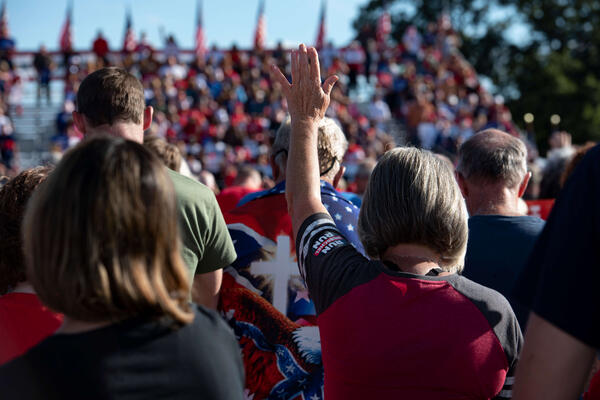
On Sunday, May 17, members of the Trump administration will participate in “Rededicate 250: National Jubilee of Prayer, Praise & Thanksgiving,” a nine-hour prayer festival on the National Mall in Washington, D.C. The purpose of this festival is to call for America to rededicate itself to its Christian roots.
So, for what feels like the millionth time, a chorus of researchers, historians, and journalists all repeat: America’s founders didn’t want it to be a Christian nation.
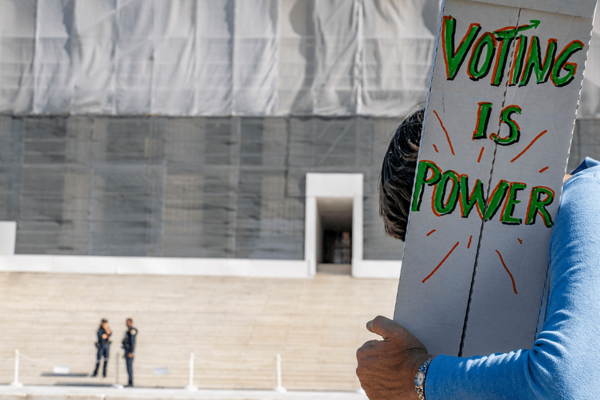
This Saturday, Black leaders are inviting Americans of all races and faith traditions to rally across the nation to protect minority voting rights in the aftermath of a recent Supreme Court decision weakening the 1965 Voting Rights Act.
“We believe that the gutting of the Voting Rights Act is the latest of many red flags and alarms that the state of our country is not well,” California pastor Rev. Michael McBride told Sojourners this week.
McBride, one of the key organizers for Saturday’s National Day of Action for Voting Rights, said churchgoers in particular “have a moral responsibility … to lift up our voice, that this injustice not be unmet by the faithful among us.”
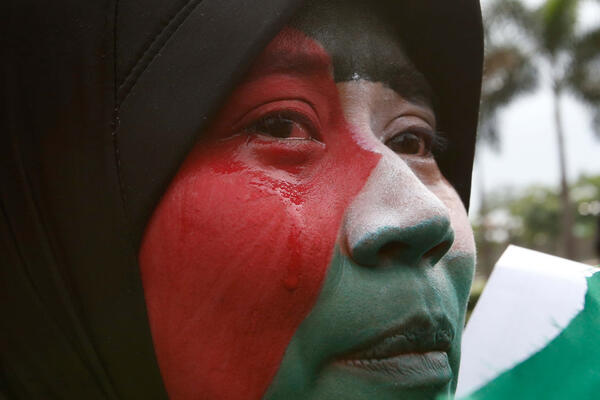
On April 19, the Armed Forces of the Philippines killed 19 individuals and forcibly displaced more than 653 residents in Negros Occidental, an island in the southern Philippines. The AFP defended their operation as necessary “to confront armed groups that threaten local communities,” while activist group Bagong Alyansang Makabayan (New Patriotic Alliance) contends that the attack constituted “indiscriminate firing and strafing.” For Bagong Alyansang Makabayan, it is another example of the Manila government’s fascist violence against the poor and unarmed civilians.
On April 20, a day later, the Israel Defense Forces launched airstrikes, killing five Palestinians in Gaza and leaving many others wounded. The Peace Research Institute Oslo reports that at least 75,200 people have been murdered by Israeli forces since October 2023. Indeed, while separated by thousands of miles, there is an intimacy that binds Palestine and the southern Philippines together—an intimacy forged through the destructive imperialism of the United States.
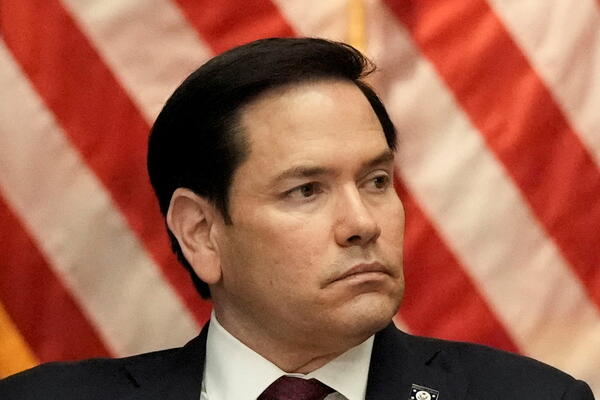
When the U.S. Department of Justice released its report on “eradicating anti-Christian bias” last week, the argument it sought to settle had long hardened along familiar fault lines. For some, the document confirmed what they see as a years-long sidelining of Christian voices in public life. For others, it read less like a civil rights diagnosis and more like a reframing of political grievances as religious persecution.

The table is a tangible and salient image of the common good. Think of it this way: we spend most of our lives around tables. We gather around them to eat. We sit at them with a warm cup of chai. We stack books on them at the local library. They’re attached to the back of every seat on an airplane and create community spaces on train cars. Tables, like the possibility of a common good, are all around us. They exist in ordinary spaces where people gather, converse, read, eat, and worship. The table represents the practice of intentional hospitality—of making room when we are under no obligation to do so.
When we center our communities around the table, we consider how much food is available, how many chairs can fit comfortably, what each person is bringing, and how to make space when someone knocks at the door asking if there is room for a few more. A table offers us a sacred place of belonging with an invitation to join. When neighbors are brought together in this way, we can completely and radically reimagine what our common life looks like.
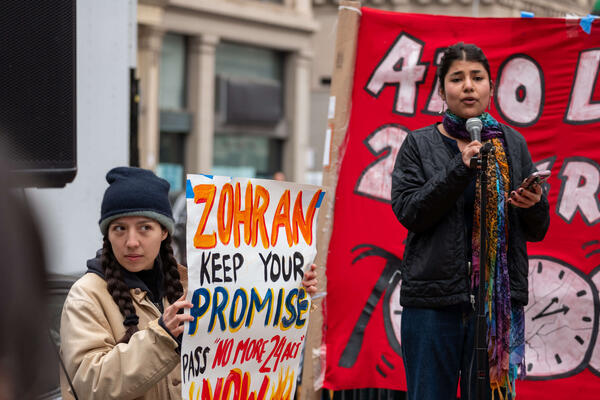
In New York City, many home care workers work 24-hour shifts for up to five days straight, and are only paid for 13 hours of each shift. If they do not agree to this, they risk losing their job.
Home care workers provide 24-hour, live-in care for elderly and disabled patients, as defined by Medicaid. Home care workers feed, bathe, and administer medicine to patients. These workers attend to their vulnerable patients’ unpredictable needs around the clock. But because insurance companies like UnitedHealthcare and New York Healthfirst receive fixed public Medicaid payments to manage care, they make a profit by hiring only one worker for an entire shift.
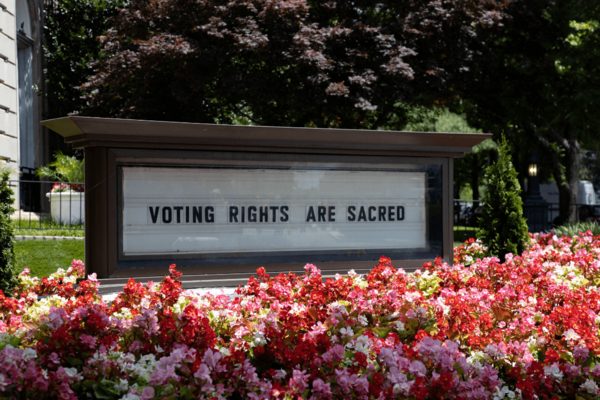
A recent ruling from the U.S. Supreme Court reminded me of Jesus’ words at the end of the Sermon on the Mount: “Watch out for false prophets,” Jesus says. “They come to you in sheep’s clothing, but inwardly they are ferocious wolves. By their fruit you will recognize them” (Matthew 7:15-16).
Last week, in Louisiana v. Callais, the court voted 6-3 along ideological lines, rendering the Voting Rights Act practically meaningless. When it was passed in 1965, the act was the crowning achievement of the Civil Rights Movement. The law created enforcement mechanisms to uphold the 15th Amendment and prevent states from discriminating against Black and other minority voters. Section 2, the specific provision weakened by the court last week, prohibits voting procedures—including districting maps—that hinder voter participation on the basis of race. In 1982, Congress amended this section, making it easier to challenge voter district maps that, intentionally or otherwise, diluted the power of minority voters.
There are moments when a system fails so completely that it reveals its design. For me, that moment was in 2005 when Hurricane Katrina struck the Gulf Coast. I watched from Newark as floodwaters submerged New Orleans, Black families were stranded on rooftops and packed into the Superdome while the state and national media moved with a deadly indifference. As a young adult, I learned something important: Systems don’t collapse; they are disinvested in and allowed to fail when people are deemed expendable.
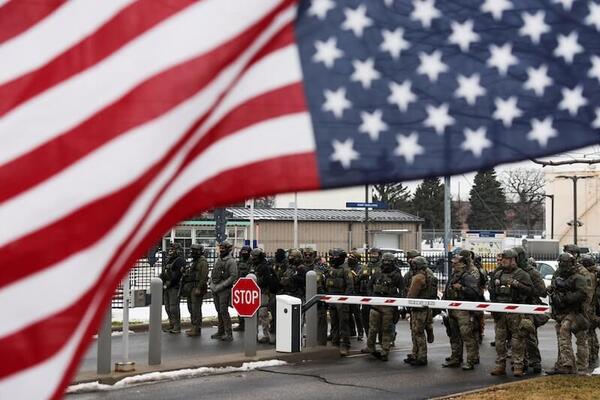
It was 23 years ago that Rev. Jeremiah Wright delivered one of the most profound and misunderstood sermons in U.S. history. In “Confusing God and Government,” delivered on Palm Sunday in 2003, Wright tells the story of race and war throughout U.S. history, arguing that the country had failed Black and Indigenous populations. Toward the sermon’s climactic end, Rev. Wright stated, “No, no, no. Not ‘God Bless America;’ God Damn America! That’s in the Bible, for killing innocent people. God Damn America for treating her citizen[s] as less than human. God Damn America, as long as she tries to act like she is God and she is supreme!” This moment would cause controversy during the 2008 presidential campaign, when Barack Obama, who attended Wright’s church, was accused of anti-Americanism.
But Wright was right. If the United States, as a nation, has a soul, it is currently hellbound.