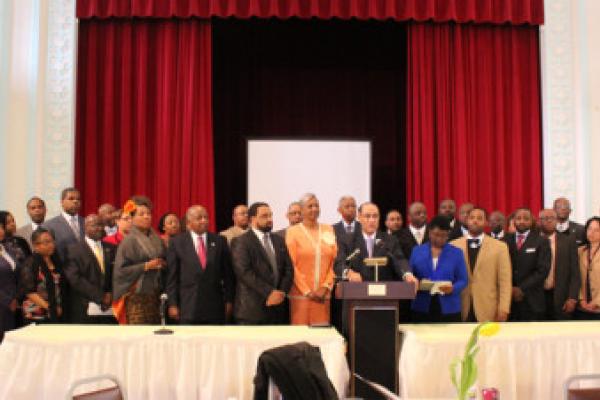
WASHINGTON — Black clergy have launched a new coalition to fight gun violence, saying they are undeterred by the recent failure of legislation on Capitol Hill and all too aware of the problem of gun violence.
At meetings held Tuesday in Washington and Los Angeles, supporters of the African-American Church Gun Control Coalition called gun violence “both a sin and a public health crisis” and committed to a three-year action plan of advocacy, education and legislative responses.
“As people of God and as faithful members we have the obligation to stir the world’s conscience and to call on our nation’s decision makers to do what is just and right,” said the Rev. Carroll Baltimore, president of the Progressive National Baptist Convention, which convened the coalition.
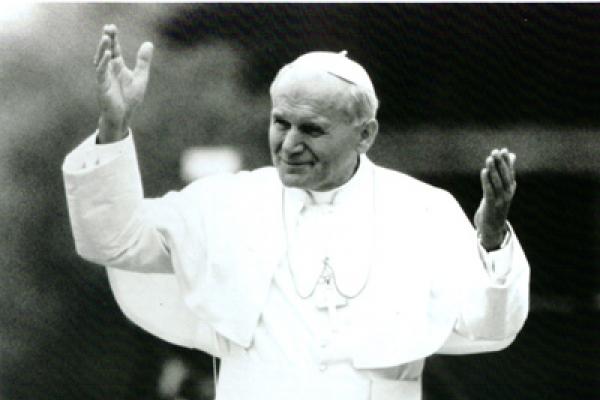
Reports this week that the late Pope John Paul II may be on the verge of sainthood after a second miracle was credited to his intercession aren’t a huge surprise: When he died eight years ago, crowds were already clamoring for his canonization, and Pope Benedict XVI quickly waived the usual five-year waiting period to get the process rolling.
But the news that Pope Francis, just six weeks on the job, has cleared the way for the long-stalled canonization of martyred Salvadoran Archbishop Oscar Romero is a stunner that sends another important signal about the new pope’s priorities.
“Sainthood is often as much about politics and image as anything else,” said the Rev. Harvey Egan, a Jesuit priest and professor emeritus of theology at Boston College.
“It’s not surprising to me that this present pope being from South America, having the same inclinations as Romero, would unblock the process and say ‘Push his cause through,’ and I think rightly so.”

When a distressed child hugs a teddy bear, there is a moment of innocent comfort that not only soothes the child but the grownups around her, too.
No wonder, then, in the wake of the Dec. 14, 2012, mass shooting in Newtown, Conn., the donation of choice for many people was a teddy bear. The bears — huge, tiny, handmade, store-bought, rainbow-colored, traditional brown — began arriving within 24 hours of the tragedy. They came from churches, children's groups, Facebook campaigns, car dealerships, and individuals across the globe.
Undeniably, for some of the children in Newtown — and adults, for that matter — a new stuffed animal was just the right gift at the right time.

Stories are what change the world, more than just ideas. And that’s what I am seeing and hearing on the road — stories that will change people for the common good. Nobody outside of Washington trusts Washington because there are no more human stories — just money and the calculations of power.
But even Washington can be affected by the stories outside of Washington — take immigration reform for example, which will happen despite the political paralysis. People of faith are telling their stories of conversion to what their Bibles say about “the stranger.” They are telling stories of new relationships with their “undocumented” brothers and sisters. And their stories are changing Washington.
So rather than just offer you more “ideas” about the common good, we are going to offer you some stories about how ordinary people are creating it.
Some talented young filmmakers have created stories to inspire you. This first video tells in beautiful scenes, the story of how a group in the Dominican Republic is using a recycling program to fund senior services. It’s about community and about serving our neighbors. It is a real inspiration for working within our own spheres of influence for the good of all.
Watch. Listen. And then create your own story for the common good.
Many of today’s evangelical Christians seem to be taking to heart the words traditionally attributed to St. Francis of Assisi: “Preach the gospel at all times. When necessary, use words.”
Or at least they were at the recent Q Conference here, a gathering of more than a few of the most influential and innovative mover-shakers of the evangelical world.
Over the course of two days in a format similar to the popular TED talks, the speakers spoke passionately more about what they were doing to make the world a better place than they did about getting more butts into pews on any given Sunday.

In the wake of the Boston Marathon bombings that left three dead and more than 260 injured, perhaps none face more significant adjustments or a longer road ahead than the 14 amputees who lost a limb.
For these victims, the path forward involves relearning almost everything, from getting out of bed to getting in a car. Whether they go on to lead satisfying lives depends largely on how they handle the spiritual challenges at hand, according to amputees and researchers.
Losing a limb is like losing a family member: It involves grief and mourning, according to Jack Richmond, a Chattanooga, Tenn., amputee who leads education efforts for the Manassas, Va.-based Amputee Coalition. When one’s body and abilities are radically changed, questions of meaning are suddenly urgent: Why did this happen? Why am I here?
“You’re wondering: Why did I live?” said Rose Bissonnette, an amputee and founder of the Lancaster, Mass.-based New England Amputee Association, a support organization for amputees.
Conservative and liberal religious leaders may not agree on much, but both are expressing displeasure with the Boy Scouts’ proposal to accept gay members but reject gay leaders.
The Boy Scouts of America released its draft proposal on April 19 that will be voted on at its annual meeting in May.
“No youth may be denied membership in the Boy Scouts of America on the basis of sexual orientation or preference alone,” reads the proposed resolution, which also notes that the Scouts “will maintain the current membership policy for all adult leaders of the Boy Scouts of America.”
An international consortium of nonbelievers is planning rallies Thursday outside Bangladeshi embassies and consulates to demand the release of several Bangladeshi bloggers who were arrested on charges of blasphemy.
The rallies are in support of four Bangladeshi men arrested earlier this month for “hurting religious sentiments,” a crime tied to an 1860 law that can carry up to 10 years in jail.
The four men — all bloggers — staged a sit-in at a public square demanding a ban on the country’s largest Islamic political party; Islam is the official state religion in Bangladesh.

Well, somebody had to do it: Somebody had to go buy the incessantly hyped volume Lean In by the stratospherically successful Facebook COO (and mother of two) Sheryl Sandberg, and figure out what’s behind the seemingly endless radio talk shows and online profiles — they have been following me, they have, filling up my car like clouds of incense and dinging on my phone with the book’s mantra-like subtitle, Women, Work, and the Will to Lead.
I bought this part-memoir, part self-help book on a gorgeous spring weekday when, because I work part-time, I was supposed to be home anyway. Because the pollen was getting to me and I had woken up groggy, my husband generously offered to take the children to school on his way in to work, something that Sandberg would applaud: husbands who will assume major leadership at home are a major key in enabling mothers to succeed.
I stumbled around the house in my nightgown for a while, then finally got dressed and picked up Lean In at the Target in suburban Largo, Md., which at 10 on a weekday morning, was as silent as a tomb.
I drove half an hour to have lunch with a homeschooling friend, folded laundry and cleaned some grout, picked up my children from school and finally settled down to read the book on the bench at my son’s baseball practice, as the evening sun sank over the trees.
I found myself surprised by how much I enjoyed it: Sandberg, who’s about my age and who shares some of my generational preoccupations, comes across as warm and intimate, gently self-deprecating in describing her own “monkey bar” career path (it’s not a ladder, she says, because you can move sideways too), as well as some of her mistakes.
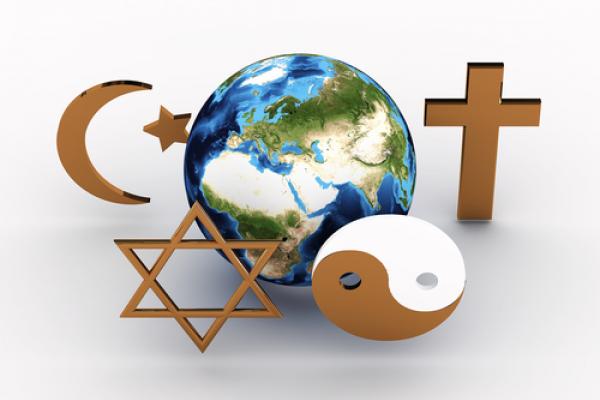
I agree with Rev. Wallis — focusing on the common good is a good step toward answering the question of how to be on God's side, and solving many of our nation's greatest points of division. In a country as diverse as ours, however, it can be challenging to know what the common good actually is. As individual participants in society, we all come to the table with different ideological structures for framing our understanding of what is commonly good. Those structures are often built around religion, philosophy, and our beliefs and understandings about existence, mortality, and the cosmos. The situation is exacerbated by the fact that we live in, arguably, the most religiously diverse nation of all time.
Yes, Jesus has called me to love my neighbor as myself, but what does that really mean when my neighbor is Mormon, Muslim, Jewish, Atheist, secular humanist, or Hindu?
Religion is often blamed for the world's greatest conflicts, and rightfully so. One doesn't have to look far to see conflict or violence that is linked to religious motivations or sentiments in some way (think the tragedy at the Boston Marathon or the Sikh man that was murdered shortly after 9/11 because he was wearing a turban). In a country that becomes more religiously diverse every day, it is easy to allow conflict to arise between different religious and non-religious groups. It is true, difference in religious and philosophical ideology can be a cause of great division. But what if I told you it doesn't have to be that way?