
A soft answer turns away wrath, but a harsh word stirs up anger. Proverbs 15:1
I often wonder how frequently people think about the impact their words have on others, specifically, on the development of human perception. The conclusion I’ve sadly reached is that when a language norm is established by dominant cultural forces —such as the news media, in our day – the truth seldom matters. Once something is spoken and repeated enough times people consider it to be true regardless of the real facts or circumstances.
One recent debate clearly illustrating the power of words is around which terminology the media should use when referencing immigrants who are in this country without authorization to work. Those outlets that use the word “illegal” defend this practice by pointing to the Associated Press’ Stylebook, which designates “illegal” as the appropriate term. Those using the term “undocumented” have noted the changing circumstances within the culture and recognize that using such inflammatory terminology only adds fuel to the proverbial political fire around the issue of immigration.

“Are Mumford & Sons as big in America as they are here?” my English friend asked me a year ago over a pint at a pub on High Street in Oxford, England.
“Uh … yea,” I replied, astonished that their popularity was even in question. “They’re huge.”
Turns out that English friend is Marcus Mumford’s cousin, and he eventually got to see how big they are in the states, spending this past summer in Arizona and scurrying over to Colorado for their show at Red Rocks. (I know I’m jealous.)
But has that popularity and success translated into a decent sophomore album? Absolutely. One way to avoid the perilous “sophomore slump” that plagues many musicians and bands these days is to stick to your guns. And that’s exactly what English quartet Mumford & Sons did with their second album Babel.
“The idea was always, ‘If it ain’t broke, why fix it?’” producer Markus Dravs told Rolling Stone.
And that’s almost exactly what audiences get on Babel. It’s as if Mumford took all the good things from their first record, Sigh No More, and channeled them into Babel.
Who blames ‘em? Their foot-stomping, banjo-plucking signature folk-rock sound has sent them to the far corners of the earth and back. It also shot Sigh No More up to platinum status, selling five million copies and nominating the band for two Grammys.
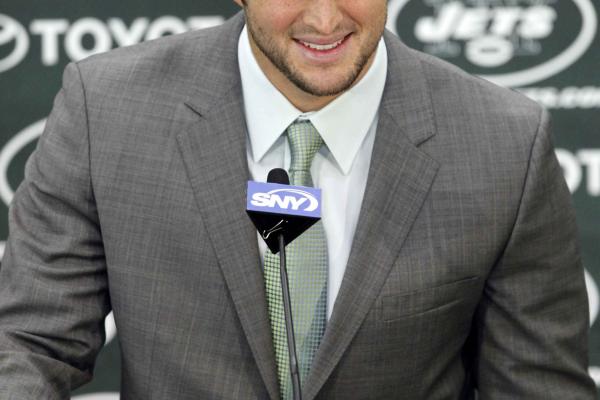
Can Tim Tebow do no wrong?
Michael Butterworth of Bowling Green State University has turned his attention to sports media coverage of Tebow, an evangelical Christian and New York Jets quarterback. The author of a forthcoming article in the journal of the National Communication Association, Butterworth talked about how Tebow coverage seldom treads beyond a “nice guy” image to delve into his faith.
Some answers have been edited for length and clarity.
Members of the Syrian opposition generally want a democratic government that protects the rights of minorities, though many also want a constitution based on Islam, according to a recent survey.
Their aspirations are important because the Obama administration has said it is refraining from arming the opposition, which has been pummeled by Syrian security forces for 18 months, in part out of fear of igniting sectarian violence. There's also fear that weapons would reach Islamist radicals who would threaten allies in the region.
The survey by the International Republican Institute, which trains democracy activists around the world, found high support for a government that "respectfully acknowledges religion" and treats all religions equally. The second-most popular model of choice was for a constitution "based on Islam."
"Most of the opposition is Sunni Muslims and they are democratically minded, but they want a government based on some kind of Islamic law or that follows Islamic guidelines," says Elizabeth O'Bagy, an analyst at the Institute for the Study of War who helped the survey writers find contacts in the opposition movement.

I was groomed in a Latino home where nail salons were viewed as rites of passage for becoming a senorita — growing young lady. Sometimes when I’m looking for some TLC, I head to my local nail salon in East Harlem. I could go to a more upscale salon, but here at Pretty Nail Salon, is where I want to be — connected to a neighborhood of ladies who have utilized storefront nail salons, beauty parlors, and hair-braiding places as makeshift therapeutic spaces where counsel and support is just as paramount to looking beautiful.
I have also discovered that nail salons are burgeoning places of policy concerns. Pretty Nail Salon has provided me with an informal education on how social policy affects the everyday day lives of working class folks. Our presidential candidates could also benefit from an appointment at Pretty Nail Salon, to listen to the local narratives and deepen their understanding of how social policy is affecting the lives of the urban poor and working class.
I first heard about the movie “Hellbound?” (coming out this fall) at Wild Goose Festival. They were offering an advance screening of the movie, and although I was just passing by the tent at the time, the subject matter stopped me where I was. A thoughtful, well-researched, accessible discussion about the history, purpose, and prospects of hell in Christian theology?
I’m in!
The film opens with reflections on September 11th, including a 10-year anniversary memorial event at the site. And as would be expected, the infamous picketers from Westboro Baptist Church were there, complete with signs bearing slogans like “Thank God for 9/11″ and, of course, “God Hates Fags.” The movie progresses to, let’s say, more educated points of view, focusing more on the front end on those who advocate for a real hell that is populated with innumerable souls experiencing eternal conscious torment.
But then the movie breaks off from the oft-quoted pro-hell camp and considers the social and historical backdrop for hell, as well as extensive screen time for the doubters and skeptics about the reality of such a place. Folks offering counters to the “traditional” evangelical view of hell include Brian McLaren, Frank Schaeffer, and an Eastern Orthodox priest, all offering fascinating tidbits meant to expand our understanding of where this modern-day understanding of hell even came from, let alone whether we claim a God who would send people there.
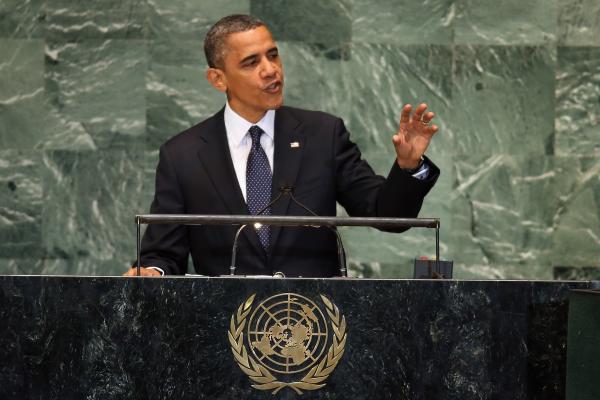
President Obama on Tuesday gave a forceful speech at the United Nations, in which he challenged much of the world's assumptions about free speech and religion.
Here are five points from his address, which together, add up to as close to an Obama Doctrine on Religion as we've seen:
1. Blasphemy must be tolerated, however intolerable
The idea that the U.S. protects even vile speech, so ingrained in American culture, seems counterintuitive to much of the world. It’s an especially tough concept when speech targets a religion, but Obama argued that restrictions on speech too often become weapons to suppress religion – especially the rights of religious minorities.
It’s annoying, isn’t it, how American political debate ignores the pressing issues and instead focuses on the trivial? I’m talking about pressing issues like the recently released poverty numbers – nearly 1 in 6 Americans lives in poverty, and the child poverty rate is even higher. That’s 46.2 million people living on less than $23,021 a year for a family of four.
Those are sobering numbers. Here’s another: a new study by Fairness and Accuracy in Reporting shows that of the 10,489 news stories on the campaign this year, just 17 of them addressed poverty in a substantive way. That’s a whopping 0.16 percent of coverage devoted to issues of poverty.
We need to get poverty back on the public agenda. In the richest country in the world, numbers that high should be seen as a moral crisis.
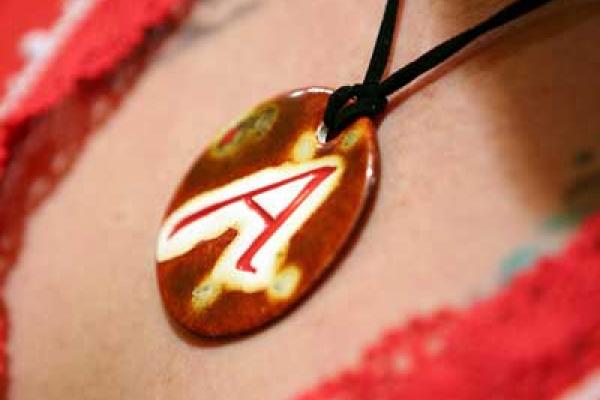
Hester Prynne would be so proud.
The red letter “A” that Nathaniel Hawthorne’s heroine was forced to wear as a badge of shame in the classic novel The Scarlet Letter is now proudly chosen by atheists to wear on jewelry made from ceramic, silver, gold, and wood.
Christians have their crosses and crucifixes, Jews their Stars of David, Hindus their oms, and Buddhists their lotuses. Atheists ask, why shouldn’t they and other nonbelievers have their own symbols as well?
“It is the most recognized symbol in our community right now,” said Amy Roth, a Los Angeles atheist who makes ceramic "A" pendants for her “Surlyramics” jewelry line that she sells at atheist conventions and meetings, as well as online.