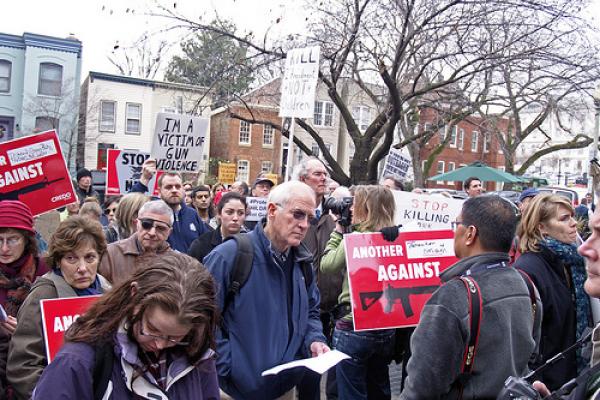
When I was in high school, my family moved from a Black Chicago Southside neighborhood fraught with gang tensions to a nice, multiracial middle-class community further south. Yet, my mom and dad still drove my brothers everywhere, so they would not get shot walking to the basketball court or to a friend’s home because of their shoes, their coat, or the color of their shirt. It was the ’70s and Marvin Gaye’s anthem asked the question on the minds of a generation: What’s going on?
Decades later, it is still my question. Six Sikhs killed in worship in Wisconsin. Thirty-three shot dead at Virginia Tech. Twelve killed and 58 injured in a movie theater in Aurora. One teacher and 12 students at Columbine. Six women, eight little boys, and 12 little girls in classrooms in Newtown. Those babies still had their baby teeth. What’s going on?
Marian Wright Edelman, president of the Children’s Defense Fund, cites these stats in her recent Huffington Post blog: 119,079 children and teens have been killed by gun violence in our nation since 1979. It is as though 4,763 classrooms of young people have been killed by guns. Twenty-two times more children and teens have been killed since 1979 than military personnel in the Iraq and Afghanistan wars combined. That cracks my heart wide open.
The shootings at Sandy Hook took our breath away. We felt in our hearts, this could happen to my child, to my neighbor’s child, and in my community. Unfortunately, in many communities, like my neighborhood in Chicago, we’ve known for a very long time that our children were in the line of fire.
President Barack Obama’s Inauguration Address this week included a bold statement about his vision for addressing climate change. In fact, he redefined the issue of environmental protection as not only morally important but a command from God. After the vacuum of discussion of climate change during the presidential campaign, this proclamation came as a welcome surprise.
Most analyses of Obama’s speech point to the fact that the reason he was able to say what he did is that American public opinion has solidified behind these ideas. Plenty of polls will tell you that the number of Americans who accept the reality of climate change has soared in recent years, perhaps partly due to the natural disasters the president mentioned.
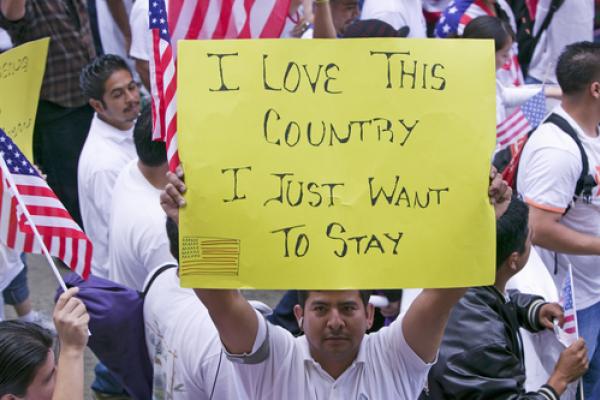
Conventional wisdom is that President Barack Obama won re-election in November in part because of shifting demographics and the rising Latino vote. The research confirms it, but also tells us another story: both parties have much to gain by courting Latino voters, and much to lose if they assume November’s pattern will be repeated with no additional effort.
New polling analysis by Latino Decisions shows that for the first time in history, Latino voters can plausibly claim to have decisively influenced an election. If Latinos had supported Mitt Romney by the same margins they had supported George W. Bush in 2004, the outcome would have swung in favor of Mitt Romney.
However, this does not mean that the tide of politics has inevitably turned towards Democrats. In fact, Latino voters are the most “moveable” racial voting bloc, meaning that both parties have an opportunity to win Latino votes, provided they reach out to the community in meaningful ways.
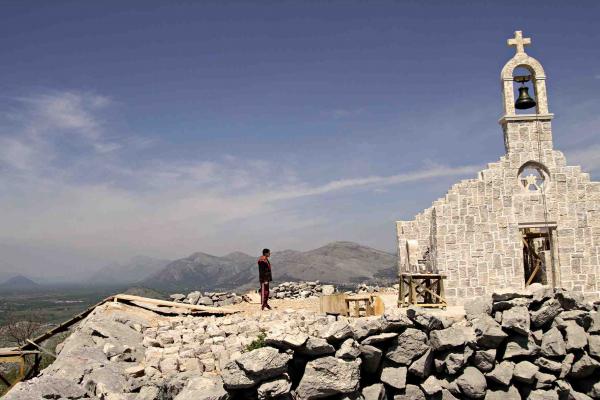
PARK CITY, Utah — It’s been said that Hollywood films comfort the afflicted while Sundance films afflict the comfortable. Film offers a vicarious entry to the world the way it is, and the films I saw at the 2013 Sundance Film Festival left me longing for a different world — the world the way it ought to be.
It ought to be a world in which Muslims and Christians love, serve, protect, and forgive each other. Circles is based on a 1993 incident that took place in Trebinje, a small town in the Serbian region of east Herzegovina. Three Serb soldiers were brutally beating Alen Glavovic, a Muslim shopkeeper. When Srdjan Aleksic, a Christian Serb intervened to stop the soldiers, they turned their attention on him and beat him to death. The film explores the impact of this incident on the Muslim who survived the beating, Srdjan’s fiance and his father, on the children of the perpetrators, and on the whole village.

A kid that's born to play golf, a Microsoft that is still trying to make me think they're cool, a hotel room in a shipping container, an art exhibit made out of used Christmas trees, and a design company that gives away half of its work for free. Woah.
When thousands of abortion opponents gather Friday on the National Mall for their annual protest march, they will be united in their fierce passion for ending a procedure that the Supreme Court legalized 40 years ago in the controversial Roe v. Wade decision.
But they will also be more divided than ever on how best to rally people to join their cause: shock them with harsh slogans and graphic images of mangled fetuses, or convince them with reasonable arguments and affecting ultrasound images.
If activists are going to the March for Life “to display graphic photos or videos of aborted babies,” Simcha Fisher wrote this week in the National Catholic Register, a conservative outlet, “I’m begging you to reconsider.”
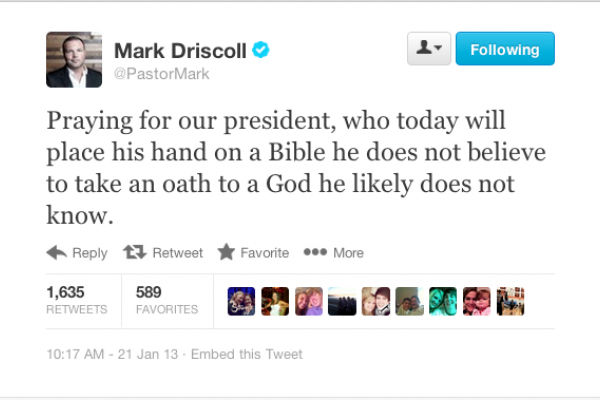
Rev. Mark Driscoll, founder of Mars Hill church, has a true gift. Just when I think I’m making at least a modicum of progress toward tolerance – if not actual Christlike love – toward the guy, inevitably he does something to make me despise him all over again.
On the Monday, before President Obama’s inauguration ceremony, Driscoll sent out the following message to his more than 300,000 Twitter followers:
Praying for our president, who today will place his hand on a Bible he does not believe to take an oath to a God he likely does not know.
As of Thursday morning, the tweet has received more than 3,400 retweets and nearly 1,350 favorites. Driscoll’s next tweet was about an iPad Mini giveaway.
In the past 20 years, the world has witnessed the death of social contracts. We have seen a massive breakdown in trust between citizens, their economies, and their governments. In our own country, we can point to years of data painting a bleak picture of the confidence Americans have in any of our traditional institutions.
Former assumptions and shared notions about fairness, agreements, reciprocity, mutual benefits, social values, and expected futures have all but disappeared. The collapse of financial systems and the resulting economic crisis not only have caused instability, insecurity, and human pain; they have also generated a growing disbelief and fundamental distrust in the way things operate and how decisions are made.
This week at the World Economic Forum in Davos, Switzerland, we are looking to the future and asking “what now?” At a Saturday session — “The Moral Economy: From Social Contract to Social Covenant” — a document will kick off a year-long global conversation about a new “social covenant” between citizens, governments, and businesses.
This is really “a call” for worldwide discussion about what values are needed to address the many difficult challenges and choices the world is now facing. Inequality, austerity, retrenchment, constraints, mal-distribution, growing conflicts over resources, and extreme poverty all raise questions about our values.
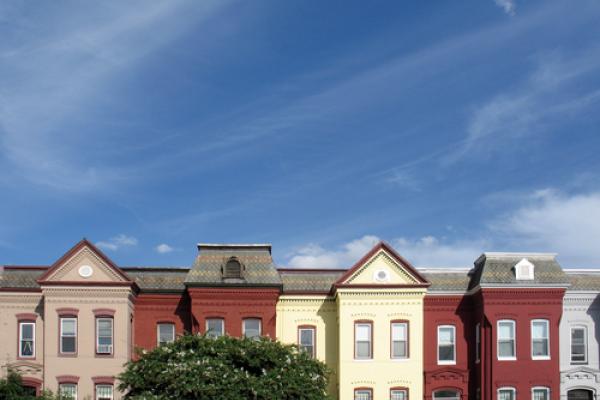
Annie Lowrey's recent New York Times magazine article "Washington's Economic Boom, Financed by You" provides a stimulating look into Washington, D.C.'s "economic boom" of the last few years. As D.C. residents, many of us encounter the ongoing transformation of our city every day. We know the area's economy has grown about three times as much since 2007 as the country — largely a result of expanded government spending (primarily in the form of two foreign wars). We also know that the greater metropolitan region is one of the richest in the country. As Lowrey noted, the Washington metro area has seven out of the top 10 highest-income counties in the U.S., including the three highest.
However, Lowrey only tells one side of the story — the rich side. The "economic boom" has largely passed by D.C.'s poor and working people. By not mentioning D.C.'s grossly high poverty rates, the article is misleading.
Amid Washington's economic boom, there is also massive economic displacement, increased economic inequality, and higher rates of poverty.