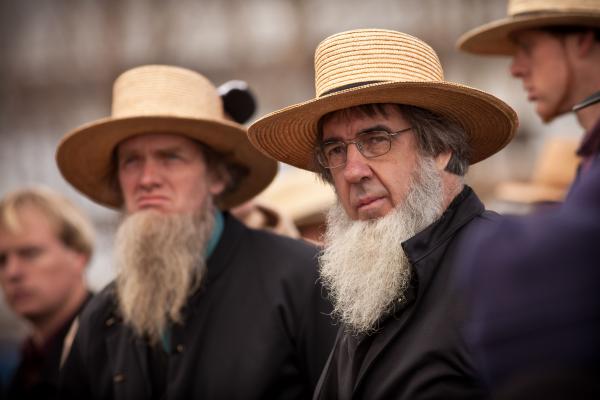
CLEVELAND — No one disputes that followers of Amish bishop Samuel Mullet Sr. used horse-mane shears last year to forcibly cut the beards and hair of other members of Amish communities in rural Ohio.
Only their motivation is in dispute as Mullet and 15 of his faithful stand trial in U.S. District Court on federal hate-crime charges. Did religious bias move them to act, or did a compassionate desire to help wayward brethren return to strict Amish ways?
"Why did they do this? I know it sounds strange: Compassion," defense attorney Dean Carro told jurors Tuesday during opening statements. "No crime has been committed. These were purely good intentions."
But prosecutors showed jurors a photo of defendant Johnny Mullet using one hand to grab the long, white beard of Raymond Hershberger, a 79-year-old Amish bishop, and using the other hand to chop.

The United States has surpassed all records in global arms sales — a whopping $66.3 billion in armaments sold last year.
Most of the weapons went to Persian Gulf nations, although India also bought more than $4 billion in military equipment. U.S. arms sales in 2011 were triple the previous year’s level and the highest annual total ever recorded.
The U.S. is once again the world’s number-one arms proliferator, accounting for 75 percent of global arms sales. Word of this dubious distinction comes as our leaders claim to support and have been working at the United Nations to negotiate a global Arms Trade Treaty.
The report makes a mockery of the UN negotiations and our government’s presumed commitment to control the arms trade.

Editor's Note: This is the sixth and final installment of Presbyterian pastor Mark Sandlin's blog series "Church No More," chronicling his three-month sabbatical from church-going.
They say you can never go home again.
The thinking is that, having left and experienced new things, you have changed and the people back home have continued in their lives just as you left them. Your experience of going back home again necessarily will be very different from your experience of home as you remember it, even though it may have changed very little.
In many ways, Church is one of my homes and I left it. I walked away for three months and experienced a bit of life outside of it. The three months are up and I'm going back home. This coming Sunday (Sept. 2) will be my first Sunday back.
The saying “you can't go home again,” probably originated from Tom Wolfe's novel, You Can't Go Home Again. It's the story of an author who leaves his home, writes about it from a distance and then tries to go home again. It doesn't exactly go well. The folks in the town are none-too-happy about him airing their dirty laundry so publicly.
So, you can't go home again? Well, I'm going to try.

There is hardly a more controversial political battle in America today than that around the role of government. The ideological sides have lined up, and the arguments rage about the size of government: how big, how small should it be? Some famously have said government should be shrunk so small that it "could be drowned in a bathtub."
But I want to suggest that what size the government should be is the wrong question. A more useful discussion would be about the purposes of government and whether ours is fulfilling them. So let's look at what the Bible says.
The words of Paul in the 13th chapter of Romans are perhaps the most extensive teaching in the New Testament about the role and purposes of government. Paul says those purposes are twofold: to restrain evil by punishing evildoers and to serve peace and orderly conduct by rewarding good behavior. Civil authority is designed to be "God's servant for your good" (13:4). Today we might say "the common good" is to be the focus and goal of government.
So the purpose of government, according to Paul, is to protect and promote. Protect from the evil and promote the good, and we are even instructed to pay taxes for those purposes. So to disparage government per se — to see government as the central problem in society — is simply not a biblical position.

Imam Feisal Abdul Rauf has spent most of his adult life trying to build interfaith and international bridges. But to many Americans, he is the public face of the so-called "Ground Zero mosque," one of the most controversial religious projects in recent U.S. history.
Rauf reflects on that turmoil in his new book, Moving the Mountain: Beyond Ground Zero to a New Vision of Islam in America. But as the book's subtitle suggests, the longtime imam spends most of his time facing forward — toward the development of a distinctly American brand of Islam. He spoke recently with Religion News Service. This interview has been edited for length and clarity.
Q: Why did you write this book?
A: I wrote this book because the American public saw me and heard me, but really didn’t get to know me very well, or to understand what my work was all about. This book is my calling card to the American public.

The Taliban in Afghanistan shocked the world this week when they beheaded 17 people, allegedly for the crime of dancing at a mixed-gender gathering.
Which prompts the question: Does Islam forbid dancing? While Islamic scholars are divided on the answer, it’s easy to find Muslims in America and abroad who love to boogie down.
“Even though there are scholars who forbid dancing, there is a long tradition of dancing in Muslim cultures,” said Vernon Schubel, a Muslim and professor of religious studies at Kenyon College in Ohio.
There is no mention of dancing in the Quran, which serves as Muslims’ primary source of guidance. There is a story about dancing in the hadith, or collected stories about Islam’s Prophet Muhammad, which are the second-most important source of guidance for Muslims.
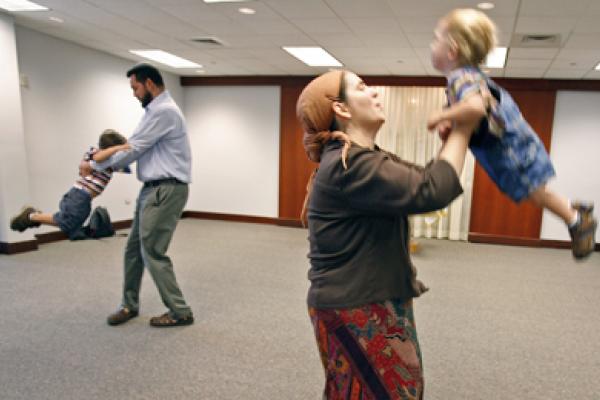
Seven years after Hurricane Katrina toppled a nearby floodwall and drowned their synagogue, and after a seven-year journey praying in hotel meeting rooms, then in rooms borrowed and rented from another congregation, the 100 or so families of Congregation Beth Israel are finally home.
The wandering congregation moved into their new synagogue in suburban Metairie on Aug. 26, three days before the Katrina anniversary and two days before Hurricane Isaac hit landfall in Louisiana.
With a short parade that included a New Orleans brass band, clergy and friends ceremonially carried their five sacred Torahs to their home in Beth Israel’s new ark.
There’s a passage from Hebrew Scripture from the Song of Solomon carved into the ark’s face: “Mighty waters cannot extinguish our love.”
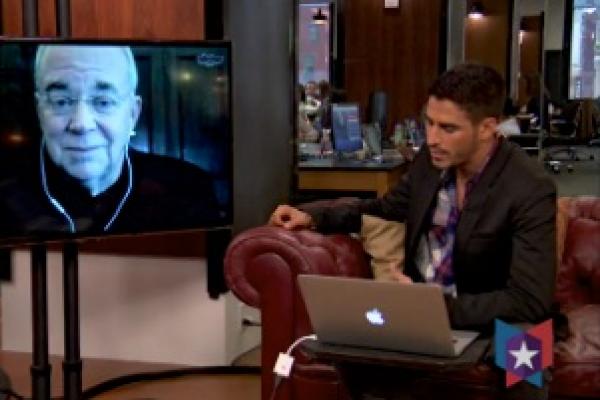
Sojourners' CEO, the Rev. Jim Wallis, was a guest on Arianna Huffington's new online news channel, HuffPo Live, today to talk about the face of poverty in this heated election season and what has changed (or not) since the 2004 presidential election.
"More children than ever are poor," Wallis said. "From a religious point of view, that should be a top election issue. The highest poverty rate in half a century should be a fundamental moral issue."
"More and more of our friends are in poverty," Wallis told HuffPo Live host Ahmed Shihab-Eldin, "in the pews, in our workplaces, because so much is happening to so many people — through no fault of their own — and they are slipping below the poverty level."
There is a whole new wave of "suburban poverty," and many more of us know people who are poor than we did an election cycle ago, he said. There is a new "face" of poverty.
Watch the video of Wallis' appearance inside the blog...
Whether encouraging children to succeed, caring for elders at the end of life, or investing in struggling communities, strong families can make all the difference. Unfortunately, our broken immigration system often negatively affects families, increasing both their emotional stress and financial burden. Too often our laws actually separate family members from each other in ways that create lasting damage.
Recently, the federal government announced a policy change designed to keep families together as they navigate the process of applying for green cards. While this shift will also streamline the process and reduce the complexity of application, the new rules can still be confusing to those seeking help. That is why the Interfaith Immigration Coalition is working to educate the faith community about these developments. On September 10, the Coalition will host a webinar from 4-5 p.m. EDT for faith leaders interested in learning more. Take this opportunity to hear from policy experts, legal advocates, and faith leaders about this important topic.
When: Monday, September 10th from 4- 5 p.m. EDT
Where: Phone
RSVP here.

I love to receive letters. When I was a little boy, I lived on a long, straight street and I could see the mail truck coming from a long way off. After the mailman stopped in front of our house, I ran with hope in my heart down our front walkway, between our two giant maple trees and across the street to our mailbox. Would there be a letter for me? Was someone in the world thinking of me?
One day last year it was not the mailman, but a second-grader on the school playground, who handed a letter to me. I unfolded it.
"Dear Mr. Barton, hi it Odeth from 2th grade I miss you a lot I wanted to know about you so much I am being good I am in 4th grade Do you miss me. I live in __________ I go to school in __________ I hope you will come to my school … can you come visit me in school ask for my name…I am 10 year old I want you to come to my school.
Your best student,
Odeth"
What a wonderful thing, to be remembered by a student.