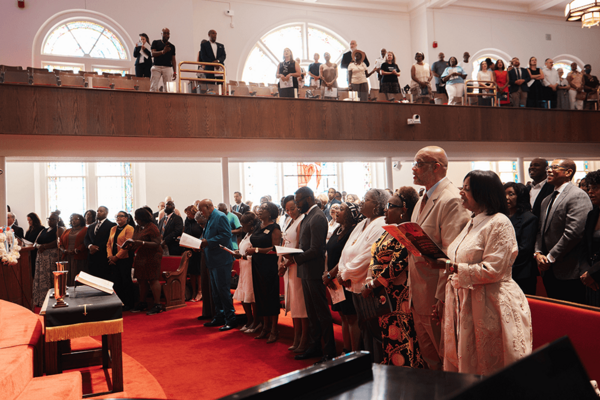
Sixty-three years after Black students propelled 16th Street Baptist Church to the heart of the Civil Rights Movement, the historic church is launching a center dedicated to educating the public on the fight for justice.
Directly adjacent to the church building, the new 16th Street Education and Visitor Center aims “to honor those who sacrificed, to teach the truths that shaped the fight for justice, and to inspire every visitor to carry that work forward.”
In 1963, more than a thousand Black students skipping school and wearing their Sunday-best poured out of the front doors of 16th Street Baptist Church and marched along the streets of downtown Birmingham, Ala. The “Children’s Crusade” was part of Martin Luther King Jr.’s and the Southern Christian Leadership Conference’s aggressive desegregation campaign in Birmingham. The images of children running and shielding one another from fire hoses and police dogs in Kelly Ingram Park, across from the church, horrified the nation and captivated activists.
Then, a few months later, the Ku Klux Klan bombed the basement of the church. The blast shook the entire building, blowing out most of its stained-glass windows and damaging structures along the street. Four of the five young girls closest to the blast were killed. Their deaths became national news, with people across the globe donating to help rebuild the church.
The “fifth little girl,” Sarah Collins Rudolph, survived and was left permanently scarred and lost an eye. Today, she travels and speaks for social justice and peace. I had the honor of meeting Rudolph in 2020, and I visited the church, park, and the Birmingham Civil Rights Institute next door twice in high school.
The place remains heavy with the memory of gruesome white supremacist violence, but 16th Street’s new center aims to create “a living classroom” for the next generation.
I spoke with the Center’s executive director, Terrence Brown, to hear about how his decades of experience in public education informs the Center’s plans to empower young people to sustain the fight for social justice.
This interview has been edited for length and clarity.
Evana Upshaw, Sojourners: How does 16th Street Baptist Church connect faith and social justice?
Terrence Brown, 16th Street Education and Visitor Center: Faith and social justice is rooted in the existence of the church itself.
In the late 1800s when the city of Birmingham was formed, you had these people who came out of different states and of the rural parts of Alabama to come take advantage of what they called the “Boomtown.” They could make a lot of money in the steel mills and in the adjacent careers connected to the steel mill. You see the birth of Jim Crow during that time as well. These people who got together because they wanted to express themselves formed the church. From its formation, you had a bank that was formed out of the church—the Alabama Penny Savings Bank. You had this church protesting in action when there was a problem with juvenile delinquency. The church decided to take a stand. When things were not right, the church decided to create a place for people who were homeless.
What we see in our church records and transcripts is a willingness of the church to make manifest this concept of what being Christlike is to a larger community—not only sitting in the pews and listening to the gospel. A lot of people perceive this social action piece as being birthed in 1963, and yes, that is true, but there was a larger, more sustaining movement throughout the church, even from its existence.
In thinking about recent events such as the Nolan Wells case, the number of Black bodies that have been found hanging from trees recently, or state violence, like killings committed by Immigration and Customs Enforcement, how would you connect the 1963 bombing with current political and racialized violence?
Let me start off first by saying that there’s nothing new under the sun. There are some distinct parallels.
There has to be a level of personal connection in order for people to move and to really stand for what is not right. And not only stand, but to now begin the process of organizing to make sure that these things don't happen, period, full stop. That it decreases, in my mind, is not necessarily where we want to be; we really want this type of violence against bodies to not happen anymore. That requires people of like-mindedness to come together.
Some of this is legislative. Some of this is community action. Some of this is strategy rooted in protest. But we’ve got to find the way for people to find themselves in this path where they are responding—individuals are responding. And what that will often take are organizations that will stand and be a vessel of conversation so that work can happen.
When you talk about organizations that will stand up, is that your hope for the Center?
Well, yeah. But before you talk about the Education and Visitor Center, you have to take account of understanding the history.
So, everything will always center itself around people acquiring the knowledge of 16th Street as a whole. And the tour ministry serves as the starting journey of that, because if you don't understand that historical context of struggle, of overcoming, and of setback and comeback—that has to be the center context. Our hope is, from the tour, you begin to see yourself in that narrative. And at least begin to ask, ‘What would I have done?’
As you go through the pain and the tragedy of what took place in 1963, that invokes a certain level of emotion. But then, once you have those emotions, the question for us became, “Now what do you do with it?” To have the emotion and to go home is a very dangerous thing. But to be able to go to a place, i.e. the Education and Visitor Center, and use the arts as a tool to reflect and to think about those experiences, to think about what you may have done—or what you would like to do. Then, before you leave the Education and Visitor Center, what we do is ask you to commit. For some people, to recommit. And we have a very strategic way that we ask people to make a commitment. There's a digital display for your commitment, and as you give your email address there are some 60+ commitments that you can make to make the world better. And what we hope is that we can capture all of that and then begin to help you make your journey.
Your journey to the 16th Street Baptist Church may only be a one-and-done, but what we want to be able to do is, once you come to this place, we take you on this journey so you’re not alone.
The Education and Visitor Center is designed to help us have difficult conversations. I think that there are a lot of people who want the world to be better, we just disagree on how to get there. And sometimes there requires a level of trust, a level of learning how to listen without judging while people are talking and really deeply understanding an individual’s point of view. The color of my skin in the United States gives me a life experience that someone else may not have. But if you know me, if you trust me, then my ideas come across not in a judgmental way, but in a way that shares my point of view. And now let’s reconcile and let’s find the middle. Or, let’s find the “righteous alternative” so everybody’s needs are met.
I’m really curious about how you frame church tours as a ministry. Can you say more about that?
In the tour itself we never mention God. That’s not the intent of the tour. The intent of the tour is to see these throughlines: perseverance, hope, love for our fellow man, the increasing need to get up when you’ve been knocked to your face or knocked to your knees. It’s like all those Judeo-Christian concepts and principles that are seen in text are now lived.
When you look at the history, this church has been knocked down—literally leveled to the ground—and rebuilt. And those people had to sit and pray and make the decision to rebuild a church that the city condemned initially. Those nuanced stories of that type of work—it is a faith journey. And if you are an individual of faith, you see it quickly. If you’re not a person of faith, then maybe it serves as a piece of inspiration of what could be. In that regard, it is indeed a ministry. It’s like a living sermon in a lot of ways.
Recent research has pointed to a decrease in church attendance. 18–30-year-olds are the least likely to identify with a religion or say it’s important in their lives. As an educator, how do you hope to see younger generations engaging with faith and social justice?
We invite them into the space and deal with questions that they are grappling with. I’ll give you a perfect example: How do we deal with homelessness? We see it. We don’t talk about it. How do we bring all of these people to the table to say, “Let’s look at it. See? It’s out there. So how do we handle it? How do we deal with it?”
And maybe some of that is, “Hey, I don’t even know anybody that’s homeless.” Well, let’s go find somebody that’s homeless. Let’s give them a meal, let’s sit them at the table, let’s have some conversation. “What does it mean? What is it like? Tell me what you feel.” So that we get a real idea of what this is about, and really deal with it on a deep basis. But I think that’s the problem. We see things as a problem, but we never come together to say, “How do we fully understand it? How do we get at it? How do we engage a larger community into it?”
“I see these generations after mine—not to say that we are not—but they’re problem solvers. They really want to get at it and take a crack at it. Sometimes we are reluctant to give them a voice and the ability to experiment.”—Terrence Brown
I see these generations after mine—not to say that we are not—but they’re problem solvers. They really want to get at it and take a crack at it. Sometimes we are reluctant to give them a voice and the ability to experiment. We hope that the Education and Visitor Center will be that space where we can invite politicians to sit at the table and let’s talk it through and try to solve some of these problems in the world.
What can the Center offer folks who don’t participate in organized religion?
We offer them a welcoming space to reflect, to reconnect to the larger mission of making the world better, and we offer that community. There will be a variety of programming that will take place. For example, we have a literacy campaign with the Birmingham Civil Rights Institute. Every quarter we’ll do a book reading with activities. Everybody’s welcome.
We know based on life experience that quilting is a very wonderful way of building community. We have contracted an organization called Bib & Tucker, which is a women’s empowerment “sew-op” in the city, to help run [a quilting] program.
In the Education and Visitor Center there is a 60-seat communal dining space. The tables [seat] 10, and there are cards on the table to facilitate conversation between the people that we don’t know. Hopefully, we can build community and walk away knowing that there are people that may believe what we believe, but maybe they challenge the way we think.
So it’s welcoming to everybody. We want that to be a welcoming and wonderful place, and a place where people feel respected and loved. Because regardless of whether you have faith, no faith, or little faith, our faith dictates that we treat people with gentleness and with kindness.
What we’ve come to realize is that we cannot do this work on our own. It’s impossible, and it doesn’t make good sense. We are leaning on partners who have consistently done the work in our community to help propagate this work.
Did this article have an impact on you? Tell us how! Whether you’re moved to take action, have a question, or want to share a comment (good or bad), we value your feedback!