When I published a spiritual memoir based on the teachings of a 16th-century saint named Teresa of Avila, my 13-year-old daughter suggested my next writing project should be something “more people would want to read.”
I am an Episcopal priest living in a West Coast city where my collar is often mistaken for a retro fashion statement, and the barista asks what day of the week people “meet up at the church.” So I was resigned to a life in the spiritual shadows as the world marched on, oblivious to the life-giving and transforming treasures of the saints. Sure, writing with an eye toward popularity might make my children proud and cocktail-party conversations easier, but I’m just not wired that way. What fool expects popular culture to give divine longing more than a surface-level skip, or passing blow?
Then I went to a Rosalía concert outside of Guadalajara, Mexico, and marveled as the passions of my heart and feminine mystics throughout history filled the sold-out arena. In a pop music landscape full of watered-down God references, I almost couldn’t believe the richness depicted: the complexities and resistance of the spiritual journey, the searing pain of social entanglements and expectations, the sweet ecstasy of full surrender to God, the thrilling power of forgiveness, and the joyful liberation of divine allegiance. This theological feast was creatively rendered by Rosalía in a way that over a million people in 57 sold-out shows around the globe have experienced. Last week, even Bono admitted that she inspires him and a song on U2’s latest album, too.
Rosalía is a 34-year-old Spanish artist who was formally trained in the traditional flamenco music that makes up her first album, Los Ángeles. Since then, her releases have been progressively more genre-bending, experimental, and popular: El Mal Querer fused pop and flamenco, and Motomami added reggaeton, hip-hop, bachata, and electronic to the mix. Somehow, there was still room for Rosalía to surprise the world with LUX in 2025—which included a lot of her earlier influences but also a heavy dose of classical, recorded with the London Symphony Orchestra. More surprising than the strings, however, is LUX’s subject and structure: Rosalía tackles themes drawn from the lives of female saints in a four-movement album, all while singing in 13 languages.
Doesn’t sound very pop-y, right? And yet it generated 42.1 million streams on Spotify in its first 24 hours, setting the record for a Spanish-speaking woman artist on the platform. I hid from my three children in the corner of the local library to listen to the album start to finish, without interruption, and was electrified by her spiritual ambition.
I am not the first to note that the LUX tour turned arenas into cathedrals. But this transformation was not just a result of aesthetic choices—the Latin cross-shaped stage, the lyrics about God, blood, love, and tears—or even the sublime music. It was rendered through the democratization of central aspects of church liturgy and teaching, and through the work of the concert’s spiritual director herself: Rosalía.
She functioned not as an aloof superstar turned Gospel preacher (á la Ye, in his pre-Nazi era), or as a high priestess of a provocative, symbol-laden spectacle (think Madonna). Instead, Rosalía becomes a very human mirror to our own interior landscapes. In drawing from the perspective of a host of female saints without ever sacrificing her own voice, Rosalía becomes a priest in the most basic sense: a thoughtful, playful, caring, and emotionally engaged guide to the multivalent borderlands of human and divine relationship.
Like the wisest and best-liked teachers, Rosalía doesn’t take herself too seriously (She swears! She shoots Jalisco tequila on top of a piano! She is a pop star), but she takes the art of spirituality very seriously. When the audience implored her to take a second shot, she teasingly balked, saying, “Don’t you want a functioning artist?,” and then took a half.
Part of her genius is this light-enough touch. She brings levity through her temperament, an improvised “confessional” with a different local celebrity at each show, and even two sweetly silly intermissions. It’s a pastoral sense of pacing, allowing her to include an audience that would likely never follow a two-hour opera on such heavy spiritual themes, but will dance and sing with Rosalía through the same landscape. As with historic and symbolic liturgies, there are many layers of meaning, but if it’s done well, you don’t need to know the many high-art and hagiographic references for it to work.
READ MORE: Rosalía's Lux Is a God-Haunted Masterpiece
I couldn’t help but see the concert and the audience through Teresa of Ávila’s eyes. As we waited for the show to start, I imagined Teresa’s delighted intrigue at seeing so many young fans, male and female, emulating Rosalía’s bleached halo, adorned with mantillas (a symbol of religious devotion), and as much white as possible. Even if it is, in part, “just” a concert-era emulation, it is also a turning toward a fundamental interior reality: We are more than our bodies. We have beautiful, valuable souls, and an innate connection to the One who created us. But, as Teresa herself said of souls, “we rarely consider their qualities, their precious value, or Who dwells there” (Interior Castle, 1.1.2).
All around on the floor of the VFG arena, we saw outward markers of an embraced imago dei, visible connections to this capacity for relationship with the divine. The most popular sweatshirt in the merch tents? A white hoodie that says “Hot for God.” Teresa’s critics through the ages would blanch. Teresa herself? A raised eyebrow, a small nod, a knowing smile.
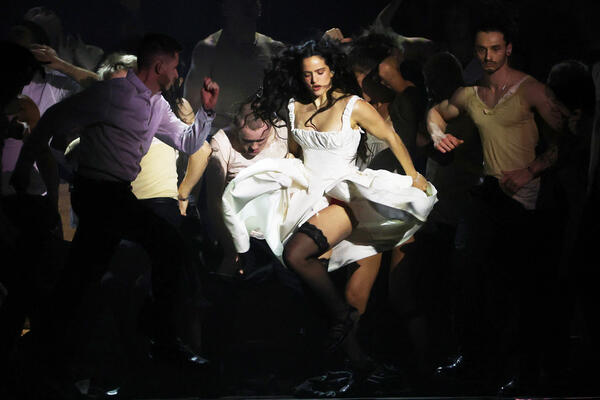
Then, as the show begins, so much of what Teresa taught about internal transformation plays out on the stage, with a live orchestra, full French dance troupe, and Rosalía’s vocals leading the way. Like the album, the production has four acts, but reggaeton tracks from her previous album, Motomami, are thoughtfully placed within the expanded frame.
Nevertheless, the general arc is the same: First, Rosalía explores the tension of belonging to a messy physical world while recognizing divine longings and purpose. She has begun to turn inward, Teresa says. She knows there is more; she wants more. Ballet functions beautifully as a symbol for this desire to transcend gravity and grit, and a white tutu’d Rosalía evokes the turmoil of our teens and early twenties, when most of us wrestle with this awakening.
In the next act, darkness descends. Oooh, Teresa whispers to me. We are in the second dwellings now. The battle will be intense. The pull of the world proves to be heavier, stickier, stronger than we anticipated. We are in a pulsing Berlin nightclub with operatic fervor as Rosalía inhabits the seductive traps of fame and fortune (“La Combi Versace” / Versace outfits). Just when I begin to wonder if Rosalía is, in fact, lost, if she’s just reveling in the darkness, “De Madruga” moves through the crowd, a song about dawn conveyed with hypnotic determination to get out, like horses racing on an open plain toward the light. I didn’t know at the time that “De Madruga” points to Good Friday in Southern Spain, but I could tell the scene was about to dramatically change.
And indeed, the third act opens with Rosalía singing solo about the humiliation of Jesus on the cross—“El Redentor.” Teresa sighs with relief. We are moving toward the third dwelling now, the place of commitment.
With the help of the waltzy “La Perla,” we dismiss the false loves who have hurt us and stolen our peace, and then we are ready to fall into the arms of God. As the opening notes of the “Sauvignon Blanc” ballad play, Teresa elbows me, excitedly: This is my song! I whisper back: I know. And we both cry as Rosalía sings about the elation of surrender, and the sweetness of this relationship.
Before T. can remind me that it's not all sweetness, Rosalía moves on to “La Yugular,” a song that evokes the discomfort and intensity of realizing God is this close, all around, everywhere, in fact, too close for comfort, through the provocative and jarring use of floor cameras. Rosalía puts her eyeball up to the camera, and my own eyes get wide. Teresa nods, approvingly. She knows. She is young, but she knows. We cannot escape His gaze, and that is not easy.
As if to prove her point, Rosalía moves directly down to the B-Stage, the one shaped like a cross, singing “Dios Es Un Stalker.” But just as anyone who is paying attention is beginning to feel uncomfortable, is beginning to think about all their failures, the reasons they are running, or maybe even the people they think God would never deign to pursue, she sings an intense and fiery flamenco-inspired song about radical forgiveness, from the middle of the cross.
As a priest and penitent myself, I know the liberative thrill of confession, the levity that God’s grace often brings in the wake of naming our shame. But I was shocked that Rosalía knew this. I still thought of her as a pop musician just exploring themes of spirituality. I awoke to her as a liturgist when a giant speaker emitting smoke like a thurible descended over the stage and audience, like the botafumeiro of the Catedral de Santiago de Compostela, directly into this moment of absolution: to bless us, and draw us into an ecstatic rave of humble resilience, jumping to the chorus of "CUUUUuuuuuute": “Que aquí el mejor artista es Dios” (“God’s the best artist here”).
Rosalía is operating outside church structures. But she’s also trying to share the treasures of the saints, the treasures of heaven, with the masses. It’s beautiful but often misunderstood work. I hope she keeps reading and meeting the many bold women who have trod this path before, and in different ways, even now. She reminded me I am not alone; I want her to know the same gift, continually.
Rosalía is operating outside church structures. But she’s also trying to share the treasures of the saints, the treasures of heaven, with the masses.

Did this article have an impact on you? Tell us how! Whether you’re moved to take action, have a question, or want to share a comment (good or bad), we value your feedback!