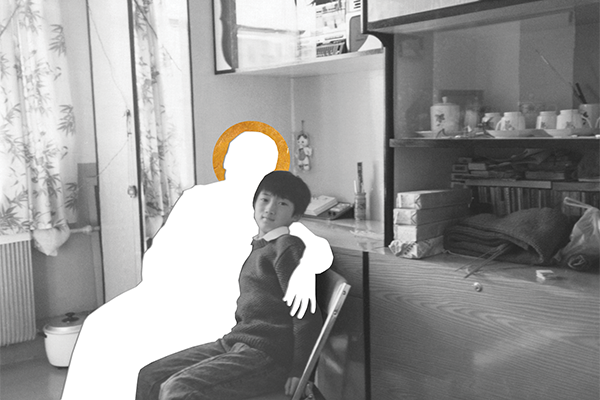
MY YOUNGEST DAUGHTER has an unusual first name, taken from two deceased relatives. When I introduced her to someone, they asked (in a phrase I now think of often), “Is she named after the ancestors?” Yes, I can affirm, she is named after the ancestors. Through her, we carry those ancestors with us. When we name them, we remember the ways each one of us carries them. We carry their identities, their sufferings, and their persistence into the future we dream about.
On All Saints’ and All Souls’ Days in early November, many Christian churches celebrate the communion of saints by remembering the forebears in faith who have provided great examples or, more expansively, simply those who have died.
Naming and remembering our ancestors is a profoundly political act that helps us hold together “the world we dream about and the one we live in now” (as Orpheus sings in the musical Hadestown). Commemorating the saints promises us three things: a just future is coming; suffering will be honored and remembered; and our identity will be formed by their stories.
By remembering our ancestors, we learn how they kept faith even when the future seemed impossible. New York Times columnist Jamelle Bouie wrote, “An abolitionist in 1830 … has no expectation that they will ever live to see the end of the slave system.” When we remember the ancestors, we remember what they accomplished—even if they never lived to see those accomplishments. What is unimaginable in our lifetimes? A world without police or prisons? A sustainable approach to the environment rather than constantly contributing to climate change? The act of remembering the ancestors keeps the possibilities of the future open.
Remembering the ancestors is also a way of ensuring that suffering endured in the past is not forgotten. I’ve been studying truth and reconciliation models, including the Truth and Reconciliation Commission in South Africa. What appeals to me about these processes is their promise to bear witness and refusal to let what has been done in secret remain secret (see Mark 4:22; Luke 8:17). Memory is a revolutionary act.
This surely applies to politicized suffering, but also to the everyday sadness that comes with every death. Remembering activates belonging. On All Saints’ Day, our parish church reads a long necrology of names of parishioners. Each Sunday, we pray for those who have died that week in previous years. I used to be irritated by praying for these people I had no relationship to until I realized that we pray for them because this place—our parish—was their place, where they belonged. Whether I knew or cared about them is not as important as making sure that everyone is remembered somewhere.
But what about people who don’t have a place to call their own, don’t have a community where they are remembered? What about those who have been forced to migrate or who simply feel anchorless?
Remembering the ancestors keeps the possibilities of the future open.
The Dhaka Principles for Migration With Dignity, global human rights guidelines for protecting migrant workers, adopted by the Episcopal Church in 2024, recognize this. Among the basic rights of migrants—movement, safety, equality, and basic needs—these principles affirm the essential right to identity and ethnicity. The right to maintain ties to one’s origin, culture, and ancestry is an essential part of rootedness. For those who may not have a connection to a particular place (or even for those who do), the ancestors themselves become a site of connection and identity.
For me, the story of ancestors invites me to reflect on exile. My grandfather, Hans Newfield, was a Jew born in Vienna before World War I. At the time of the Nazi annexation of Austria in 1938, he was abroad. This twist of fate meant he was able to turn his work (directing opera on international tours) into eventual emigration to the United States, saving him from the Holocaust. Naming him reminds me where and who I came from: It drives me to imagine a world where all persecuted people can find safety where they are and a world where those who seek safety by moving are welcomed. Both the desire to stay and the ability to go are represented in my family’s story.
In Christian terms, the communion of saints becomes our heavenly home. I am somewhat suspicious of the language of All Saints’ Day, because I am skeptical that the oft-touted view of an afterlife (populated by sunlit clouds, heavenly harps, winged immortals, and so forth) has anything to do with the Christian hope of resurrection grounded in a “new creation” (2 Corinthians 5:17) here on earth. I find it more helpful to think of All Saints’ Day as a time for us to remember who came before us so that our souls can be rooted in our connection to them. We grow from where we have come from. The new community of God, the vision of eternal justice that drives our political work forward, arises from the identity we have gained from the loved ones who shaped us. The arms of the ancestors carry us into the future.

Hannah Bowman is a literary agent, public theologian, and the founder of Christians for the Abolition of Prisons, where she writes and teaches on the connections between Christian theology and prison abolition.
Did this article have an impact on you? Tell us how! Whether you’re moved to take action, have a question, or want to share a comment (good or bad), we value your feedback!