“You need to wait for people to catch up,” the pastor said.
It was 2015, and I was visiting the church offices to talk with this pastor about changing parts of the liturgy to make it more inclusive for genderqueer parishioners in this open and affirming congregation. The well-meaning pastor’s response hung heavy in the church office. Over the first few years of my coming out as transgender in a Christian church, pastoral staff and close friends tried to be the community I needed them to be. But I needed more than this cisgender community was able to offer. Months later, the same pastor and I cried together as we concluded that I would find the all-encompassing, life-giving support I needed elsewhere.
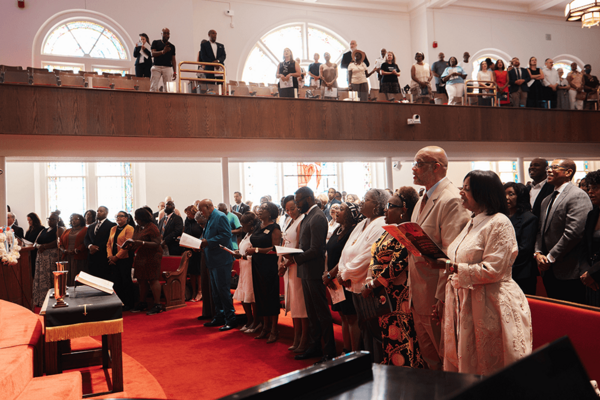
More than a decade later, I wonder if that experience would have been different if the community felt more flexibility to change the Sunday morning liturgy. The idea is an age-old recipe for disaster: You change people’s weekly worship habits at your own peril. I have a vivid memory of when the new edition of my denomination’s hymnal was introduced in the mid-1990s, and our congregation’s elders refused to sing out of it. We are all deeply impacted by changes to worship routines because we have been deeply formed by worship routines. We have come to understand ourselves, our world, and our God through these weekly habits. But until churches have rigorous and honest conversations about the ways we name and honor God, we will remain bound to old sins.
People take it personally when changes are made. But what do we do when oppression manifests itself through exclusionary language that has been baked into our worship routines? This was the question I had brought up at that 2015 midweek meeting.
I am not the only person who has been wrestling with the American church’s legacy of excluding LGBTQ+ people. In recent years, churches across the U.S. have been engaging in debates about whether to become “open and affirming” of LGBTQ+ members. But without comprehensive study of their liturgies, these churches will remain “open and affirming” in name alone. The trans people sitting in the pews will not be affirmed if the congregation does not critically consider how the community has been formed and how they might revise their worship habits to make room for trans flourishing.
It is worth considering a change to our worship routines so that those in the community who have the least power can be honored.
It is worth considering a change to our worship routines so that those in the community who have the least power can be honored.
How might we practically do this? First, consider the language used for the vast, mysterious, ever-changing, always present, infinitely creative, radically restorative Divine. And consider why your community has committed to only using male imagery to relate to this holy power. Or perhaps you belong to a progressive community that uses feminine imagery when referring to the Holy Spirit. And while this is certainly a step in the right direction, the question you and your community should be asking is why feminine imagery is reserved for the Holy Spirit alone. Scholars have long made a compelling case for shifting from male-only language to gender expansive language for God. If we worship a God who is exclusively male, we fail to explore gender expansiveness or creativity. This, in turn, reaffirms the power of masculinity, ultimately contributing to the transmisogyny that plagues our legislatures, schools, and public spaces.
But we must also consider the rhythms of worship throughout the liturgical year. When do you tell the sacred stories of the trans community? I’m betting many readers immediately identify a Pride Sunday in June. However, historians and Bible scholars make a compelling case that queer and trans people have always existed—in our world and in our sacred texts. Our stories deserve to be woven throughout the liturgical year because our lives form a significant part of humanity’s social fabric. This was the inspiration for writing my first hymn, an Advent text that brings trans people into the nativity narrative. As long as we relegate trans and queer stories to one Sunday a year, we exclude people from sacred space. The question churches should be asking is this: Against the backdrop of a violent anti-trans moral panic, how might we lean toward affirming the holiness of trans stories in our liturgical practice?
READ MORE: Catholic Tradition Has Always Included Trans People Like Me
Finally, consider the discipleship we offer one another. Does your pew neighbor misgender trans, nonbinary, or gender-nonconforming congregants? I have yet to attend a church where such an accident doesn’t happen, and it is unlikely that any church community will be able to eliminate these mistakes entirely. People, after all, are human. We make mistakes. But in an effort to create new habits, to be formed by a different routine, I encourage each of us to offer a compassionate correction when we witness someone get misgendered. When we open ourselves up to learning in real time and own up to the harmful impact of our words and actions, we create the conditions for authentic life to peek through. As long as we remain a bystander to misgendering, we exclude the Christ of the margins.
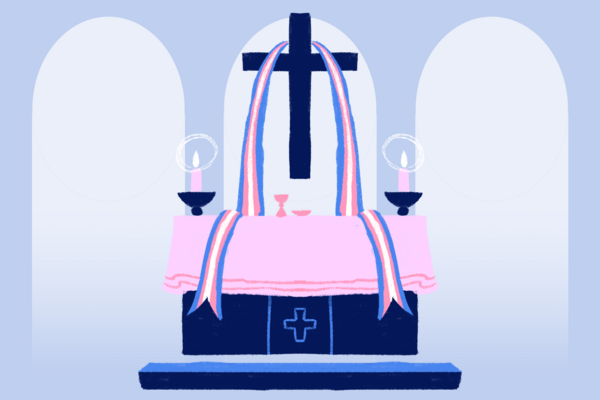
Trans people are sacred, but liturgies across the West have formed us to believe otherwise. It feels like a bait-and-switch when a trans person walks into a house of worship that has a Pride flag on its sign, but the Divine is exclusively referred to as male. This “open and affirming” community is willing to put up a symbol, but stops short of the personal work involved in changing worship patterns. To me, that whiplash experience says, “Your life doesn’t matter enough for us to change our habits.”
In my most patient moments, I can see why many communities put up the Pride flag or an “all are welcome sign” and leave it at that. Leaders may be sensitive to tokenizing the handful of trans congregants, not wanting to volunteer us to speak for our entire community. We need frequent, accessible conversation spaces to support affirming congregations in taking the next step of revising worship habits.
This is the goal of Sacred, Trans, and Blessed, a two-part event on Oct. 8—hosted at Grace Lutheran Church (Evanston, Ill.) or streamed live to wherever you are. During the day, worship ministers, seminarians, pastors, and lay leaders are invited to a panel discussion about how to liturgically observe Transgender Day of Remembrance on November 20. Whether a community regularly marks the day on the Sunday closest to November 20th, or a community has never incorporated the observance in their routines, attendees will have the opportunity to learn how to celebrate sacred trans stories in a liturgical context.
In the evening, we will gather for one of the first-ever hymn festivals of out trans hymn writers. Slats Toole, Zara Torreglosa, and I will lead the gathered body in singing sacred music that centers trans voices and experiences. Amid the crucifying realities of anti-trans legislation and cultural transphobia, our collective voice will embody resurrection.
Making one of the changes listed above, or bringing a new hymn back to one’s community, may not change the world for trans people. But doing so can plant a seed, nurturing space for authentic life. Trans people are sacred; may our worship reflect that truth.

Did this article have an impact on you? Tell us how! Whether you’re moved to take action, have a question, or want to share a comment (good or bad), we value your feedback!