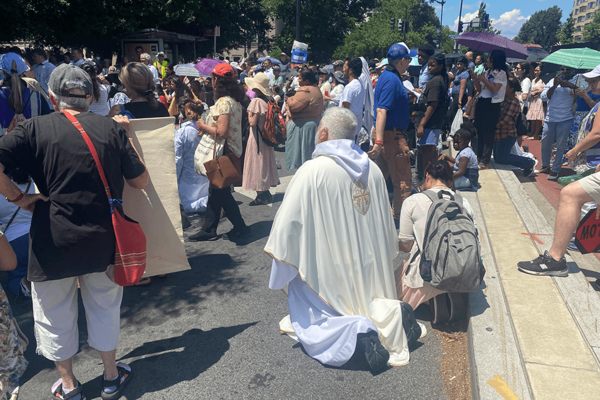
As Catholics from all over the world observed Corpus Christi by processing through the streets to celebrate the Eucharist, about 300 parishioners in Washington, D.C., did the same—with a specific focus on honoring the dignity of immigrants.
Going back to the 13th century, Corpus Christi is the Catholic Church’s celebration of Jesus Christ’s real presence in the Eucharist. For Bishop Evelio Menjivar-Ayala, auxiliary bishop of the Archdiocese of Washington who led the immigrant-focused procession and who will soon serve as bishop of the Diocese of Wheeling-Charleston in West Virginia, the day is a reminder to stand in solidarity with those who are suffering, especially immigrants who live in fear of deportation.
“The mystery we celebrate today is a mystery of unity,” he told Sojourners on Sunday. “We share one bread, one cup, and then we become the body of Christ … But the Eucharist has to go beyond just receiving Jesus at Mass or adoring Jesus in the blessed sacrament.”
Participants walked with the consecrated host—the bread for Eucharist after it has been blessed by a priest—from the Shrine of the Sacred Heart in Mount Pleasant to the Cathedral of St. Matthew the Apostle downtown. Along the way, they stopped to read scripture, pray, and tell stories of those affected by increasingly aggressive U.S. immigration enforcement. Ahead of the group, volunteers held a banner with the procession’s theme: “We are the body of Christ caring for the wounds of the world.”
“When one member suffers, the whole body suffers,” Menjivar-Ayala said, referencing 1 Corinthians 12:26. “The Eucharist is a great thing to awaken in us that sense of communion with others, communion with those who suffer, communion with those who are afraid, communion with those families who are experiencing hardship because of immigration enforcement.”
With temperatures in the high 80s, many participants carried umbrellas for sun protection. Some volunteers hauled coolers of water bottles, while others pushed a trailer carrying large speakers blasting praise music. Trained de-escalators from the DC Peace Team joined in case they encountered immigration enforcement agents or outside conflict.
For Hoa Dang, who normally attends St. Matthew’s, the theme of the procession was personal. Now 54, Dang came to the U.S. at age 3 as a refugee from Vietnam.
“All those people who are coming on boats, braving all those dangers,” she said, “I feel it.”
She said that it was encouraging to be under the protection of the body of Christ, especially at a time when immigrants and refugees are being attacked.
Laura Hernandez, who is from Mexico, joined the procession with her husband Salvador, who is from El Salvador. The couple got married at Sacred Heart and have been attending the church for about 30 years. Laura Hernandez said of the procession, “It makes me feel proud to be an immigrant.”
Valerie Sutter, 83, who lives in Virginia and normally attends Mass in Georgetown, said she came to the procession with a particular mission.
“I wanted to thank every immigrant for coming to this country and making it a better place,” she said. “It reminds me of my grandparents who came here from Ukraine and Ireland many, many years ago.”
260608-CorpusChristi.png
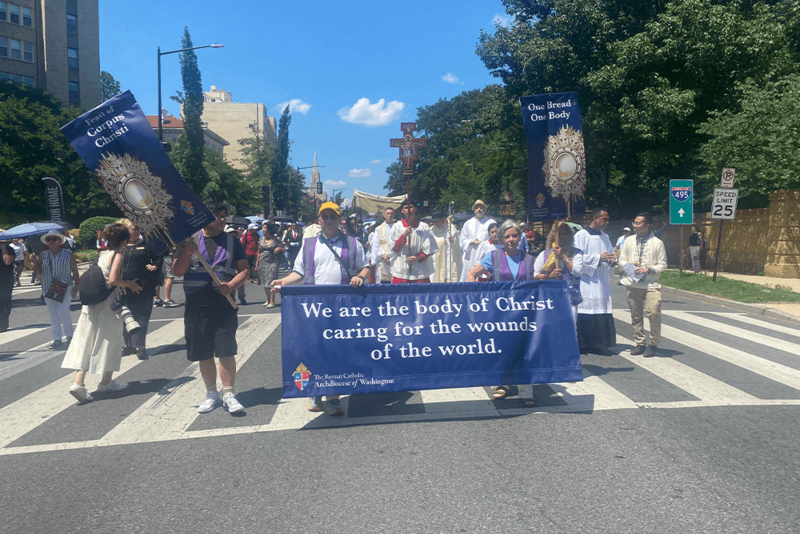
The idea to do a Eucharistic procession focusing on immigrants came from a task force on immigration formed by Cardinal Robert McElroy, according to Antonio Cube, coordinator of justice and peace at the Archdiocese of Washington. It was planned in partnership with several Catholic organizations, including Season of Faithful Witness, Catholic Legal Immigration Network Inc., Network Lobby and Jesuit Refugee Service/USA. Another Eucharistic procession dedicated to immigrants took place in New York City, also co-hosted by Jesuit Refugee Service/USA.
Cube noted that such processions are an important event for Catholics, since the consecrated host is rarely brought outside of the church.
The procession comes at a time when the Catholic church hierarchy has come out strongly against the Trump administration’s immigration policies. Last fall, the United States Conference of Catholic Bishops issued a rare special message opposing the “indiscriminate mass deportation of people.” Pope Leo XIV called the treatment of immigrants in the U.S. “extremely disrespectful.”
Catholic communities across the country have experienced first-hand the effects of mass deportation and family separation policies. The USCCB estimates that nearly one in five Catholics are vulnerable to deportation or live with someone who could be deported. The Archdiocese of Washington saw a 30% drop in Spanish-language mass attendance after Trump took office, according to McElroy’s comments on 60 Minutes in April. “It’s all fear,” he said.
Tying the message of Corpus Christi to the experience of immigrants highlights the church’s responsibility toward those suffering due to aggressive immigration enforcement policies, said Bridget Cusick, vice president of marketing, communications and outreach at JRS/USA.
“We can’t go about hurting other people in such profound and systematic ways and not be doing damage to the larger body,” she said. “That’s what we are really trying to say.”
She highlighted a number of ways that immigration policies are harming people: family separation, lack of due process, third country removals, and poor conditions in detention centers. While Catholic leaders have been especially vocal on immigration in recent years, recognizing the dignity of migrants and displaced people has long been part of the church’s teaching, Cusick said.
“Refugee and migrant issues and talking about how we are expected to treat the stranger go back to the Bible,” she said. In 1891 Pope Leo XIII helped formalize those tendencies when he laid the foundation for modern Catholic Social Teaching in his encyclical, Rerum Novarum. Successive popes, from John Paul II to Leo XIV, have all spoken about the dignity of migrants.
The church’s mandate to care for the vulnerable comes from Jesus, said Menjivar-Ayala, who himself migrated from El Salvador to the United States in 1990.
“We have that mandate to care for the wounded, for the weak, for those who feel persecuted,” he said. “I hope that people wake up to that reality of who we are as the church and who are as the body of Christ.”
Editor’s note: This story was updated on June 9, 2026 to correct that Menjivar-Ayala is not yet installed as bishop of Wheeling-Charleston and is currently auxiliary bishop of the Archdiocese of Washington. He will be installed on July 2, 2026.
“We have that mandate to care for the wounded, for the weak, for those who feel persecuted. I hope that people wake up to that reality of who we are as the church and who are as the body of Christ.” —Bishop Evelio Menjivar-Ayala

Did this article have an impact on you? Tell us how! Whether you’re moved to take action, have a question, or want to share a comment (good or bad), we value your feedback!