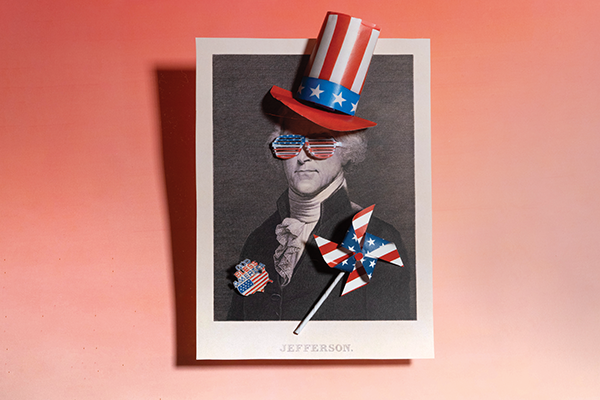
NEXT DOOR TO the West Wing, in the Eisenhower Executive Office Building, you’ll find portraits of the 56 signers of the Declaration of Independence. Visitors to the exhibit—part of the White House’s celebration of the 250th anniversary of the nation’s founding—scan QR codes to watch AI-generated videos of these figures come to life.
But the history this gallery presents is carefully curated and conveniently cleansed. Take Thomas Jefferson: His talking portrait makes no mention of the hundreds of people he enslaved, including Sally Hemmings, whom he forced to bear multiple of his children. Instead, the animated Jefferson praises the “empire of liberty” created by the Louisiana Purchase—ignoring the First Nations already living there and the forced removals that followed. John Adams repeats the anachronistic quip much beloved by today’s Far Right: “Facts do not care about our feelings.” Benjamin Franklin fails to mention that he had once been an enslaver but by the 1780s had become a vocal abolitionist. None of the signers mention that they cut a section where Jefferson lambasted King George for “captivating and carrying [Africans] into slavery in another hemisphere, or to incur miserable death in their transportation thither.” History weeps.
The exhibit is part of a White House partnership with Prager University. Despite the word “university” in its name, PragerU is “proudly not an accredited university.” Instead, it’s a nonprofit media group whose mission is “Pro-American, Pro-Capitalism, and Pro-Family Values.” Its extensive content typically promotes a conservative, often Christian nationalist worldview, including videos such as “Healthcare Is Not a Right,” “Free Enterprise Will Set You Free,” and “Why You Can’t Trust Mainstream Media.”
This is neither history according to the standards of academic discipline nor accurate truth-telling. Trained historians test claims against evidence, debate in good faith, contextualize primary sources they find in archives, and subject all their work to peer review. Professional historians are comfortable with complexity and resist the temptation to turn the past into a tidy moral fable. By contrast, nationalistic storytelling often elevates confident nonspecialists—figures such as Dennis Prager, a radio personality—whose authority rests on persuasion and savvy use of multimedia rather than structured method. When expertise is sidelined in favor of agenda, the result is ideology wrapped in red, white, and blue. And it’s now being given the imprimatur of the presidency.
Jesus taught his followers that the truth will set us free. However sobering or painful, truth liberates, enabling us to see reality as it is and to make faithful choices in the pursuit of loving God and neighbor. By contrast, lies, myths, and selective histories lead to a kind of bondage, trapping us in ignorance or comforting illusions. For Christians, this is not a minor concern: We believe the good news of the gospel is strong enough to confront even the hardest truths. Truth frees us to move forward and make repair; false history is rooted in fear—the fear of reality, of accountability, and of reckoning with what it takes to heal.
Throughout U.S. history, Christians have too often opted to sanctify the nation’s myths instead of telling the truth. But as we approach the 250th anniversary of this nation’s founding documents, we have another option.
Neither master nor servant
WHEN I THINK about the role of the church in relation to the state, I go back to Martin Luther King Jr.’s sermon “A Knock at Midnight,” in which he said, “The church must be reminded that it is not the master or the servant of the state, but rather the conscience of the state. It must be the guide and the critic of the state, and never its tool.” King continued, “If the church does not recapture its prophetic zeal, it will become an irrelevant social club with no moral or spiritual authority.”
When King tells Christians we are not to be “master” of the state, he warns us against theocracy, or a nation in which the laws of the state are substantially identical to the laws and theology of the church. The result is a form of Christian supremacy, where one expression of Christianity is privileged over all others—regardless of religious, demographic, or even denominational pluralism. King also reminds us that the opposite distortion is just as harmful: When the church becomes the nation’s servant, it baptizes the nation’s story and supplies the religious language that sanctifies it, a distorted kind of “civil religion.” Political ideology shapes theology—and not the other way around.
Though you won’t find these stories in PragerU content, history provides multiple instances of when Christians played master or servant of the state—and none of them look like Jesus. Christian attempts to govern in God’s name justified both conquest and slavery, including 15th century papal bulls authorizing Europeans to “invade, search out, capture, vanquish, and subdue” non-Christian people and claim their lands in the Americas for Christian empire. American enslavers used the so-called “Curse of Ham” narrative and other scripture passages to “prove” that slavery was God’s design and should be supported by the power of the state. When believers assume their faith should control the political order, the church moves from witness to domination.
On the other end of the spectrum, many Protestant leaders in the 19th century fused nationalism, missionary language, and racial hierarchy to bless the nation’s westward expansion as “manifest destiny ... allotted by Providence for the free development of our yearly multiplying millions.” Likewise, after the Civil War, Southerners blended memory and Christian dogma into the “Lost Cause” narrative as a way of giving their losses divine significance—a mythology that sanctified segregation and ushered in a new era of racial control known as Jim Crow. The church becomes chaplain to power, offering not critique but blessing for the status quo and those who benefit from it.
This isn’t just a problem of the past; so much of our present political moment is being shaped by Christians acting as both master and servant of the state. Christians trying to be master of the state fuel contemporary white Christian nationalism, a modern effort to secure political power for a particular vision of a “Christian America.” We see this impulse to govern in God’s name in Secretary of Defense Pete Hegseth instituting monthly Christian worship services at the Pentagon. We see it in the president sharing AI-generated images depicting himself as Jesus. We hear it when the vice president declares: “The only thing that has truly served as an anchor of the United States of America is that we have been, and by the grace of God, we always will be, a Christian nation.” And as vendors capitalize on America’s 250th anniversary, we’ll see it in all manner of merch sprinkled with phrases such as “In God we trust” and “one nation under God”—language that became popular not in 1776, but in the 1950s, the fruit of a mid-century attempt to use Christianity to galvanize opposition to “godless Communism.”
For many, the distance between America’s ideals and its realities is still measured in suffering.
“Your celebration is a sham”
BUT THEN THERE are Christians who have chosen to speak with moral clarity even when it makes the nation uncomfortable. They measured the nation not by its military might or economic riches but by its faithfulness to justice and love of neighbor. They told the truth about the country not from hatred but from hope that transformation is possible. They served as the nation’s conscience.
And though the White House won’t share these stories this summer, they are part of our nation’s history, too. They include the Black Christian tradition, which consistently demonstrates what it means for the church to bring the moral authority of religion to the public square; abolitionist Anabaptists; early Wesleyans who denounced slavery; Catholic social justice movements advocating for workers and immigrants; and mainline Protestants who marched for civil rights and opposed unjust wars—Christians across traditions who have, at their best, refused to sanctify the nation’s myths and instead called it to account.
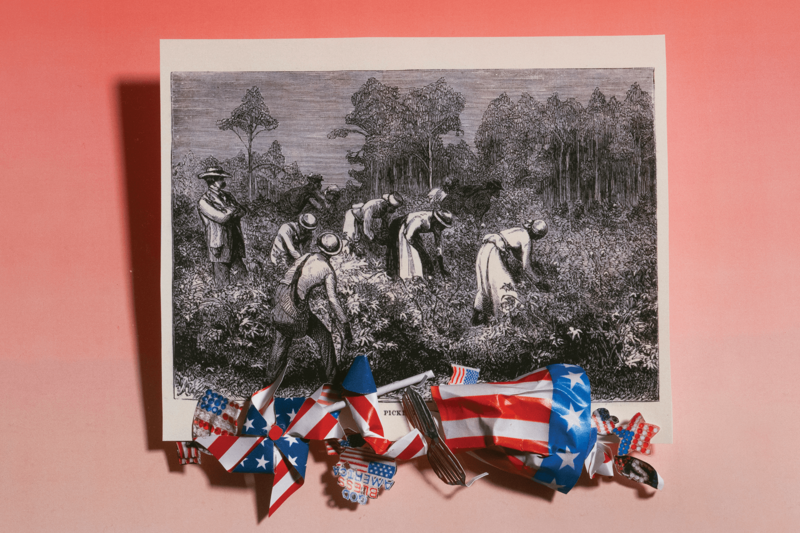
Take the speech Frederick Douglass gave to the Rochester Ladies’ Anti-Slavery Society in 1852. Top of mind for Douglass was the 1850 Fugitive Slave Act, which permitted the capture and re-enslavement of a person accused of having escaped slavery, even if they were found in a non-slaveholding state. In effect, the law nationalized slavery and set the nation on course for the Civil War. Douglass called it “tyrannical legislation,” and his speech went on to condemn slavery both in principle and in practice:
What, to the American slave, is your 4th of July? I answer: a day that reveals to him, more than all other days in the year, the gross injustice and cruelty to which he is the constant victim. To him, your celebration is a sham; your boasted liberty, an unholy license; your national greatness, swelling vanity; your sounds of rejoicing are empty and heartless; your denunciation of tyrants, brass fronted impudence; your shouts of liberty and equality, hollow mockery; your prayers and hymns, your sermons and thanksgivings, with all your religious parade and solemnity, are, to Him, mere bombast, fraud, deception, impiety, and hypocrisy-a thin veil to cover up crimes which would disgrace a nation of savages. There is not a nation on the earth guilty of practices more shocking and bloody than are the people of the United States, at this very hour.
Instead of using religious language to rule the state or to bless its actions, Douglass confronted the nation with truth: Far from being an exceptional nation, singled out by God for special blessing, Douglass said the U.S. was exceptional only in its lies and inhumanity. Christians, he argued, should oppose the buying and selling of human beings as a matter of faith and witness, since it violates the dignity of those made in the image of God. He invoked Christianity not to sanctify the nation, but to expose its hypocrisy—holding up the religion’s own teachings as a standard its adherents were betraying. In doing so, Douglass called religious people to practice their convictions, not simply profess them; he pricks his fellow Christians’ consciences.
tisbyfeature6-26-2 (1).png
Beyond condemnation
IT’S NOT HARD to imagine what Douglass’ speech might sound like if it were given today: What to the immigrant is the Fourth of July, when masked agents abduct peaceful people from the streets? What is this celebration of national self-determination to families in Venezuela or Iran, who wake to the thunder of U.S. bombs and the devastation of wars they did not choose? What is the nation’s anniversary to tens of millions of Black Americans whose ancestors were freed from chattel slavery only to be bound today by a racial wealth gap, over-policing, mass incarceration, and persistent disparities in health and education—and then silenced at the mere mention of repair? All of this unfolds amid a loud and powerful chorus that would rather deny these injustices than confront them. The pageantry remains. The principles endure. But for many, the distance between America’s ideals and its realities is still measured in suffering.
But being the conscience of the state doesn’t just mean issuing condemnation. In an unexpected move, Douglass also praised the so-called Founding Fathers and used their example to argue against slavery. “I cannot contemplate their great deeds with less than admiration,” said Douglass. In contrast with those who endorsed the practice of holding human beings as chattel, Douglass called the founders “heroes” with whom “justice, liberty, and humanity were ‘final’; not slavery and oppression.” Douglass asserted that the notion of a free and democratic nation was sound, but subsequent generations of Americans had failed to live up to the aspirations of the Founders.
Douglass was not unique in his assessment of the nation’s flaws. Others in the Black Christian tradition sounded the same notes before and after him. Harriet Tubman, Ida B. Wells, Fannie Lou Hamer, King, and a countless chorus of voices all advocated for the nation to live up to its stated ideals of “life, liberty, and the pursuit of happiness” for all, not just a white-skinned few. That witness has continued through leaders such as Jesse Jackson Sr. and his Rainbow PUSH Coalition; Bryan Stevenson and his Equal Justice Initiative along with a museum and memorial for lynching victims; Bernice King, the youngest daughter of Martin and Coretta, who now leads the King Center; and LaTosha Brown, co-founder of Black Voters Matter. In every era, the majority of Black Christians never rejected the nation outright. Instead, they held the nation accountable to its professed principles and told its people to be true to their aspirational identity as Americans. They refused a master or servant arrangement in which Christianity blesses or abuses power and instead practiced a prophetic witness that calls power to account. Their faith animated their efforts to move the nation toward a more participatory multiracial democracy.
If we tell the truth about our past, we do more than honor history. We secure the future.
Telling the truth
THIS YEAR, PEOPLE will commemorate the semiquincentennial in a variety of ways; some truthful, some mythologized. Much energy will be spent on correcting and expanding the narrative of the nation’s history—something that matters immensely in an environment where myths are employed to support a Christian nationalist agenda. But the church must go further than fact-checking. The church must be a ready witness to truth.
If we choose to be the conscience of the U.S., the church will refuse to repeat myths that flatter the nation—including myths about being founded as a Christian nation and history as a series of triumphs rather than an uneven, ongoing struggle for progress. Instead, the church will name our failures clearly so we can learn from them. Rather than being an accomplice to ignorance about our government’s human and civil rights abuses, the church will shine the light of truth on the hidden parts of our history. Pastors will denounce dehumanization from the pulpit, no matter which political party is responsible or how many church members they lose. Christians will employ protest tactics and boycott Christian organizations that platform racists, sexual abusers, or those greedy for financial gain. People of faith will consistently call out white Christian nationalism as a false gospel at odds with the Christianity of Christ. Followers of Jesus will not let a fear of sounding “political” keep them silent about injustices committed by our government in our name.
In doing this, U.S. Christians will offer truth that, while difficult, is the firm foundation of freedom. The truth is that one political party claims to be the true “Christian” party and yet enacts policies that exploit the weak and protect the powerful. The truth is that the U.S. is an empire that treats other nations in ways that would outrage us if the tables were turned. The truth is that as passionate as we are about our own religion, the U.S. is comprised of people of many religions and none at all—Christianity should not have a privileged position in the public square. The truth is that U.S. history has been told from the perspective of white, wealthy men for long enough, and adding other perspectives will give us a more complete and accurate accounting of our past, so that we can chart a more direct path to a truly democratic future.
If the church recaptures its prophetic voice, we can push this place we live to be a nation that remembers truthfully, repents honestly, and pursues justice with renewed courage. Such truth-telling opens the door to a deeper reconciliation—one forged not by hollow apologies or symbolic gestures, but by confession, repair, and a shared commitment to righteousness. We could be the kind of nation where people come together across lines of race, ethnicity, gender, and class—not in spite of our history, but because we have finally told the truth and have begun the work of repair. The result is not only reconciliation but renewal: the flourishing of all people, especially the poor, and a public witness that caring for the “least of these” strengthens the whole. If we tell the truth about our past, we do more than honor history; we secure the future. The nation may yet endure for another 250 years, and, by God’s grace, those years could be more just, more honest, and more whole than any that have come before.

Jemar Tisby is a New York Times bestselling author, historian, and founder of Tisby Media, an organization dedicated to creating truth-telling content at the intersection of faith, race, and justice. Read more of his work at jemartisby.substack.com.

Did this article have an impact on you? Tell us how! Whether you’re moved to take action, have a question, or want to share a comment (good or bad), we value your feedback!