Jemar Tisby is a New York Times bestselling author, historian, and founder of Tisby Media, an organization dedicated to creating truth-telling content at the intersection of faith, race, and justice. Read more of his work at jemartisby.substack.com.
Posts By This Author
After 250 Years, Christians Owe America the Truth
The church has often amplified the worst American lies. How can we get to a better, more honest future?
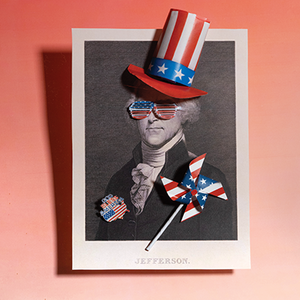
NEXT DOOR TO the West Wing, in the Eisenhower Executive Office Building, you’ll find portraits of the 56 signers of the Declaration of Independence. Visitors to the exhibit—part of the White House’s celebration of the 250th anniversary of the nation’s founding—scan QR codes to watch AI-generated videos of these figures come to life.
But the history this gallery presents is carefully curated and conveniently cleansed. Take Thomas Jefferson: His talking portrait makes no mention of the hundreds of people he enslaved, including Sally Hemmings, whom he forced to bear multiple of his children. Instead, the animated Jefferson praises the “empire of liberty” created by the Louisiana Purchase—ignoring the First Nations already living there and the forced removals that followed. John Adams repeats the anachronistic quip much beloved by today’s Far Right: “Facts do not care about our feelings.” Benjamin Franklin fails to mention that he had once been an enslaver but by the 1780s had become a vocal abolitionist. None of the signers mention that they cut a section where Jefferson lambasted King George for “captivating and carrying [Africans] into slavery in another hemisphere, or to incur miserable death in their transportation thither.” History weeps.
What Christians Who Care About Mass Incarceration Need to Know About District Attorneys
These officials have enormous power, but very little accountability.

Philadelphia District Attorney Larry Krasner
AMERICA HAS A CRISIS of mass incarceration, and it has little to do with crime rates. The system is broken: America imprisons more of its citizens than any other nation in the world. Even though the United States contains just 5 percent of the world’s population, the nation has nearly 25 percent of the world’s prisoners. At every point, from the laws on sentencing to policing practices and health conditions in prisons, impersonal forces exact a very personal toll on incarcerated persons and their families.
Many citizens have started to work on solutions by raising awareness, legalizing drugs such as marijuana, and passing laws that require police officers to wear body cameras. But one critical function of our legal system has received too little attention from Christians and the rest of the public: local prosecutors.
Local prosecutors, or district attorneys, as they are formally known, hold enormous influence. These 2,400 individuals nationwide have the authority to determine when, how, and how severely to charge a person with a crime. They help determine when someone goes home and when someone goes to prison for decades. Their decisions could mean the difference between an innocent person going free or going on death row.
I first became aware of the issues related to local prosecutors while attending a lecture at the University of Mississippi in fall 2017. I was there to hear James Forman Jr. talk about his Pulitzer Prize-winning book, Locking Up Our Own: Crime and Punishment in Black America, which describes how black Americans, for complex reasons, supported the “tough on crime” policies that led to mass incarceration. During the Q&A that followed Forman’s lecture, one student asked Forman how nonlawyers could join in the effort to reform the criminal justice system. A part of Forman’s response remained with me.
“Get involved in local races,” he said. “Local prosecutors are the most powerful people in the system, but nobody votes in these races.”