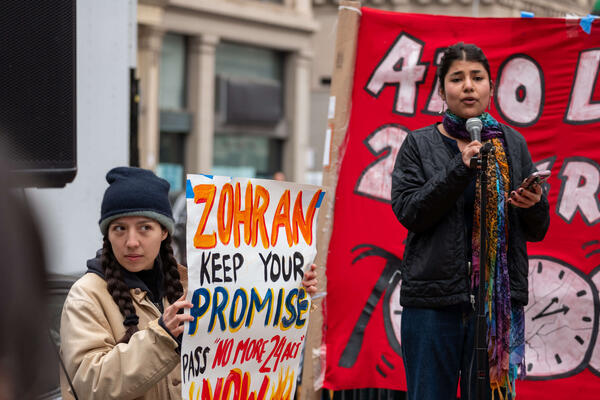
In New York City, many home care workers work 24-hour shifts for up to five days straight, and are only paid for 13 hours of each shift. If they do not agree to this, they risk losing their job.
Home care workers provide 24-hour, live-in care for elderly and disabled patients, as defined by Medicaid. Home care workers feed, bathe, and administer medicine to patients. These workers attend to their vulnerable patients’ unpredictable needs around the clock. But because insurance companies like UnitedHealthcare and New York Healthfirst receive fixed public Medicaid payments to manage care, they make a profit by hiring only one worker for an entire shift.
“This policy has been made possible only by lots of secret behind closed doors deals; and the related privatization of public insurance like Medicaid and Medicare, and the proliferation of for-profit healthcare delivery has made this worse,” said Dr. Steve Auerbach from Physicians for a National Health Program in a statement.
On April 16, workers and organizers launched an indefinite hunger strike outside of City Hall to call for the passing of the “No More 24 Act,” a resolution that would put an end to the 24-hour workday in the city, capping a home care shift at 12 hours. This resolution would also protect patients by giving them access to quality care from home care workers who are not fatigued or sleep-deprived.
Since it was proposed four years ago, this has been the farthest the resolution has progressed. On April 23, the hunger strike came to an end as Speaker Julie Menin promised the bill would be put to a vote in May. Night or day, rain or shine, these workers—who were mostly women—stayed in their tents next to the fence of the city building, calling on legislators to give them back their time.
I started writing this story from the picket line on the seventh day of the strike, while standing next to a blue tarp shielding the striking home care workers from the cold.
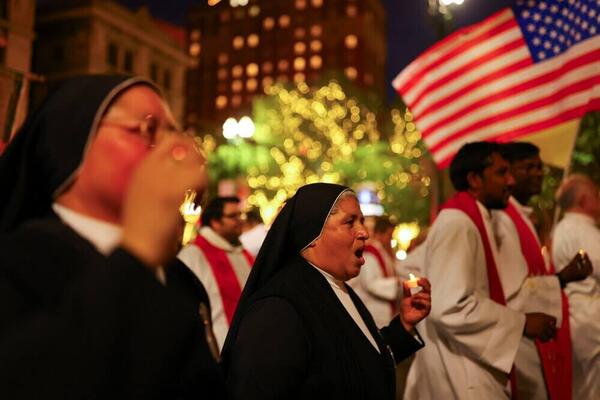
During the program outside of City Hall on April 20, Raquel Irizarry also attended, a member of the NYS/NYC Poor People’s Campaign and the co-founder of Brooklyn Interfaith, along with Paul DeCoster, Kim Barra, and Fajad Malik. She said, “People’s bodies and lives are being destroyed for people to make profit, and that’s a sin.”
Volunteers like Irizarry worked around the clock to support the workers through flyering, speaking, and providing water, blankets, and other supplies.
“This inhumane forced labor goes against our most basic, fundamental teaching of loving our neighbors,” Irizarry said, “It is modern-day slavery.”
On International Women’s Day last year, Irizarry heard about the campaign when a member of the Ain’t I A Woman?! Campaign, the coalition leading the movement to end the 24-hour workday, was handing out flyers in Maria Hernandez Park in Bushwick. That was when she decided to march and chant with the home care workers in front of New York Democratic Governor Kathy Hochul’s office to call for the “No More 24 Act” to be passed.
Irizarry has been an active part of the campaign ever since. She has even taken the lead in drafting an interfaith open letter supporting the “No More 24 Act.” “This is a line in the ground that is being drawn,” she said. “If it happens to them, it will happen to other people as well.”
That’s why the campaign has drawn in so many people from different backgrounds. This fight affects office workers who stay in the office for 60-hour workweeks. It affects the theater workers, who, according to their letter in support of passing the “No More 24 Act,” perform while sick and injured so as to protect producers’ bottom lines. It affects young people like me, who are tired of a system built on the exploitation of our labor.
This exploitation is especially acute among immigrant women. Referring to a study conducted by Paraprofessional Healthcare Institute—a nonprofit focused on long-term service for elders and people with disabilities—the progressive policy research organization the Center for American Progress notes that “immigrants occupy more than 27 percent of direct care jobs despite comprising 17 percent of the workforce overall, and of those immigrant direct care workers, 86 percent are women.” Often, the immigrant women who provide in-home care lack legal status, which “makes them especially vulnerable to exploitation.”
READ MORE: Praying the Imprecatory Psalms in the Age of Empire
I have witnessed the impacts of this exploitation firsthand. A fellow organizer I know had to get rotator cuff surgery because of the toll that working 24-hour shifts had taken on her body.
I also organize with GABRIELA New York, a grassroots Filipino women’s organization. Through our Justice for Filipino Caregivers campaign—which we co-organized with Migrante—we’ve even heard stories of workers who have experienced wage theft of up to $100,000, sexual harassment, and verbal and physical abuse from their employers.
Care work is a cross that women already carry, but immigrant women who do home care work are especially vulnerable to exploitation. According to a 2025 report from the Center for Migration Studies, 73% of home health and personal care aides in New York City are immigrants and 77% of health care workers are women. Their lives are treated as disposable. They aren’t even allowed enough sleep to restore their bodies, and enough time off to be with their families. It is a slow death.
Although it is Eastertide, there are places where Christ is still hung on a tree. Even though New York City now has a Democratic Socialist mayor in Zohran Mamdani, the needle has not yet significantly moved in the direction of more progressive labor policies.
“This is my body broken for you,” Jesus said before he was crucified on the cross in the hands of the Roman Empire, dying one breath at a time. Now, the Empire State, one of the richest cities in the world, is crucifying the bodies of immigrant women forced to work 24-hour shifts.
“Ending the 24-hr workday will not add burden to the city budget, as it is not about money, but about the life and death of workers and the patients who need quality care,” said the home care women workers in a letter addressed to Menin.
Rev. Nozomi Ikuta, Social Justice Minister at Grace Congregational Church in Harlem, sees this local campaign as part of a broader effort to confront systems of exploitation upheld in places around the world, from Palestine to Cuba to Iran. “It’s exploitation against poor people and people of color, whether it’s extracting their labor, their resources, [or] stealing their land,” she said. After being invited by Irizarry to join the rally, she gave a sobering call: “Let’s love our neighbors. Don’t exploit them. Don’t enslave them. Don’t kill them.”
“If we want to love God, we need to love our neighbors because that is what we are called to do,” said Irizarry.
During an overnight shift on the picket line, while I walked three home care workers to the porta-potty down the block, one of them put her arm around me and asked where I was from. It made me think of my mother, a 5-foot-tall Asian woman, who came to the U.S. to work at a nursing home. There, she had to transfer elderly people who could not carry their own weight from their bed to a chair to eat, and then from the wheelchair to the toilet. Even though my mother wasn’t working 24-hour shifts, she worked this job for three years, and it wore her down mentally and physically. Prayer carried us through then, and I believe it carries me now, as I love the image of Christ that I saw in front of me.
“Mulat, ang masa ang mesias,” said the Filipino poet-activist Eman Lacaba. It translates to, “Awakened, the masses are Messiah.” The working masses will save us because they will liberate us from our oppressors and the inhumane conditions we are subjected to.
“Mulat, ang masa ang mesias,” said the Filipino poet-activist Eman Lacaba. It translates to, “Awakened, the masses are Messiah.”
The auntie smiled at me, handing back the key to the porta-potty before heading back to the tent to sleep on a foldable chair. The city was quiet, but the rage of working people was palpable in the silence, freeing us all.

Hannah Keziah Agustin is a writer from Manila, Philippines, based in Madison, Wisc. Her poems and essays can be found in Guernica, Electric Literature, Michigan Quarterly Review, and elsewhere.
Did this article have an impact on you? Tell us how! Whether you’re moved to take action, have a question, or want to share a comment (good or bad), we value your feedback!