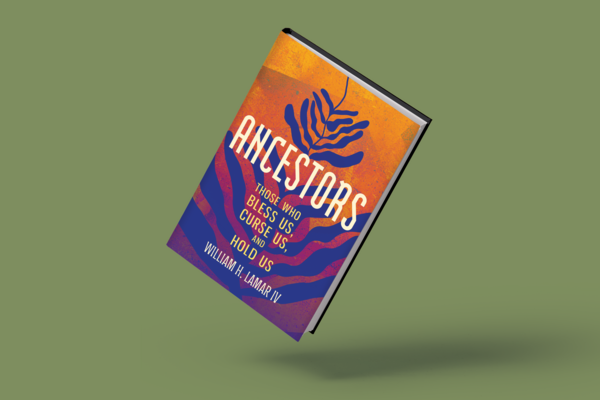
WHO ARE THE ancestors shaping our lives, churches, and nations? And what are they saying to us? These are the questions Rev. William H. Lamar IV invites us to reflect on in Ancestors. Interweaving his personal story with commentary on the Bible, music, and contemporary events, Lamar brings our attention to the ancestors who journey with us. The ones who “beckon our limbs, our loves, and our very lives—sometimes for good and ... sometimes for ill.”
Ancestors live on as “human energy beyond time and space,” Lamar writes. They are a spiritual presence that we can feel and hear when we take time to listen. To Lamar, ancestors aren’t just blood relatives. They can also be found in the books we read, the music we listen to, and the buildings and statues that bear their names.
Lamar discusses ancestors who lead us toward liberation, including Rev. Martin Luther King Jr., Harriet Tubman, Malcolm X, and Elizabeth Freeman, as well as “shadow ancestors” who push people to uphold systems of oppression, such as Robert E. Lee, Andrew Jackson, and Jefferson Davis. The nation is shaped by the ancestors we choose to honor. “When we call our ancestors’ names, we are not merely speaking. By calling their names we are reinscribing limits or transgressing boundaries,” Lamar writes. “When we tell our ancestors’ stories we are rediscovering and traveling upon well-worn paths as well as escorting younger generations, for good or for ill, along with us.”
Ancestral veneration is foundational to Christianity. Books in the Bible such as Matthew and 1 Chronicles begin with genealogies—the naming of ancestors. In the transfiguration, Jesus has an encounter with his ancestors, Moses and Elijah. “G-d is entangled with ancestors because G-d is the first ancestor,” Lamar explains. “G-d is the mysterious Mother-Father who birthed us all.”
The ancestors are still speaking, but we have to listen.
In December 2020, the Proud Boys vandalized Metropolitan African Methodist Episcopal Church in Washington, D.C., where Lamar is pastor. They did so in the spirit of the white supremacists who built this nation, the shadow ancestors who tried to quiet the liberative spirit of the Black church and its ancestors.
But Metropolitan AME would not be silenced. Lamar and the church stood strong, held and sustained by the ancestors of the church. With them stood Frederick Douglass, Rosa Parks, A. Philip Randolph, and Mother Mary Burroughs. Metropolitan, Lamar writes, “is the work of spirit-people from around this land. Its sublime stained-glass windows tell the story of collectivity in a culture of death-dealing individualism.” It is a church where all are welcome and where the ancestors invite us to live differently.
The ancestors are still speaking, but we have to listen. They are still guiding us, but we have to follow. They call us to love: “We are called to a love that sees and hears. To a love that is risky within a denial-filled world. We are called to a love that feeds souls and bodies. We are called to love that sacrifices comfort in the interest of caring for the needs of others. This is the love the ancestors embody that wants to emerge in us, robust and palpable.”

Deirdre Jonese Austin is a minister, writer, scholar, and womanist whose work focuses on religion, race, gender, and sexuality.

Did this article have an impact on you? Tell us how! Whether you’re moved to take action, have a question, or want to share a comment (good or bad), we value your feedback!