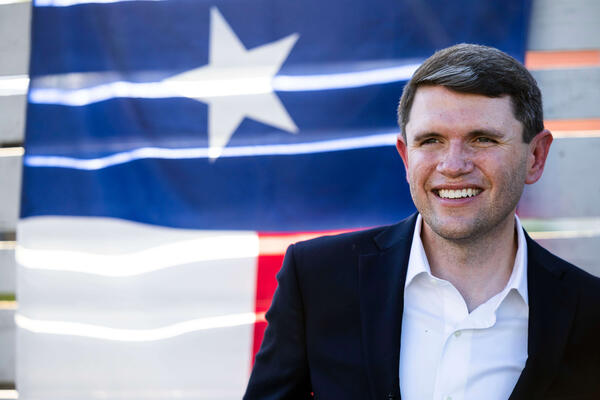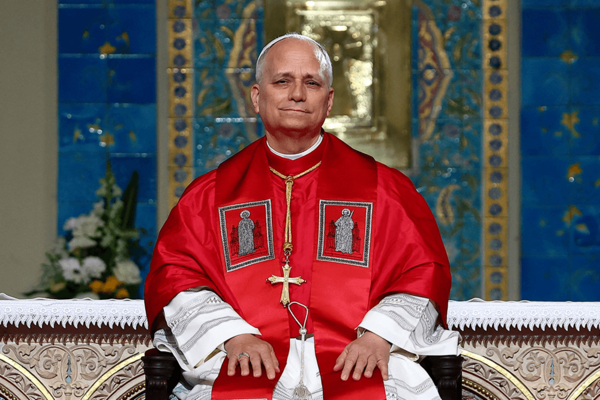
On Monday, Pope Leo XIV responded to ranting criticisms from President Donald Trump, saying in part that he had no interest in being perceived as a politician.
“The message of the church, my message, the message of the gospel: Blessed are the peacemakers,” Leo told journalists as he arrived in Algeria. “I do not look at my role as being political, a politician.”
Trump attacked Leo late Sunday night as “WEAK on Crime, and terrible for Foreign Policy,” at the beginning of a lengthy post on Truth Social.
“I don’t want a Pope who criticizes the President of the United States,” he wrote. “Leo should get his act together as Pope, use Common Sense, stop catering to the Radical Left, and focus on being a Great Pope, not a Politician.” The president also posted an AI-generated image of himself as Jesus, though he later deleted the post and claimed he thought it was him as a “doctor … a Red Cross worker.”
Soon after, the U.S. Conference of Catholic Bishops issued a statement saying “Pope Leo is not [Trump’s] rival; nor is the Pope a politician.” Leo said on Monday: “I don't want to get into a debate with him. I don’t think that the message of the Gospel is meant to be abused in the way that some people are doing.”
But experts in Catholic theology and international politics told Sojourners, it would be a mistake to interpret the pope or bishops as suggesting that the gospel or his papacy are apolitical. That would contradict his clear messaging against war, poverty, immigration, and other issues. Instead, they said Leo’s comments should be understood as an attempt to affect politics and foster dialogue while avoiding partisanship.
Catholic social teaching’s approach to politics
Anna Rowlands, professor at Durham University in England and author of Towards a Politics of Communion: Catholic Social Teaching in Dark Times, said that to Pope Leo—and his predecessors Popes Francis and Benedict XVI—politics is understood as the way humans negotiate common life together. She said Francis talked about politics as “an extension of the idea of caritas, of charity extended to institutions,” and Benedict spoke of “political love” as the “care for institutions.”
“The Catholic Social Teaching tradition that Pope Leo belongs to would frame this as: No, he’s not a politician; yes, the gospel is political,” she told Sojourners. “Pope Leo will have the highest respect for the office that President Trump holds. That’s what leads him to be super critical of when the highest calling of that office appears not to be being lived out.”
As Trump—and some national media—frame the two men as international political figures caught in disagreement, Rowlands said the pope is certainly interested in influencing politics. But Leo wants to situate himself not as an adversary but as a person capable of fostering dialogue and preserving peace. She drew on the experience of Pope John XXIII, who was able to help defuse the Cuban Missile Crisis by offering both the U.S. and Soviet Russia the chance to be seen as peacemakers.
“The pope has the ability to speak to the better side of people’s nature, to remind them that it's always possible to take a pathway that makes the first step towards peace, even right when you're on the brink—even the brink of potential nuclear conflict,” she said.
Leo as international figure
Christopher White, an associate director and senior fellow at Georgetown University and author of Pope Leo XIV: Inside the Conclave and the Dawn of a New Papacy, did point to some differences in temperament and approach between Leo and his predecessors. Leo belongs to the Order of St. Augustine, which heavily influences his approach to leadership and governance.
“The Augustinian Order is run incredibly collaboratively,” White said. “No decisions are really taken alone. They’re taken after great consultation … Pope Leo really believes people should be talking to each other.”
Leo has been “deeply committed” to multilateralism and diplomacy—opposites of authoritarianism, White said. In his first year as pope, Leo has adjusted to his role as an international leader and, internally tried to “turn down the temperature on hot-button issues inside of the Catholic Church,” White said. For example, he has sought to heal divisions between the Vatican and Catholics who want to celebrate Mass in Latin. While “fully on board” with Francis’ agenda, Leo has tried to strike a conciliatory tone and spend the majority of his time listening and talking to stakeholders within the church, White said.
“There were those in the Francis era who, particularly in this country, dismissed Francis as an out of touch Argentine who had never spent time in the United States with exception of his one week here,” White said. “[Leo] was appalled by the fact that a number of American church leaders had written off Pope Francis, but his instinct has been, ‘What can I do, what can I say to reach out to them?’ His style has been particularly effective.”
That may explain why even some of Trump’s more vocal supporters in the church, such as Bishop Robert E. Barron of Winona-Rochester, Minn., have called Trump’s comments “entirely inappropriate and disrespectful.”
“I am very grateful for the many ways that the Trump administration has reached out to Catholics and other people of faith. It has been a high honor to serve on the Religious Liberty Commission. No President in my lifetime has shown a greater dedication to defending our first liberty,” Barron wrote on X. “All that said, I think the President owes the Pope an apology.
An American pope from Latin America
While those in the U.S. know him as the pope from Chicago, Peruvians also celebrate Leo as one of their own. Leo spent nearly 30 years working in Peru, from 1985–2014. Peru’s president described Leo as Peruvian “by choice and conviction,” and the BBC reported that Leo had called Peru “mi segunda patria”—“my second homeland.”
Peru was one of the places where liberation theology was articulated and developed in the 1960s and ’70s before Leo arrived. The themes of poverty, anticolonialism, and anti-imperialism were richly established by the time Leo made Peru his home, Jorge Aquino, a theology and religious studies professor at the University of San Francisco, told Sojourners.
“He seems to have been informed with the experience of extreme poverty in that country and pastorally and theologically it has had an effect,” Aquino said.
While in Algeria this week, Leo criticized the “neocolonial” world powers that violate international law.
“The future belongs [to] those who do not allow themselves to be blinded by power or wealth,” Leo said. “Africa knows all too well that people and organizations that dominate others destroy the world.”
Aquino said that by naming colonialism, Leo is standing squarely in the theology that criticizes politics that polarize wealth and poverty, creating so-called “first world” and “third world” countries—as early liberation theologians put it. It’s also a criticism of imperialism, and the long U.S. policy of interfering in Latin American independence—a pattern revitalized under the Trump administration.
“The poverty of Latin America is well understood as substantially inflicted by first-world economic investment in the Global South, but also political interference,” he said.
The message to American Catholics
Black Moses Rankins, the executive director of Call to Action, a progressive Catholic organizing group, told Sojourners he sometimes wishes the pope could more aggressively combat the president.
“I wish he could say, ‘As a U.S. citizen and pope of the church, president, you suck at what you’re doing right now. This war kills people and harms people,’” Rankins said. “[But] his role is bigger … He is to be like Christ. If you go in the scriptures and look at conversations Jesus had with other leaders like what we’re dealing with today … you never hear a story where Jesus went directly for someone’s head.”
Leo has to follow in a biblical tradition, Rankins said.
“Like it or not, liberal or not liberal, that’s what Christ would say. Christ wouldn’t say ‘Donald Trump, you’re doing a bad thing.’ He’d say, ‘Leaders who lead with love are more effective.’ Leo has to be Jesus, at the end of the day.”
Still, Rankins said the pope’s willingness to speak into American politics should cause an inflection point for American Catholics.
“They have to ask themselves if they’re followers of Christ or followers of Trump,” he said.
Reuters reporting contributed to this article.
“The Catholic Social Teaching tradition that Pope Leo belongs to would frame this as: No, he’s not a politician; yes, the gospel is political.”—Anna Rowlands, author of Towards a Politics of Communion.

Did this article have an impact on you? Tell us how! Whether you’re moved to take action, have a question, or want to share a comment (good or bad), we value your feedback!