On my last day of college, I went to my chaplain’s office to ask her a final theological question. “In case this comes up in the next few years and I don’t have a trusted faith leader nearby to ask: What does it mean for Christianity if we learn definitively that aliens are real?”
I wish I could recall her exact response. But I only remember that she was amused—and not worried at all about the existential impact of the extraterrestrial. If I had asked her today, she probably would have directed me to see Steven Spielberg’s latest aliens-are-real epic, Disclosure Day.
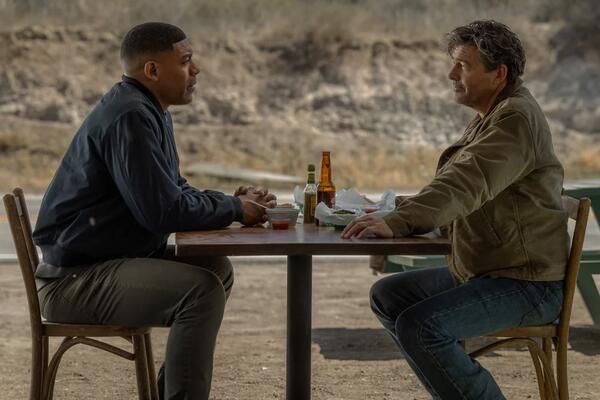
Early in Disclosure Day, we learn that Daniel Kellner (Josh O’Connor) is in possession of proof that aliens are real. He stole this proof from his employer, Wardex, with the help of a handful of other defectors who believe the world deserves to know the truth: not just that aliens are real, but that humans haven’t been kind to them. His powerful former employer will go to great lengths and violence to keep that truth hidden. So for much of the film, Daniel is on the run.
His girlfriend, Jane, is caught up in the chase. But she’s not sold on Daniel’s mission. She worries that disclosing the truth about aliens will prove destabilizing for humans. “People will start seeing them as deities,” she tells Daniel. “People will stop believing in God.” Jane’s character, played emotively and persuasively by Eve Hewson, quickly becomes Disclosure Day’s main conduit for theological questions.
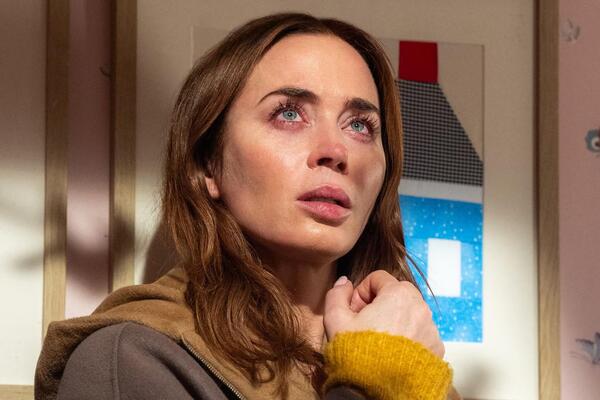
But the film belongs to Emily Blunt. She portrays Margaret Fairchild, a TV weather anchor suddenly bestowed with telepathic powers, infusing the character with levity, magnetism, and warmth. Disclosure Day gives her room to display her full range as an actor: There’s a touch of the action heroics we first saw in Edge of Tomorrow. There’s an impressive dose of the emotional depth she unleashed in A Quiet Place and Oppenheimer. But her greatest gift to Disclosure Day is her comic touch. In a film that occasionally buckles under the weight of its own seriousness, Blunt’s humor keeps things buoyant. A getaway scene where she tries earnestly—with slow, determined success—to destroy her phone is a film highlight.
Blunt grounds Margaret’s extraordinary abilities in recognizable humanity. By simply looking into a person’s eyes, she knows their fears, their past, their language. It’s a super-human, or even non-human, level of empathy. Like Daniel, her association with what’s alien puts a target on her back.
This is nowhere near Spielberg’s first foray into the extraterrestrial, and it’s also not his best. An overreliance on CGI wildlife can make you feel like you stumbled out of an alien movie and into the Polar Express; and heavy-handed monologues spoon-feed audiences the moral of the story.
READ: From Artemis II to Cinema, Why Are We Drawn to Space Stories?
Though the moral of this story, like several other Spielberg alien stories, is an important one. From Close Encounters of the Third Kind to E.T. the Extra-Terrestrial to Super 8, Spielberg continues to push viewers away from fear and toward empathy and awe. The core message of Disclosure Day, repeated in both English and a click-clackity alien dialect, is clear: “Don’t be afraid of what you don’t know.”
In many ways, Disclosure Day is a typical Spielberg alien film delivered in an atypical time. Just a couple of weeks ago, the Trump administration launched aliens.gov. Unfortunately, the website has nothing to do with extraterrestrials and everything to do with anti-immigration propaganda. Upon entering the site, viewers are greeted with a stream of green text:
For 60 years, the U.S. government has kept a closely guarded secret. Aliens have been walking among us … They’ve shopped in the same stores, attended the same classes as our children, and lived seemingly normal human existences. With one exception — they do not belong here. Millions arrived under the cover of darkness and embedded themselves directly into our society. Countless presidents, congressmen, and senior officials knew exactly what was happening. Instead of protecting American citizens, they chose to cover it up and even accelerate the invasion … President Trump was the first to call out the real danger Aliens pose to every American family, every community, and the future of our nation.
The site seems to have two purposes: to brag about Immigration and Customs Enforcement arrests (branded “encounters”) and to cast immigrants as non-humans. It’s popcorn propaganda, a xenophobic gimmick, and totally unsurprising.
In a political climate this brazenly nativist, it’s easy to hear Disclosure Day’s moral refrain—“Don’t be afraid of what you don’t know”—and internalize an adjacent moral lesson: “Don’t be afraid of who you don’t know.”
In a political climate this brazenly nativist, it’s easy to hear Disclosure Day’s moral refrain—“Don’t be afraid of what you don’t know”—and internalize an adjacent moral lesson: “Don’t be afraid of who you don’t know.”
Jane is certainly scared of what and who she doesn’t know. So, like college-aged me, she seeks the wisdom of a spiritual leader—a nun at the convent where she was briefly a postulant. Would the nun be scared or surprised if aliens turned out to be real, Jane asks. The sister, like my chaplain, seems amused and unbothered. Why, the sister posits, would God create such a vast universe only for humans to enjoy? Jane pushes back, reminding the nun, in an apparent reference to Genesis 1:26-28, that humans are God’s supreme creation.
The nun replies, “Genesis says we are God’s supreme creation on Earth.”
Disclosure Day takes a swing at supremacy, that seductive, deadly disposition. When we see ourselves as supreme—as the supreme race, the supreme citizens, the supreme sentients—we become capable of all types of harm. The conviction that we sit atop creation can justify exclusion, experimentation, domination, and more. But when we accept that we may not be alone in the universe—or entitled to a particular pocket of it—we trade supremacy for humility, certainty for wonder, fear for faith.
Disclosure Day hits theaters Friday, June 12.

Jenna Barnett is the culture editor at Sojourners and the producer of the award-winning podcast Lead Us Not.
Did this article have an impact on you? Tell us how! Whether you’re moved to take action, have a question, or want to share a comment (good or bad), we value your feedback!