James Dobson

Hearing about the news of James Dobson’s death reminded me of a conversation I recently had with my sister while we were making our way to an Ethel Cain concert.
We were conversing as we hurried to the car, excited to profess our love to Willoughby Tucker, and I told my sister she was the only reason I knew about Ethel Cain—whose real name is Hayden Anhedönia. We then indulged in some cynical jokes about the “woke” impulse to cancel Anhedönia because of old social media posts, which she has since apologized for and described as “deeply shameful and embarrassing.”
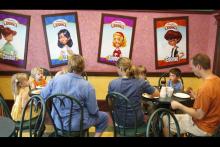
God is not up in heaven thinking up bad things to happen to you. He loves you so much and only wants the best for you. But sometimes that means you have to go through a little bit of pain and heartache. But if you trust him and you love him, he will not let you down.
These words of comfort were given by James Dobson to a young girl in an episode of a Christian radio drama created by his organization. Within these few short sentences, you can find the entirety of Dobson’s ideology: God’s love entangled with the necessity of His punishment.

James Dobson, the Christian family psychologist and media mogul who became one of the key architects of the Religious Right, has passed away.
At his height, Dobson’s influence was vast. His Colorado-based organization Focus on the Family helped build American evangelicals into a political monolith. He enjoyed access to the highest levels of Republican administrations—so much so that the New York Times dubbed him “the nation’s most influential evangelical leader” in 2005. He served on President Donald Trump’s evangelical advisory board in 2016 and supported his re-election bid in 2020.

As a former strong-willed child, I’ve had the notion of James Dobson’s mortality in the back of my mind for the last half-decade or so.
I was not expecting a few tears to fall at the news of his death at age 89, but they showed up anyway. Even though this guy hadn’t hurt me for decades, it felt like a relief. I know he inflicted damage on millions of others that might never fade, but his death made it feel like Earth had just become a little less cruel.

Through the last decades of the 20th century, evangelical parenting advice from people like James Dobson or Gary and Anne Marie Ezzo emphasized parental authority and children’s obedience. Now that many of the kids who grew up under those rules are parents themselves, they’re determined to raise their own kids differently — even while finding it hard to break inherited patterns.

Societally we focus a lot on spanking, I think, because it seems to draw such a line between barbarism and civility, or, seen from the other perspective, between parents who are serious about discipline and those who are wishy-washy. But spanking isn’t the issue behind the issue. The issue behind the issue is authority — the right to exercise power.
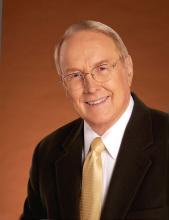
The Focus on the Family founder released his endorsement on July 21, hours before Trump was set to take the stage to accept his party’s nomination on the last night of the 2016 Republican National Convention in Cleveland.
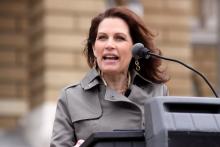
This is it — these are the people who will serve as Donald Trump's evangelical advisers for the next 140 days leading up to election day, and perhaps even longer.
JAMES DOBSON and Kurt Bruner get three things right in their recent novels Fatherless and Childless: Euthanasia is wrong, married couples should make time to have hot sex, and stay-at-home moms should get some respect.
Pretty much everything else in the novels, the first two-thirds of a trilogy (book three, Godless, is due out in May 2014), is way off and internally incoherent. The plot starts in 2042, when an aging population and economic malaise have motivated the government to legalize euthanasia. Businessman Kevin Tolbert, recently elected to Congress, lectures his peers about the need to stop euthanasia and encourage parenthood in order to revive the economy. His wife Angie’s high school friend Julia Davidson, an allegedly progressive and feminist reporter, is assigned to write a story about him (lecture alert). Meanwhile Kevin and Angie struggle (with mercifully few lectures) with their third child’s diagnosis of Down syndrome. Subplots deal with a disabled teen and an elderly dementia victim who turn (or are pushed) to euthanasia.
Actual euthanasia, as disability-rights groups such as Not Dead Yet have documented, often turns on society defining “dignity” according to physical ability and health instead of the innate value of a human being. These novels, however, ask us to believe the main impetus for euthanasia would come from the drive to reduce the federal deficit, to deal with “swelling entitlement spending.”
What spending? The novels’ elderly and disabled characters are drawn or pushed toward euthanasia because of family financial troubles: There is no mention of any Social Security, Medicare, or Medicaid help going to any of them.
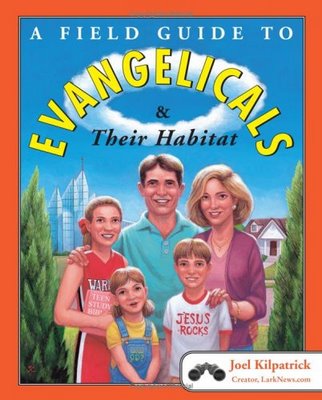 Most of my friends knew evangelicalism only through the big, bellicose voices of TV preachers and religio-political activists such as Pat Robertson, the late Jerry Falwell and James Dobson. Not surprisingly, my friends hadn't experienced an evangelicalism that sounded particularly loving, accepting or open-minded.
After eschewing the descriptor because I hadn't wanted to be associated with a faith tradition known more for harsh judgmentalism and fearmongering than the revolutionary love and freedom that Jesus taught, I began publicly referring to myself again as an evangelical. By speaking up, I hoped I might help reclaim "evangelical" for what it is supposed to mean.
Yesterday, Jim posted his response to Focus on the Family....Action's 16-page "Letter from 2012 in Obama's America." They say that though their letter is a "what if?" exercise, that this "does
The Evangelical Council for Financial Accountability (ECFA.org) was launched in 1979, in response to growing concern "over an increase of [sic] questionable fund-raising practices in the nonprofit sector." As their Web site explains, Sen. Mark Hatfield challenged "a group of key Christian leaders" to begin policing their own mission agencies as a kind of "Christian Better Business Bureau."
Perhaps 30 years later, evangelicals, because of "an increase in [...]
The Christian Broadcasting Network talks to Jim Wallis in a recent segment on James Dobson's criticism of Barack Obama. Bishop Harry Jackson of the High Impact Leadership Coalition is also interviewed. Watch it.

Jim Wallis talks about the evangelical agenda in the context of James Dobson's recent criticism of Barack Obama. Watch it: