Israel-Palestine
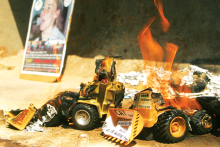
IN 2003, RACHEL CORRIE, 23, a U.S. college senior, was killed by a bulldozer. This was not a freak accident. Corrie was in Gaza with a team of peace activists, nonviolently protecting Palestinian homes from demolition. The bulldozer operator was an Israel Defense Forces soldier. The Cat D9 was made in East Peoria, Illinois. Corrie’s family subsequently sued Caterpillar for war crimes and extra-judicial killing — without success.
This June, the United Nations released an investigation into the corporate machinery sustaining Israel’s ongoing anti-Palestinian project. The report adds 48 international corporations, institutions, and charitable organizations to a list of more than 1,000 corporate entities that, violating international law, profit from Israel’s project to displace, replace, and now eliminate Palestinians.
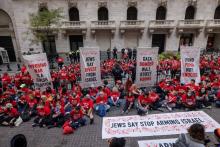
Given Christianity’s sordid history when it comes to antisemitism, we have a responsibility to reaffirm our commitment to combating antisemitism. But we must be vigilant to resist the lie that this commitment requires our silence on Palestine or Palestinian human rights. As journalist Peter Beinart told Sojourners in April, there is a “sense of guilt and anxiety that exists about Christian antisemitism,” and it “is leveraged sometimes by pro-Israel leaders … It’s much easier to level accusations of antisemitism than to actually have an honest conversation about how you justify a system that the country’s own human rights organizations are calling apartheid.”
The way to address antisemitic violence is not, as our current and previous administrations have suggested, by silencing Palestinians or those advocating for a free Palestine.
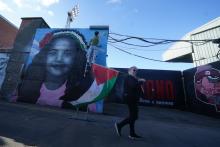
I went on a trip to the American South with the Telos Group, a nonprofit dedicated to equipping people to advocate for peace and reconciliation amid conflict. The purpose of the delegation was to help Palestinians learn about the histories and current realities of the Black and Indigenous struggle for justice in the United States.
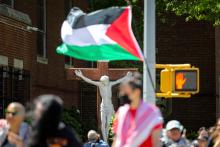
On May 15, Palestinians around the world will mark Nakba Day to remember the catastrophic events of Palestinian mass displacement. In years past, this day has largely flown under the radar. But this year feels different. After the atrocities committed by Hamas on Oct. 7, 2023, and in the wake of the state of Israel’s mass killing of Palestinian men, women, and children along with the staggering destruction of Gaza, the world can no longer look away. The question now is whether it will summon the courage to act.
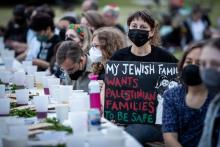
What does it mean to celebrate Passover during a time of rising authoritarianism, climate crisis, and genocide? Every year, Jews mark Passover by reading the Haggadah and by refraining from eating leavened bread for eight days in commemoration of the ancient Israelites’ hurried trip out of Egypt. The Exodus story tells of their journey from slavery to freedom, and each year Jews are commanded to experience this ritual anew, imagining that God is setting them free as if in the days of old.
But as the yearly calendar brings us to a holiday celebrating divine redemption and freedom, it’s hard to avoid the despair of this historical moment.
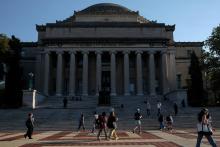
As the assistant professor of medical ethics at Columbia University Vagelos College of Physicians and Surgeons for the past three years, I have had a front row seat to the trials and terror of the past couple of years. And while I am preparing to transition to another professorship, I cannot remain silent about the crisis at Columbia.
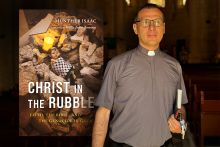
In ‘Christ in the Rubble,’ Palestinian pastor Rev. Munther Isaac surveys the devastation of his homeland and finds God in the most unexpected places.
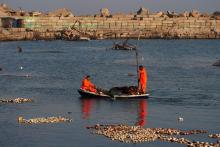
In the halls of empire, men sit at gleaming tables untouched by war, they speak of peace as though it is theirs to grant. But they have never gathered their children into one room to sleep at night so that if death comes, it takes them together. They have never watched the sky split open with fire, felt the air convulse after the blast, felt the wind howl past — hot, violent, and thick with the dust and scent of obliteration. And yet, they sign their names to ceasefires, shake hands, and expect the world to applaud. They do not blush as they bankroll the demolition of homes, the bombing of hospitals, and the erasure of entire families .
During the first week of February, U.S. President Donald Trump hosted Israeli Prime Minister Benjamin Netanyahu, whois the subject of an International Criminal Court arrest warrant for committing war crimes and crimes against humanity. This meeting took place as the fragile ceasefire agreement between the Israeli occupying forces and the Palestinian militant group, Hamas, hung in the balance. Trump, never one to concern himself with the nuances of international law (or any law, really), originally floated the idea of the U.S. “owning Gaza” on Feb. 4 and then has since doubled down on this colonial fantasy, one so crude and reckless that his own administration scrambled to downplay it.
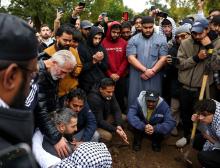
On Oct. 14, 6-year-old Wadee Alfayoumi was stabbed to death in a Chicago suburb. Joseph Czuba, the 71-year-old man who stabbed Alfayoumi is a longtime member of a church and, according to the Will County sheriff’s office, was motivated by anti-Muslim sentiments and Israel’s war against Hamas. According to Joseph’s wife, Mary Czuba (who has filed for divorce), Czuba had been radicalized by conservative talk radio.
I live in a Chicago suburb and am the associate regional minister of American Baptist Churches Metro Chicago. When I heard Alfayoumi had been killed, I was horrified; as a mother, a Christian, a faith leader, and most of all a human, I took the news extremely hard.
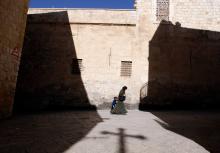
As a Palestinian Christian, I am proud to be a descendant of the world’s most ancient Christian community. My pride transcends the mere fact of belonging; it is rooted in the cultural legacy and global impact that our community has bestowed upon the world through nurturing and shaping Christianity from its earliest days until now. But this pride carries with it a solemn responsibility: I must be committed to preserving the integrity and values of this cultural and religious heritage, indigenous to my homeland, from being misappropriated to justify oppression, whether mine or someone else’s.
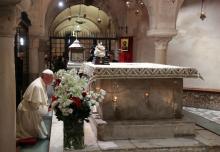
"Truces maintained by walls and displays of power will not lead to peace, but only the concrete desire to listen and to engage in dialogue will," he said in his second speech of the day, after a private meeting among the religious leaders.
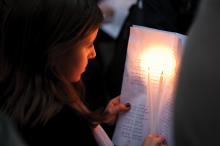
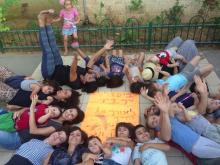
Amid ongoing violence between Palestinians and Israelis, a school in Jaffa seems more determined than ever to teach Arab and Jewish children about coexistence.
In a sunny playground here just 3 miles south of Tel Aviv, children paint recycled tires in vibrant colors and refurbish wooden furniture to beautify a place that many in the community say is their best chance at a peaceful future.
This is the Jaffa branch of “Yad b’Yad” — or “Hand in Hand” in both Hebrew and Arabic — a school made up of four kindergarten and two first-grade classes that aims to respond to growing Jewish-Arab segregation and violence with mutual respect and open dialogue.
“Psychologically, this is the only place where we feel that my children, and my neighbor’s children, are secure,” said Hani Chamy, an Arab engineer and generations-old resident of Jaffa who was one of the first parents to send her two girls to the pre-school.
“It’s a great relief.”
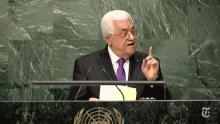
On the first day the Palestinian flag was raised at the United Nations, President Mahmoud Abbas of the Palestinian Authority declared his intent to break agreements with Israel, including the 1995 Oslo Peace Accords, which proposed a two-state solution for the Israeli-Palestinian conflict, The New York Times reports.
“We cannot continue to be bound by these signed agreements with Israel and Israel must assume fully all its responsibility as an occupying power,” said Abbas.
Despite Abbas’ strong words, it is unclear what practical consequences will follow.
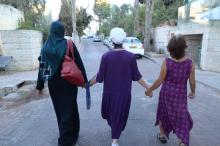
An interfaith group gathered in a private home Sept. 21 to head off potential tensions over how Jews and Muslims celebrate Yom Kippur and Eid al-Adha, two holidays that overlap this year.
The meeting of the Abrahamic Reunion took on added significance in Jerusalem, where more than a week of violent clashes between Israelis and Palestinians on the Temple Mount have spilled into the streets of East Jerusalem.
Two dozen people of various faiths heard a rabbi explain the laws and traditions of Yom Kippur, the Jewish Day of Atonement, and a Muslim sheikh explain the laws and traditions of Eid al-Adha, the Muslim holiday that honors the willingness of Ibrahim (the biblical Abraham) to heed God’s order to sacrifice his son.
The day culminated with an interfaith peace walk between the eastern and western parts of the city. Israel captured East Jerusalem in 1967 and considers it part of its capital. The Palestinians say East Jerusalem must be the capital of a future Palestinian state.
“What did you do on your summer vacation?”
Even now students may be answering that question in essays at the start of this new school year. Maybe you wrote such a paper years ago. No matter what you did or where you went this past summer, it was almost impossible to escape the heaviness of the headlines. #BringBackOurGirls has become a distant refrain, almost forgotten beneath the crush of summer tragedies:
Thousands of children traveled alone from Central American countries to enter the U.S. as refugees. Ebola deaths spread to more West African nations killing hundreds including many health workers. The forces of ISIS, intent on carving out an Islamic caliphate, took over major Iraqi cities and beheaded a U.S. journalist in Syria. Russia usurped Crimea and threatened the rest of Ukraine. The U.N. refugee agency announced in late August that “the number of refugees, asylum-seekers and internally displaced people worldwide has, for the first time in the post-World War II era, exceeded 50 million people.” Gaza has been reduced to rubble while Hamas rockets still fly toward Israeli cities. Michael Brown, an eighteen-year-old African American man who might have started college this week, was shot and killed by a white police officer in the waning days of August.
After such a summer, how can we do anything but scoff at Paul’s words from Romans?
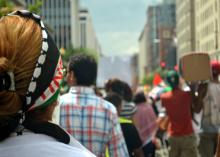
Saturday marked the third time since Israel began military operations in Gaza on July 8 that I let my voice be heard. I stood and marched alongside some 20,000 other individuals that like me have become utterly disgusted by what is unfolding in the Middle East.
A cease-fire has been struck, but as of yesterday, at least 1,800 Palestinians, most of whom are civilians, have been killed and nearly 7,000 have been wounded. Another 200,000 have been displaced in a territory whose infrastructure is now in ruins with mass power and water outages.
Despite the horrific events that have happened halfway across the world, the protest last Saturday, which took place at the White House, was a beautiful sight. Among the 20,000 protesters were Muslims, Jews, and Christians. There were blacks, whites, Arabs, Asians, and Latinos. There were women and men, both young and old, who had come from cities like Chicago, Tampa, Baltimore, and Boston. Many barriers were broken as we stood and marched in solidarity with the people of Palestine.
There were times when my heart was completely broken as I saw signs with photos of dead and mutilated bodies and others that listed the names and ages of children who had been killed by Israeli airstrikes. But in those same moments I would look across the sea of protesters draped in black, white, green, and red yelling phrases such as "Free, Free Palestine!" and "Stop the killing, stop the hate!" and I would once again become a prisoner of hope. I take refuge in the rock that is Christ Jesus. I know my God stands with those being oppressed, with those seeking justice and peace. I know my voice and prayers along with millions of others around the world will be heard.
Although I am pro-Palestine, that does not make me pro-Hamas or anti-Israel. I recognize and condemn Hamas's involvement in the failed peace talks and inability to find solutions. I also mourn equally for the loss of life on the Israeli side. However, despite the part Hamas has played in all of this I do not find Israel's actions to be justified. So I march.
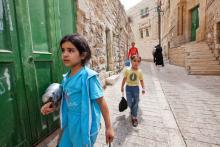
In the Judeo-Christian tradition, God calls us to love and show compassion to the stranger, particularly those who suffer. But first, they must become real to us. And there is nothing more viscerally real, perhaps, than the face of a dead child.
Is it possible to let our hearts by broken by the dead children of our enemy? Is our God big enough to allow us to imagine that God loves those we fear and despise?
Not until, I believe, they have faces.
Iraq, Syria, Ukraine, Israel, Gaza – though religious fervor is alive and well in these embattled areas, loathing, horror, and hatred seem to reign, darkness to rule. In the grim night, we cannot see each other’s faces.

The first thing that visitors and volunteers see at the Tent of Nations just outside of Bethlehem is a large stone on which are written the words, “We refuse to be enemies.” As Israeli settlements draw ever closer to their land and the Israeli Defense Forces destroy their orchards, the Nassar family continues to pay a heavy price in their practice of Jesus’ teaching, “Love your enemies, do good to those who hate you, bless those who curse you, pray for those who abuse you (Luke 6:27-28).”
The Nassars refuse to divide the world into friends and enemies, challenging the rest of us to do the same.
As a Christian, I was raised to be pro-Israel. Since going to the region many times, I’ve become pro-Palestinian and pro-peace, too, which has led me to explore the narratives of Palestinians as well as Israelis. I grieve the deaths in both Israel and Palestine. Every human life has extraordinary value. The loss of even one life is a loss to all of us.
In the bright light of these days’ events it is helpful to be reminded of unalterable truths that transcend party conventions and oppressive governments. The political gatherings and increasing pain of the Middle East conflicts confuse the consciousness. They divert attention and trouble our slumber. Corporate callousness and individual hopelessness has set in and we have turned our faces to that which inures us from the persistent discomforting news.
Pick your own, even if momentary distraction. For me it has been Washington National’s baseball in the drive for a championship and maybe a World Series appearance. My spirit rises or falls on the team’s performances and batting averages of the Nats mini gods.
The biblical Job sought less superficial solace from his and the world’s sufferings. He responded to one of his “comforters” saying “when the land falls into the hand of the wicked He (God) blindfolds its judges” (9:24).