immigration enforcement
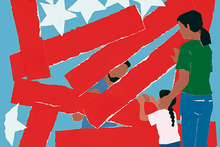
LAURA WAS AN Ecuadoran painter who sold her colorful pastoral scenes to tourists on the streets of Quito. Then the Covid-19 pandemic hit, and the tourists stopped coming. Her livelihood gone, Laura hired smugglers to help her join family in the United States. She arrived at the U.S.-Mexico border in 2021, shortly after the border wall had been raised in places from 12 to 30 feet, through the efforts of the Trump administration. The smugglers leaned a ladder against the high wall for Laura to climb. Once she reached the top, they took the ladder away. She fell into the U.S., fracturing her spine, pelvis, and both legs. She had arrived, but at terrible cost.
I wrote about Laura [a pseudonym] in Strangers in the Province of Joy, my recent book on migration across the southern border. Her story illustrates a larger point: We cannot solely enforce our way to a functioning immigration system. The $147 million price tag to raise the border wall caused a sharp increase in migrant injuries and deaths, but it did not significantly deter border crossings. And the southern border wall is just one manifestation of decades of increasingly more restrictive policies that have cost billions, killed thousands—and largely failed to curb unauthorized migration.
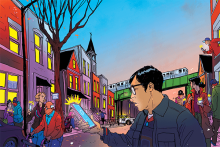
AS ORGANIZERS IN her city began preparing for the No Kings protest in October 2025, Erin Groble thought seriously about whether she should attend. On the one hand, she felt the need to do something. She was raised Lutheran and attended the Jesuit Loyola University in Chicago, and the increased presence of federal agents in Chicago challenged her to figure out what it meant to love her neighbor. On the other, she was genuinely scared at the possibility of being physically harmed or getting into conflict with authorities.
“I realized it just wasn’t really authentic to who I was. It just didn’t feel like the right thing for me to do,” Groble told Sojourners. “But then I started thinking, ‘OK, well, what is the right thing for me to do?’”
Groble was already part of a group chat organized by Brendan Curran, a Catholic priest and community organizer with The Resurrection Project. Curran had brought her block about 50 yard signs advertising “Know Your Rights” information via QR codes. Groble and her neighbors had planted a few of the signs, but there were plenty sitting in her neighbor’s home. “Yard signs are kind of hard to put up—especially in the city!” Groble said. “You have to find a place to put them; there’s a lot of concrete here and a lot of the soil is compacted. So, you need a lot of determination. I just went on my normal walking route, and in front of schools, by parks, by bus stops, I put them all up.”
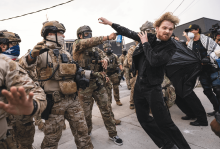
I WAS NEVER the smartest seminarian, but I read my Bible every day. I feel rooted in the scriptures and formed by what I see Jesus teaching us and how he’s calling us to imitate him. I was moved in that moment to pray in the verbatim words of Jesus, to warn the ICE officers who were standing on the roof about the spiritual consequences of their actions in language that was not just me—[it] was an echo of scriptural prophetic language talking about how generations after them would view their actions and calling them to repent.

On Feb. 8, Guadalupe Garcia de Rayos went to Mass and said a prayer before voluntarily going to her biannual appointment at the immigration office in Phoenix.
Guadalupe knew that, because of President Trump’s executive order on immigration enforcement, she was now considered a high priority for deportation and could be sent back to Mexico, leaving her two teenage children, both of them U.S. citizens.
There are no whirring helicopters, law enforcement vehicles, or hundreds of federal agents swooping down on businesses as in days of old. Instead, such immigration raids have been replaced by a less overtly brutal approach: "silent" raids, or audits of work eligibility I-9 forms.
But the fear remains.
At the first whisper of an employer receiving notice from U.S. Immigration and Customs Enforcement (ICE) that employees' eligibility records are about to be checked, pulses rise. Legal workers worry about being erroneously bounced out of work; unauthorized employees fear being kicked out of the country and separated from their families. Communities are shaken, business operations are disrupted, and jobs are lost. The anemic economy takes another hit.
Action alerts make a difference. Our call for the Department of Justice to investigate Arizona Sheriff Joe Arpaio has succeeded!