H'rumphs
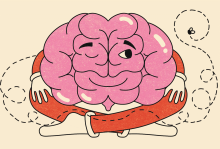
READERS, I AM here to tell you about My Mindfulness Journey, but not in an annoying way, guaranteed or your money back. (Please keep reading. It’ll be different this time.)
But, before we get to mindfulness—aware of Carl Sagan’s comment, “If you wish to make an apple pie from scratch, you must first invent the universe”—we will need to invent my brain, or at least take some major psychological detours. Which is appropriate, since ADHD is all about detours.
Oh, wait. Got ahead of myself there. Let’s start at the beginning.
My 2020 experience was a typical one, in that I spent 100 percent of it in my home and/or in untenable personal and professional situations. Switching to working from home utterly destroyed my routines and support systems. The accompanying collapse of my productivity, mood, and mental health prompted my therapist to ask if I’d ever considered that I might have Attention-Deficit/Hyperactive Disorder, or ADHD.
ADHD is a neurodevelopmental disorder that affects attention regulation, executive function, working memory, and a host of other issues—seemingly designed with the express purpose of embarrassing me in front of my boss.
In the months following my diagnosis, I analyzed my habits with the eye of a quality control inspector, dumbstruck by the breadth and scope of this particular unit’s malfunctioning. “How have I survived all this time?” I wondered almost daily. “And surely one of these ‘normal’ people could give me a scrap of their extra dopamine? For a good cause?”
At the same time, I realized: You know what would be a great way to help me learn to live with an overactive and unpredictable brain? Mindfulness.
IN HER RECENT article “Praying the Imprecatory Psalms Is an Act of Nonviolence,” Liz Cooledge Jenkins explains that the imprecatory psalms of the Hebrew Bible “demand that God exact judgment against evildoers.” These psalms are particularly ... colorful. Take Psalm 35, for example:
Let ruin come on them unawares.
And let the net that they hid ensnare them;
let them fall in it—to their ruin.
In comparison to other imprecatory psalms, the above is fairly sanitized. Often in these verses, the psalmist calls for teeth-breaking, infant murder, and widow-making. To be honest, I’ve struggled to read them. My privileged life has left me with few enemies worth cursing and scant violence to avenge. But I realize that many people of faith—especially those living under oppression’s boot—may find a certain catharsis in these psalms as they imagine God judging the truly hurtful people and powers of the world. “In praying these psalms,” writes Cooledge Jenkins, “we process our rage and give our violent impulses over to God.” One problem, though: The curses in the imprecatory psalms are a bit dated and unrelatable. I’ve gone to the trouble of updating them for modernity. For your consideration:
Psalm 1
O Lord, may the iPhone of the slumlord in Crown Heights fall into a toilet of his own urine. May a single AirPod follow quickly behind.

LEST YOU THINK labor organizing started with the most recent Amazon or Starbucks unionization, let’s look at this ancient document found submerged near the island of Patmos. The document appears to be from another group of mammals negotiating what is believed to be the first collective bargaining agreement.
Letter of Demands
From: The International Animals Union
To: Noah
Subject: Excessive Rainfall
Whereas the earth has become corrupt and filled with violence and
Whereas God has decided to destroy all living creatures and
Whereas Noah is required to build an ark and bring a pair of every kind of animal on the ark, therefore
Noah and the International Animals Union agree that the previous agreement has been terminated and replaced by the following agreement beginning on the 17th day of the second month and ending after 40 days and 40 nights, unless it rains the whole time.
I. Breaks
All animals shall be given 15-minute breaks for naps, whenever they feel like it. (We’re assuming any human over 600 years old on the ark will likewise be taking multiple naps per day.) Breaks can be used for whatever animals want, including but not limited to gathering around the water trough to talk about the change in rain patterns for the day.
II. Schedule Assignments
All animals shall be given their work assignments a week in advance via pigeon post delivered on papyrus. On holidays, work assignments shall be delivered on parchment. Ravens and doves are available for special work at the end of the cruise.
III. 40-Hour Work Week
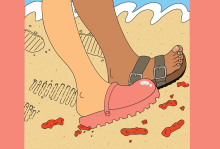
ONCE I HAD a dream that I was walking along the beach with my Lord. I felt self-conscious about wearing a two-piece swimsuit, but I didn’t know the Lord was going to be at Rehoboth Beach during spring break.
God said, Don’t worry about it, Jenna. Purity culture is so 2008.
Suddenly, scenes of my life flashed before me along the shoreline. I looked back at the footprints in the sand. In most scenes, there were two sets of footprints: Mine and God’s. God is a size 8.5 and has high arches, in case you were wondering. But then I noticed something troubling. At many of the hard times in my life, there was only one set of footprints.
When I needed you the most, why did you leave me? I asked God, with more sass than I’d like to admit. God whispered something in return, but I couldn’t hear the words. It’s really loud at the beach, and there was a sand volleyball game nearby. So then God yelled, I never left you! When you saw only one set of footprints, that was when I carried you.
I was so relieved. Sorry for the mix-up, I said to God. I also wear size 8.5, so I was confused.
But then I noticed something even more troubling.

Date: Sunday, May 17, 2122
To: allchurch @gracechurch.metaverse
From: staff @gracechurch.metaverse
Subject: Children singing in church
RECENTLY OUR STAFF has received many questions about why we do not permit children to sing during services. We understand that this is a contentious issue, and we want to do our best to respond to these concerns. Before we begin, it must be made clear that on all matters of doctrine, we look to the sacred All-Church PDF sent out by our founding elders in the year 2022, almost 100 years ago, which clearly defined our church policy.
To begin, let us look at section 4.A of the holy PDF. It states: “Please do not allow your children to sing during the sermon, especially if it’s a shouted rendition of ‘We Don’t Talk About Bruno.’” Given this language from the foundational All-Church PDF, the prescribed ban on singing seems clear (although we’re not quite sure who Bruno was or why people weren’t supposed to talk about him). Some of you have noted that this directive may have been a response to disruptions during services. While it is true that we have found several cellphone videos from 2022 of children standing up to loudly sing in the middle of the Eucharist, there is simply no way to know if section 4.A of the PDF was written in response to that.

ALLOW ME TO introduce myself: I’m IKEA, an expert in DIY construction and deconstruction, here to explain a recent religious phenomenon. According to a 2021 Relevant magazine article, Christianity is in “the age of deconstruction.” “Through deconstruction,” explains writer Kurtis Vanderpool, “we are able to find the good and the helpful parts of our faith upbringing, while reshaping or throwing out the unhelpful.” But there is a problem! While the exvangelicals on Twitter are obsessed with deconstruction, “most people you will find in church are uncomfortable with deconstruction,” says Vanderpool.
You may be thinking, “Is an enormous warehouse full of good-enough furniture really equipped to explain a sensitive theological process? No offense, IKEA, but did you even go to seminary?” No, I didn’t. But nondenominational churches often pay me thousands of dollars to host massive lock-ins and I overhear A LOT of really bad theology as youth pastors, groggy chaperones, and sugar-faced youth groups play hide-and-seek in my showrooms. (I’m pretty sure I didn’t dream this.)

AS MORE AND MORE more of us who are still working remotely receive the COVID-19 booster, and as more effective treatments are developed and omicron fades into distant memory (one can always hope), the threat of returning to “normal life”—offices, restaurants, bars—looms on the horizon. White-collar workers across the nation are looking upon their professional shoes and slacks with fear and dread. Are we as a country capable of abandoning sweatpants, after all they’ve done for us?
We have grown accustomed to a softer, smaller world, a comfortable and blanket-filled cocoon of our own making, but soon we will reenter a world that is both freer and crueler. A world where people see our faces when we walk by and (God forbid) try to start conversations with us. A world where people hug us without asking first. A world where, for some reason, we are expected to make small talk. Calvinists and non can surely agree that this is depraved.
It will be difficult to return to professional lives that involve arduous and near-mythical rituals of the before-times such as “commutes” and “dress codes” and “supervisors who know how late we sleep in.”

A SOJOURNERS COLLEAGUE actually used one of these excuses for taking a day off work. If you correctly guess which one, you get to take a day off, no questions asked, at least by me.
1. I volunteered to run the Taizé service at my church and that is not the kinda service you can just barge into with clickity-clackity heels on.
2. After coming to terms with how my childhood atonement theology shaped my attachment style, I had to retake the Enneagram test.
3. I had to throw blood at a nuclear warhead in protest of the war machine.
4. Alternate: I became lightheaded after collecting too much of my own blood to throw at a nuke. In retrospect, I should have just used grape juice.
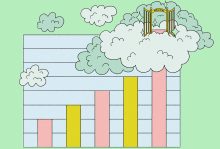
AS WE APPROACH the new year, the more fortunate among us will be taking time to organize their lives by rebalancing their financial portfolios and considering new investments. While taking care of your cash, it’s important to remember that a wise teacher once said, “Store up for yourselves treasures in heaven, where moths and vermin do not destroy.” I still don’t know what vermin is (it’s probably bad because it’s in the same sentence as moths), but I think the teacher might have been telling us that in additionto tending to our finances, we should also tend to our spiritual portfolios.
If you’re wondering about how exactly to do this, here are three rules to spiritual wealth that I think will prove helpful.
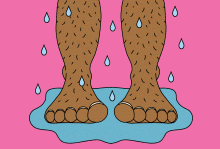
AS I WRITE this, it has been 16 months since my last haircut—the last time I felt safe being partially restrained by a front-facing cape while a stranger hovered near my face with scissors. Needless to say, my hair is unruly and prematurely greying, but fear not, it is doing wonders for my love life. I have kissed dating goodbye and started washing people’s feet with my hair. Because why walk a mile in someone’s shoes when you could just take a good hard look at their calluses? If you can feel the tug of your hair between your partner’s toes and not turn away in shame (or accidentally tickle them), what can’t you accomplish together?
This method is not only pandemic-safe-ish, it’s biblical. And it is much wiser to take intimacy advice from Mary of Bethany than Joshua Harris of Dayton, Ohio. In the gospel of John, Mary pours an expensive perfume on Jesus’ feet and wipes his feet with her hair. In the gospels of Mark and Matthew, Jesus himself calls being anointed, “A BEAUTIFUL THING” (the original Greek did not use all caps, but it should have).
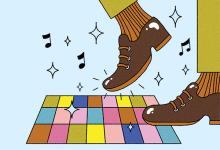
EVERY ONCE IN a while, while brushing my teeth or driving to work, my mind will wander to what I call “future regrets”—things that I’m pretty sure I’ll rue later in life but about which I do nothing to resolve in the present. Those include obvious ones like not flossing or watching PBS NewsHour enough. But there’s one thing in that category that’s a little more unexpected: dancing.
The sheer act of dancing—with its flailing of the arms and stomping of the feet (including, inevitably, stomping on other people’s feet)—doesn’t exactly lend itself to those inclined toward modesty and reserve. And unless you’re doing that flailing and stomping while walking over hot coals at the direction of human resources as part of your new employee training icebreaker, people will probably turn their attention to you, and not in a good way. But for those of us who grew up in churches where dancing was frowned upon, stepping out on the dance floor feels like a theological risk as well. (Old joke: “Why do Baptists prohibit sex while standing up? It might lead to dancing.”)
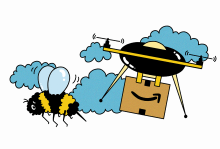
AMAZON FOUNDER JEFF BEZOS arrived at writer Wendell Berry’s home in Kentucky the same way he arrives anywhere on earth: by drone, covered in cardboard. When he stepped out of the large box, the two men shook hands and exchanged gifts. Bezos gave Berry a single octopus tentacle wrapped in burlap. Berry offered Bezos a gooseberry coated in local honey. Both quietly hoped the exchange was a step forward for modern masculinity. It wasn’t.
Bezos: This is a fabulous berry, Wendell. Do you live off the food you farm? Or book sales?
Berry: Well, tax-evading corporate conglomerates have made it harder for authors to earn a sustainable living, but I’m happy with my lifestyle.
Bezos: So, you have other investments?
Berry: I invest in sequoias and in the two inches of humus that will build under the trees every thousand years.
Bezos: I LOVE hummus. But I’m not familiar with Sequoia. Has their stock gone public?
Berry: They are trees. Very old trees.
Bezos: Oh.

IN LATE APRIL 2021, the food website Epicurious made the decision to stop publishing recipes with beef to “encourage more sustainable cooking.” The move sparked an immediate backlash. But I must admit that I would hardly care if every beef entrée were wiped from the internet, so long as the recipes that remained included a “jump to recipe” button so that I did not have to spend 20 minutes scrolling through a 50,000-word memoir about how a particular dish made its way through 17 generations of your family. But alas, it seems that for the time being we are stuck with far too many food platforms doubling up as literary agencies.
Along with facing criticism, Epicurious also won a fair amount of praise. Supporters noted that meat production is one of the most significant contributors to climate change and an ever-warming planet. As a result, over the past few years a number of people have begun to identify as “flexitarians.”
Contrary to my initial belief, these are not people who like to tell others about their bench press record. They are actually folks who generally do not eat meat but might make a few rare exceptions. If most Americans became flexitarian or even just cut cow out of their diet, this could make a significant impact. I do recognize that it is incredibly difficult to get most Americans to do anything for the common good unless it involves the words “listen,” “to,” “Dolly,” and “Parton,” but I actually believe that with a charismatic spokesperson at the forefront of a flexitarian campaign, this could get off the ground.

ON A RECENT Sunday, my pastors asked the congregation to show up for Zoom church with “something to consume during communion.” And let me tell you, if you’ve never had a tortilla chip as the bread and chipotle salsa as the wine then you might be experiencing a lower tier of consecration. Even my dog—who not only considers the lilies, but also pees upon them—ate from the crumbs of my Tostitos and knew something beautiful and mysterious had transpired.
In other words, Zoom church, even with its lag time and pixilation, has had its perks—but one perk, specifically, above all other perks: While the absence of commutes and underwire bras has been noteworthy, the absence of churchy small talk has been paramount.
My trifles with the Passing of the Peace predate and rival my newer fears of the Passing of the Germs. At the age of 8, I had what my therapist called “separation anxiety” and what my older sister called “OHMYGOD Loosen Your Grip on My Forearm, JENNA.” I did not know what to say if the kind, adult Presbyterians asked me, “How’s school?” or the even more terrifyingly open-ended: “How’ve you been?”

ACROSS THE COUNTRY a number of places are using or are considering adopting ranked choice voting for state, local, or federal elections. If you’re unfamiliar with ranked choice voting (RCV), that’s too bad, because other than the most recent here’s-how-to-make-the-perfect-garlic-bread TikTok video, this is just about the biggest news there is right now. But let me take a moment to explain.
Ranked choice voting is a process in which voters rank their candidates in order of preference. If no candidate receives more than 50 percent of the vote, the candidate with the fewest votes is eliminated and the voters who chose that last place candidate as their first choice have their vote shifted to their second choice, and so on, until there is a winner. If you’re with me so far and like the idea, feel free to stop reading and go sign a petition for RCV. If you’re still confused, let me offer an example.
Earlier this year, the children’s ministry team at my church needed to decide which book our K-5 kids should read for the upcoming quarter. Each of the 21 teachers submitted the name of a book we felt would be appropriate. We then ranked the submitted books in order of preference. Of the 21 books, my top three picks were The Mueller Report by Robert S. Mueller III, Gilead by Marilynne Robinson, and The Cost of Discipleship by Dietrich Bonhoeffer.
THIS IS MY last column for Sojourners magazine. After 46 years as art director, I’m going to call it a day; 16,910 days, to be precise. (Sadly, another month and I would have been vested. So close.) After almost a half century, I’m finally leaving this good work and these wonderful colleagues so I can spend more time with my phone.
I mean my family.
I know this will be a shock to my readers—both of them—but, and how can I put this? ... it’s not you, it’s me. Not that my readers are blameless. Over the years they have at times been merciless in their criticism, such as doubting the veracity of conversations I reported between Jesus and God (I have the tapes!), or faulting my righteous skewering of Mike Pence and Jerry Falwell Jr. (I miss them already.) Not to mention the personal medical conditions I helpfully shared but, alas, were cruelly mocked and unappreciated.
CAN WE JUST say right now that Ted Cruz will never be president of the United States? Can we say it out loud? Okay, great. I just wanted to get that out of the way before we move on.
This March brought an anniversary that few of us welcomed and none will celebrate. It’s been a year of downs: shutdowns, hunker downs, spend downs, and the down comforters some of us have started wearing around the house, having given up any lingering commitment to outerwear that can’t simply be dragged off the bed in the morning. Like robed and aging monarchs of diminished means, we stalk our indoor world with a queen-sized blanket dragging behind us over floors that, if you look on the bright side, are getting a good wipe down.
My own experience has been different since I actually have to leave the house in the morning to go to work. Despite the yearlong shutdown that caused my 45 colleagues to work from home, I need the high-speed internet connection for the magazine’s large graphic files. So, for the past year I’ve been doing something of my own invention. I call it: “Working from work.”
It’s a disconcertingly quiet 9 to 5(ish), with my primary human contact being the cleaning crew that comes in every two weeks. Despite less need for them, Sojourners is committed to supporting our local vendors, including trash pickup and cleaning, but neither crew wishes to speak at length with a lonely man who rushes gleefully toward them when they arrive. And the cleaning crew has projectile Lysol to keep me at a safe distance. (“The only way to stop a bad guy with a grin is a good woman with a spray bottle.”) Sometimes the only sound I hear in the office is when I walk by our copy machine, a motion-sensitive device that bleeps awake, lights flashing and eager to make a copy. Which no one needs it to do. (Sorry, sad little robot friend. But do you have plans for lunch?)
AT THIS POINT, vaccines for COVID-19 have been administered to hundreds of thousands of Americans, all of whom waited patiently for Donald Trump’s family to be treated first. Also, to all Republicans in the House and the Senate who tried to overturn the election. And people named Rudy, probably. This follows the latest Centers for Disease Control and Prevention guidance that assigns first priority to people who attempt to undermine democracy. Repeatedly. (Hopefully, the vaccine will also include a dose of shame, for those who have none.)
So far, few side effects from the vaccine have been reported, other than mild headaches, a slight fever, and an uncontrollable urge to watch The Queen’s Gambit again. Some recipients exhibited abhorrent anti-social behavior, which experts feared was a psychological reaction to the injection. But it turned out Sens. Josh Hawley and Ted Cruz (R-Sedition) have always been like that. The vaccine was not the cause and, sadly, not the cure.
Meanwhile, those of us still waiting for the vaccine are honoring the clear protocols of the CDC. Vaccinations first go to health care workers, then to the elderly, particularly those in senior care centers. Fortunately for me, the wait won’t be much longer. Because of my daughter I’m nurse-adjacent, and if I throw my arms around her for a well-timed hug, who’s to say which arm gets the shot? I’m also well over 65—the minimum age for elderly recipients—although I’m cursed with the body of a 64-year-old. I hope that won’t count against me.
HOW ABOUT NOW? Now can we exhale? Confident that our democracy is still clinging above the precipice of failure, its fingers sore from gripping an outcrop holding our country together, its legs dangling over the jagged stones of dictatorship below [almost finished with the metaphor], its feet clawing for a foothold of common ground, even though feet actually don’t claw, but I can’t think of the verb that feet do.
Anyway, Joe Biden won the election and finally countered that hurtful nickname of “Sleepy” by staying awake for most of his inauguration. Chief Justice John Roberts did his part by respectfully stifling a giggle when administering the oath of office to a man facing a Supreme Court that could nullify any action he takes. And none of the television cameras picked up Roberts mouthing “6 to 3, baby!”
It was a nice ceremony, marred only by Rudy Giuliani rushing the stage, waving documents and shouting something about fraud that nobody heard because we were distracted by how much he looks like a crazed jack-o’-lantern. Other than that, the nation finally celebrated a president who will usher in our long-awaited renewal. (But it turns out ushers only have the skills to separate friends of the bride and groom, so we turned off the television and resumed staring at the same four walls we’ve been looking at since March.)
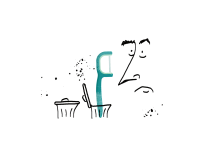
WALKING THE EMPTY streets of Washington, D.C., my hat pulled down against the wind and my face obscured by a fabric mask, I can’t help but notice the unsightly trash on the sidewalk. Lately, the usual litter of the nation’s capital—gum wrappers, empty fast-food containers, unsigned legislation for the common good—now includes a new item carelessly dropped. The formerly ubiquitous cigarette butt has been replaced by the discarded flossing pick.
While it’s good that many people have stopped smoking, must they now floss and toss? Old cigarette butts might eventually compost into something useful to the earth. But plastic devices for cleaning teeth will be with us—much like a 6-3 Supreme Court—long after any possible use to society. And they’re disgusting to look at. (Floss picks, not the Supreme Court, although [name withheld] is looking well past his freshness date.)
My guess is that former smokers have switched to floss devices to keep alive the rituals they so loved. And who can blame them? It’s so satisfying to take a pick from a fresh pack, hold it just so between thumb and forefinger, and go to town on what’s left from lunch. Maybe there should be designated areas outside office buildings where flossers could gather during breaks, bonding while prying out that troublesome piece of bagel and complaining about the boss. All the while looking relaxed and worldly as they move from tooth to tooth, then casually tossing the pick to the ground, followed by stepping on it with practiced vigor. Unfortunately, there’s a lot of peer pressure to floss in public, but just because the cool people are doing it doesn’t mean you have to. Think of the children.