pilgrimages
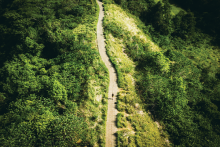
I LOVE TO walk. I came by this love naturally. My mother, now well into her 80s, is a dedicated walker, spending at least 30 minutes each evening walking on her treadmill. In earlier years, especially when the winds of the Kansas plains died down late in the day, she would walk the half-mile dirt road to our mailbox and back.
I’ve added three Labrador retrievers to my walking ritual — Hershey, Pippi, and Rue — who delight in a daily routine of getting outside, noses to the ground, tails in the air, ears perked and attuned. Responding to the rattle of their leash, each one’s anticipation is uniquely their own — a hop, a tail whipping against my leg, a wet nose urgently working to get the collar in place.
In recent years, after experiencing the awe of walking in the Pacific Northwest, where lush forests and rippling rivers drew my husband and me to their sacred cathedrals, we have started structuring vacations around where we want to hike. Step after step, we take in nature’s altars, praying with our feet, ingesting nature’s elements in holy, full-bodied communion.
In her book Enchantment: Awakening Wonder in an Anxious Age, Katherine May articulates what I feel when I’m walking. Enchantment, she writes, evokes a deep knowing that “something is there, something vast and wise and beautiful that pervades all of life. Something that is present, attentive, behind the everyday. A frequency of consciousness at the low end of the dial, amid the static. A stratum of experience waiting to be uncovered.” This is precisely why I have taken my worship on the road.
The Bible is replete with people who go walking and end up finding themselves in the process. Patriarch Abram, for example, was called to leave his home in Ur and walk to a new place in a more fertile valley where he made his new home with Sarai. Or consider the ancient Israelites who escaped the oppressive Egyptian pharaoh — and walked in the desert for a generation. Also don’t forget one of the Bible’s most familiar walks: the one taken by Ruth and her mother-in-law, Naomi. While the narrator shares few details of their journey, their trek from the hinterlands back to Naomi’s hometown must have been an adventure of dangerous proportions.
Walking requires a willingness to leave one place and go to another. And somewhere along the road, in the liminality of “not-there-yet,” transformation becomes possible.
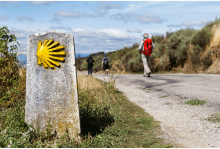
FOR AGES, THOSE living as monks, cloistered nuns, hermits, and wandering pilgrims have mastered the art of turning loneliness into solitude, creating a real presence to themselves, and to God. These spiritual explorers were often confined—as many of us are now—into narrow spaces, yet pilgrimage to the authentic self explores an interior landscape. The exterior pilgrimage often reflects the interior path of spiritual imagination conducted in confinement. Their lessons and practices are not cloistered today; they offer liberating tools that can resurrect and protect the space for real presence for all who desire detachment from the omnipresence of screens. Simply consider this: You can’t walk on unexpected pathways while looking at screens.
Untethered from normalcy
Pilgrims move in two directions at the same time—an outward direction toward a holy destination and an inward journey seeking an encounter with the sacred. Two of the best academic scholars of pilgrimages, Victor and Edith Turner, explain it in this one sentence: “Pilgrimage may be thought of as extroverted mysticism, just as mysticism is introverted pilgrimage.”
Pilgrimages, they suggest, were, and are, no walk in the park, or plain, or mountain. Embarking on such a journey, we become untethered not just from our physical normalcy. These uncertain, trusting steps also move us out of our spiritual familiarity. The pilgrim is invited not only to walk out of boxes of dogmatic beliefs but also to walk away from practices of comfortable spirituality.
This article is adapted from Without Oars: Casting Off Into a Life of Pilgrimage (Broadleaf Books, November 2020).
Over the past few days, I've had the privilege of representing Sojourners magazine at the annual Faith and Politics civil rights pilgrimage led by Congressman John Lewis.
Recently, I've begun to think how I can reconnect with God by turning all my travels (including my everyday errands) into pilgrimages. In this quest, I am greatly aided by the Rev. Kurt Neilson, author of Urban Iona.