Paintings
THE DAY AFTER the presidential inauguration in January, Episcopal Bishop Mariann Edgar Budde, preaching at a prayer service for unity attended by President Donald J. Trump, warned members of the new administration that contempt is “a dangerous way to lead a country.” She pleaded for their mercy and compassion for the most vulnerable and outlined a vision for social healing founded on genuine “care for one another.” Budde’s words stand in stark contrast to the campaign of dehumanization and destruction we’ve witnessed since.
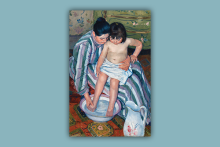
In the last few months, I’ve contemplated how, with incredible grace, Budde spoke truth to the power sitting before her in the pews. Her sermon left me feeling calm and convicted and brought to mind one of my favorite artists, the 19th-century impressionist Mary Cassatt. Like Budde’s sermon, Cassatt’s paintings are striking in their softness; they remind me of the kind of activist and person I want to be. I want to live with my heart softened and meet suffering with tenderness.
As Ruth E. Iskin explains in Mary Cassatt Between Paris and New York, Cassatt was “neither simply or completely a bourgeois, nor fully a precursor to the 1890s New Woman, but a mixture of both.” She was “anchored in a transatlantic network that included numerous conservative Americans” and an independent working woman who passionately supported women’s suffrage and full emancipation. In a male-dominated art scene, Cassatt made a name for herself with humanizing portraits of women of all ages, showing the relationship between caregivers and children and the dignity of motherhood. Her layered, emotionally vulnerable pieces highlighted the strength of women and the beauty and seriousness of care itself.
Her politics were characterized by a similar sensitivity. Iskin explains, “[Suffragists] claimed that the very role of mothers in the private sphere justified extending their activity into the public sphere of politics and government.” In other words, they made the case that the qualities of love, strength, and commitment exhibited by many women in their homes would also benefit civic spaces.
WHEN I TRAVEL to a city, I find art museums and their masterpieces: “Sunflowers” in Amsterdam, the “Prodigal Son” in St. Petersburg, “David” in Florence. Van Gogh, Rembrandt, Michelangelo. These are masters, according to some cultural imagination.
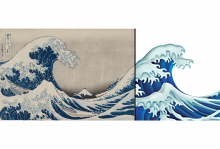
But it wasn’t until this past April that I encountered an Asian master and masterpiece: Katsushika Hokusai’s “Under the Wave Off Kanagawa.” The print is better known as “The Great Wave”—you know, the Apple wave emoji. Why is this the first Asian masterpiece that I’ve seen?
At its heartwarming core, Christmas is the story of a birth: the tender relationship between a new mother and her newborn child.
Indeed, that maternal bond between the Virgin Mary and the baby Jesus has resonated so deeply across the centuries that depicting the blessed intimacy of the first Noel has become an integral part of the Christmas industry.
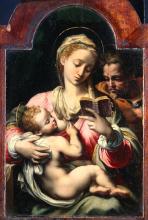
Yet all the familiar scenes associated with the holy family today — creches and church pageants, postage stamps, and holiday cards — are also missing an obvious element of the mother-child connection that modern Christians are apparently happy to do without: a breast-feeding infant.
Jesus certainly wasn’t a bottle baby. So what happened to Mary’s breasts? It’s a centuries-old story, but one that has a relatively brief answer: namely, the rise of the printing press in 15th-century Europe.
With the advent of movable type, historians say, came the ability to mass-market pornography, which promoted the sexualization of women’s bodies in the popular imagination. What's more, the printing press enabled the wider circulation of anatomical drawings for medical purposes, which in turn contributed to the demystification of the body. Both undermined traditional views of the body as a reflection of the divine.
Against the gray of concrete and stone buildings, the vibrant colors of the Paint Your Faith mural on a wall of Metropolitan United Church in downtown Toronto can be seen from blocks away.

A Toronto church wall speaks to the vibrancy of faith, thanks to the work of four aerosol artists.