films
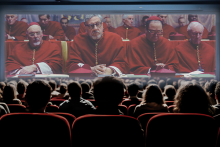
SINCE ITS PREMIERE in late 2023, Wim Wenders’ Perfect Days — a quiet, contemplative film about a janitor who cleans Tokyo’s public toilets — has been showered with accolades, including a Cannes Film Festival Palm d’Or nomination, an Oscar nomination for Best International Feature, two Japan Academy Film awards for Best Director (Wenders) and Actor (Kōji Yakusho), and even an Ecumenical Jury Prize, an independent award created by international Christian media organizations SIGNIS and Interfilm.
All these honors more or less speak for themselves, except — perhaps — the last one. Perfect Days is, after all, neither a Christian film nor an explicitly religious one. Except for the occasional reference to concepts related to Buddhism, such as meditation, karma, and nirvana, the only time protagonist Hirayama seems to make contact with some sort of higher power is when he listens to Nina Simone’s “Feeling Good” on his way to work each morning.
Fortunately for Wenders, Ecumenical Juries — which attend film festivals across the world — don’t limit themselves to the likes of Jesus Christ Superstar or The Passion of the Christ. At least, not anymore. “Initially, the focus was on films reflecting the Christian worldview,” says S. Brent Plate, a professor of religious studies at Hamilton College in New York, longtime Ecumenical Jury member, and author of Religion and Film: Cinema and the Re-creation of the World. “Over time, we shifted toward a broader interpretation of that focus, looking for films that, even if they don’t directly address religion, promote humanistic, progressive values.”
As a result of this shift, the Ecumenical Jury’s mission has come to raise worthwhile questions for film aficionados and religious scholars alike: Can movies function as a mode of religious instruction, bringing us closer to the divine the way a sermon might? Can they teach us how to be better people, inspiring us to lead more fulfilling lives by untangling the mysteries of the human condition? And, most important perhaps, can they nourish our spirit, impart morality, and help us overcome moments of personal crises in an age where the historical provider of such services in the West — the church — is losing its longstanding influence?

JEAN-LUC GODARD'S 1967 anti-consumerist film Weekend is difficult to explain in the space of a column, but a single scene offers a cross-section of its absurdity.
A bourgeois married couple begin a road trip to kill the wife’s parents and inherit their fortune. Naturally, once the deed is done, they each intend to kill the other and run off with their respective lovers. But first, they must maneuver traffic.
A country road is frozen in bumper-to-bumper traffic, and for nine excruciating and exhilarating minutes, the camera methodically tracks along the road, gawking at the jam. Some people play chess in the roadway while others toss bouncy balls between vehicles; children have emptied out of a school bus and run through the grass; there are lions, a llama, monkeys; people lounge and flirt as the couple weaves through the mess. The scene is made even more chaotic by the insatiable, mechanical wail of competing car horns and screaming squabbles.
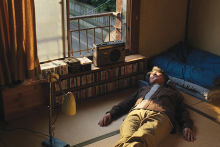
ONE WAY TO take a culture’s temperature at a given moment is to look at the art it produces. This is particularly true in film — a visual medium and a business largely driven by audiences’ perceived interests. Movies reflect their times, not just visually, but thematically.
Films made during the Great Depression, for example, included social realist dramas like Leo McCarey’s Make Way for Tomorrow, about an elderly couple who lose their home to foreclosure, and works of optimistic patriotism like Frank Capra’s Mr. Smith Goes to Washington, where Jimmy Stewart brings his determined charm to Capitol Hill. Others, like Capra’s romantic comedy It Happened One Night, offered troubled moviegoers good-natured escapism.
So, what’s on our minds recently, cinematically speaking? Among other things, a pandemic, corrupt institutions, international tragedies, and (another) contentious election year. There are many reasons viewers might want to escape into simpler or more fantastical worlds.
One recent trend, however, has surprised me: movies about presence.

EVERYTHING EVERYWHERE ALL AT ONCE, the absurdist sci-fi cinematic romp through the multiverse by a Chinese American laundromat owner in the L.A. mega sprawl, garnered seven Oscars this year, including for Best Picture. I’ve seen Everything Everywhere eight times. I’ve introduced it to friends. I did not think my favorite film could do anything wrong. What could be better than to be wrapped up in the spectacle created by directors Daniel Kwan and Daniel Scheinert and their amazing cast?
The directors’ over-the-top approach embraces the “too muchness” of its title. Laundromat owner Evelyn Wang (Michelle Yeoh) lives with her husband, daughter, and recently-arrived-from-China elderly father in a small apartment above the family business. Their dining room is cluttered with the American dream — workout equipment, inspirational business books, beeping electronic kitchen gadgets, a TV droning in the background, and a live security feed to the washers and dryers downstairs. “The Daniels,” as the directors are known, wrote in the original script, “It is a still life of chaos.”
Evelyn and her family are slowly spinning apart, and now the IRS is auditing the Wangs and their business. The forces of chaos are spreading beyond their little apartment. Later, while Evelyn is explaining to an IRS auditor (Jamie Lee Curtis) why her receipts are not in order, she gets a message from her husband (well, an alternative version of him) that she may be in grave danger and that she may hold the key to saving not only her own world but also the worlds in multiple universes and parallel time frames.
Despite its zany premise and on-screen absurdities (from anthropomorphic racoons and talking rocks to people with hot dogs for hands), Everything Everywhere never lets the spectacle eclipse the emotional story at its center: Evelyn is learning to find contentment in her own universe with her real family, even if she has the power to be elsewhere all at once.

IT WOULD HAVE been tough to be both a disciple of Jesus and a foodie. Don’t get me wrong, Jesus certainly valued food — his earthly ministry was filled with meals: The gospel of Matthew describes Jesus as one who “came eating and drinking” (11:19). As Robert J. Karris wrote in Eating Your Way Through Luke’s Gospel, Jesus was “either going to a meal, at a meal, or coming from a meal.” But what the Chosen One had in meal frequency, he lacked in meal diversity.
A “foodie” is someone who eats food as a hobby — a passion, even. The more exotic the better. If you pull up to your local boba shop, why settle for regular milk tea when you can order one infused with butterfly pea flower that turns it bright blue?
However, for Jesus’ meals, at least the ones recorded in scripture, the fish is served broiled (Luke 24:42), not creatively deconstructed. And if you’re rolling with Jesus, you better like eating bread.
Though his plate may have lacked the splendor of the centurions’ or high priests’ spreads, Jesus viewed the table as a radical place of inclusion. For many powerful religious leaders of the time, dining was yet another way to shun the outcasts. In contrast, Jesus intentionally invited those very same “unclean” people to dine with him, breaking bread (because of course it was bread) with tax collectors, sinners, and prostitutes.
In the past year, several films have articulated a hunger for the type of table Jesus championed. Flux Gourmet, Triangle of Sadness, and The Menu critique class inequality through stories revolving around fine dining. In each movie, wealthy people have rich flavors but a dearth of meaningful relationships. The exclusivity of the table seems more important than the actual food served on the plates. Jesus’ table, on the other hand, lacked variety but overflowed in inclusivity — a true palate cleanser to meals that symbolized selfish consumption.

The rift between rich and poor runs deeply through the Asian American and Pacific Islander community. A recent Pew study reveals that Asians, as a whole, “rank as the highest earning racial and ethnic group in the U.S.” But the top 10 percent of AAPI persons earn 10.7 times the amount of those in the bottom 10 percent.

Singing in Exile
On A Liturgy for the Perseverance of the Saints, Taiwanese-American artist SueAnn Shiah reimagines hymns “for those who have been driven out of the church because of their race, gender, or sexuality.” With warm vocals and spare arrangements, Shiah invokes hope for those currently “stranded in the wilderness.” sueannshiah.bandcamp.com
Faith and Imagination
In A Light So Lovely: The Spiritual Legacy of Madeleine L’Engle, Sarah Arthur digs deep into the personal journey of the influential and sometimes controversial A Wrinkle in Time author, revealing what L’Engle can continue to teach us. Zondervan

I GREW UP with Raiders of the Lost Ark—wildly entertaining, dancing brilliantly with movie craft, speeding up and slowing down in perfect measure, delicious humor and giant thrills aplenty.
But like us all, the filmmakers were subject to the prejudices, pressures, and knowledge of their time. So Raiders stereotypes the “Arab street,” and its casual approach to violence, while typical of action cinema, is ugly. The joy of the ride makes it easy to ignore that Raiders is about a Westerner using Africans to get a Middle Eastern sacred object into an American museum. It may be taking things more seriously than they deserve to even mention this, when the goal was merely a hugely enjoyable Saturday morning serial throwback. The problem with Raiders may be only visible in retrospect—it’s certainly not a bad film; just a popular one with gaps.

The True/False film festival in Columbia, Mo., likes to bill itself as “different.” And it is — the intimate weekend-long documentary fest has a well-earned reputation as a place where anything can happen: Here you’ll find award-winning directors hobnobbing with writers and college students over brunch, and accountants and lawyers who transform themselves, Cinderella-style, into flamboyantly dressed volunteers. But Columbia’s festival is unique in another way, one that’s more important than simple aesthetics: True/False also focuses on the unifying power of story.
Over its 13 years of existence, the festival has been committed to promoting the idea that introducing audiences to stories wildly different from their own expands our understanding of the human experience.

AS THE Academy Awards approach, I’d like to mention some films worthy of recognition by the lights of a different set of criteria. As a member of the Arts and Faith Ecumenical Jury, I am delighted to present our list of films from 2015 that “challenge, expand, or explore” faith, including those that illuminate religion and spirituality, pointing to a more humane vision of the world.
The choices are much more diverse than the usual annual polls. Multifaith stories (Irish Catholic, Israeli Jew, Iranian Muslim, just to start), exposés of injustice and calls for restoration, exile, and return, the damage done by immature religion, and the possibility of human spiritual evolution—all are here. And the film we agree was the year’s best does something profoundly important: It tells the story of a weaponized individual who spends her time doing everything she can to avoid killing.
Some in our top 10 I’ve written about here before—our number nine is the fun and wise animated map of the emotions, Inside Out; eight is the immigrant tale Brooklyn; five is Brian Wilson mental illness and creativity biopic Love & Mercy; and four is the powerful investigative journalism drama Spotlight, a challenge to contemporary news media to once again pursue their higher calling to tell the truth for the common good. Here are the rest of our selections:
10. About Elly. Iranian filmmaker Asghar Farhadi made this film in 2009, and it has been acclaimed as heralding “a new genre,” but it was not released in the U.S. until last year. Farhadi’s magnificent, compassionate dramas A Separation and The Past are more recent, but his ability to tell the most humane stories in the most gripping way was forged here.

BEST-SELLING WRITER James Patterson recently established a million-dollar fund to support independent bookstores amid the current publishing industry crisis. Patterson is showing both generosity of spirit and humility before the audience that made him rich, not to mention an ethical commitment to the community-building impact and personal pleasures of smaller bookshops.
I think his open-minded and visionary idea should be translated to independent theaters too. The experience of entering shopping mall multiplexes to be seated in a shoebox and watch 25 minutes of advertisements before the same film that’s screening at every other multiplex does not resonate with the poetics of the art. And I mean that literally—beautiful cinema does not belong in an ugly industrial container. I mean “belong” literally too—if art is about belonging, about the idea of finding a home for our idea of ourselves, then it would make more sense to screen movies in environments that invite a sense of home, not evoke battery farms.
If James Patterson were to set up another million-dollar fund devoted to independent movie theaters, I’d be happy to help him spend it. I’d upgrade projection, audio, and lighting so that as much attention can be paid to how a film looks as to how paintings are hung in a gallery or music played in a concert. I’d make the seats comfortable for average-sized human beings. I’d give grants to community groups who want to refurbish their dilapidated downtown theater as a venue for the common good. I’d screen films that invite social change. I’d develop new distribution networks that challenge the dominance of the military-industrial-entertainment complex—offering the rights to screen films in exchange for an ethical fee or a gift in-kind. I’d have potlucks at 5:30 p.m. and movies at 6:30 p.m. so there’s enough time afterward to write poetry together or march on the capitol.
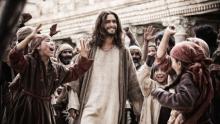
Christian leaders, including megachurch pastor Rick Warren, plan to rent every screen in numerous multiplex theaters across 10 cities for the premiere of Mark Burnett and Roma Downey’s upcoming Jesus film Son of God, on Feb. 27.
The unusual move reflects the confidence Christian leaders have in Burnett and Downey’s work in the wake of The Bible, a hit miniseries on the History channel.
The Son of God, an adaption from The Bible series, opens in theaters nationwide Feb. 28.
I’VE RECENTLY spent time researching the vision of the U.S. through the lens of one film for every state, following the intuition that, as most movies are set in Southern California or New York (and there’s a lot more America where those didn’t come from), we need to examine Fight Club and On the Waterfront, Brokeback Mountain and Nashville no less than The Wizard of Oz and Gone with the Wind to begin to capture the American dream life. It seems obvious, but it’s often dismissed: Contrasts between the states are mighty and rich. A Wyoming plain and a Sonoma vineyard, Hoboken and Harlem and Hot Springs, the Florida Keys and the Swannanoa Valley are all magnificent intersections of dreams and mistakes, which in honest art allows them to be places where the past can be faced.
And on that note, here’s my list of the 10 best U.S. films released in 2013:
The new Criterion Blu-ray John Cassavetes box set includes The Killing of a Chinese Bookie, the best entry to his work: A grimy thriller about one man trying to make art against the odds.
Jeff Bridges and Rosie Perez show us something more of how to be human in Fearless (newly available on Blu-ray), about a man who needs to die before he can live (and love).
THE MOST common image of the assassination of President Kennedy is embedded in the collective consciousness due to the fact that it was the subject of what may be the most-seen film in history, Abraham Zapruder’s 26-second home movie, grainy and garish in color and fact. The more recent eruption of reality television may have left us nearly unshockable, but a long, hard look at Zapruder’s short, hard film is still horrifying. The most provocative context in which I’ve seen the film located is Stephen Sondheim’s meaty musical Assassins. The Broadway production had Neil Patrick Harris as Lee Harvey Oswald with the film projected onto his white T-shirt. That the show took place at Studio 54 served to underline the demonic bargain at the intersection of the military-industrial-circus complex: The nightclub theater location satirized the fact that our stories about killing can either critique the cultural appetite for destruction or serve to perpetuate more of it as a form of entertainment.
If Assassins was the most provocative screen for the Zapruder film, the most politically complex is Oliver Stone’s 1991 movie JFK, now being rereleased to mark the assassination anniversary. It’s one of the greatest examples of cinematic craft applied to polemic (current examples are Captain Phillips and 12 Years a Slave)—edited like a dance, with a television miniseries’ worth of big name actors (Jack Lemmon, Sissy Spacek, Walter Matthau, Donald Sutherland, John Candy) in small roles holding up the edifice of big speechifying done by Kevin Costner and Tommy Lee Jones. It’s a thrilling film, and it has intellectual substance—the point is not whether or not the conspiracy theory posited in JFK is true, but that human beings “sin by silence” when we should speak.
I RECENTLY saw a photograph of me taken on the day I was born: two weeks premature, swaddled, peaceful, vulnerable, beautiful—pure potential. I wanted to travel back in time to give the little guy some advice and protect him. Most of all I wanted him to experience the things I missed—those that only seem to come to our attention with the benefit of hindsight. I wanted him to take more risks for the good, not worry so much, be more open to receiving love, take more walks in fields and on beaches, and avoid a thousand mistakes. I wanted him to be different.
While wanting to undo history is probably a human universal, it can also be a kind of psychic violence, emerging from the notion that there is such a thing as the person we were “supposed” to be. Indulging this notion led to me projecting it onto three intriguing films. Short Term 12 is a lovely, painful story of recovery from childhood wounds. In Seconds, the newly restored melancholic science fiction tale of human engineering from 1966, Rock Hudson brilliantly imagines what happens when you convince yourself that superficiality is depth and exchange the life you have for cosmetic “transformation.”

LEE DANIELS’ The Butler, a century-spanning tale of race in the United States and service in the White House, is a dream of a film—by turns historically realistic and magically fable-like. It’s a perfect companion piece to last year’s Django Unchained, in that case a movie whose tastelessness wrapped up as fabulous entertainment forced audiences to engage with a deeper level of the shadow of U.S. history.
Based on the story of Eugene Allen, a black man who served multiple presidents in a White House that took its own time to desegregate its economic policies for domestic staff, The Butler begins with a rape and a murder of plantation workers by the son of the boss. The ethical quality of the film is immediately apparent. This horror is not played for sentiment, nor even spectacle, but to evoke the very ordinariness of monstrosity.
This makes The Butler a rare film: one more interested in confronting us with a kind of previously unspoken truth than in goading us to feel the catharsis of guilt-salving by association. (It’s the antithesis of films such as Mississippi Burning, which use white protagonists to tell black stories and appear to believe that we can somehow participate in the virtue of the civil rights movement just by watching a movie about it.) The makers of The Butler have told a kind of truth about the struggle for “beloved community” that has rarely been seen so clearly on multiplex screens. The film illustrates the serious and painful work of nonviolence and invites us to consider the political and cultural tensions within the black freedom struggle, while giving a more humane perspective on the presidency than is often the case. We can hope the door is now open to more reflective cinema about the unfinished business of the black civil rights movement, broken relationships, traumatic memory, and how we tell the story of who we are.

EVERY SUMMER brings the end of the world. But not since 1998’s Deep Impact and Armageddon both threatened the end of the world with objects from space has there been such apocalypse redundancy in summer blockbusters: This year, class wars, real wars, ecological exhaustion, aliens, and zombie viruses destroyed our planet in as many different ways.
In her excellent e-book The Zombies are Coming!, Kelly J. Baker reminds us that apocalyptic fantasies have been part of the popular American imagination since at least the Puritan hellfire sermon. Even without a common religious narrative to guide them, end-of-the-world stories mostly function as a form of cultural critique and utopian longing. We can only imagine a desired future out of the ashes of the utterly destroyed present. In other words, things are going to have to get a lot worse before they get better.
If Baker is right that we seize on apocalyptic fantasies both to express a deep feeling that something is very wrong with our current state of affairs and to imagine some better alternative, then this summer’s world-ending movies display a profound lack of imagination. Most of them are not even particularly good at conceiving the end of the world, and none of them offer us a vision of how things might be different.
After Earth, for example, is more an overblown coming-of-age story than an apocalyptic thriller. The film follows Kitai (Jaden Smith) as he is guided via walkie-talkie by his wounded father (Will Smith) across an unknown planet. The planet turns out to be Earth 1,000 years after humans have high-tailed it to outer space. But since we never learn why humans had to leave, the apocalyptic frame feels like little more than an excuse to raise the stakes of Kitai’s journey and a chance to show off some fantastic technology. Kitai’s array of super-cool gadgets pretty much guarantees the creatures he meets will have to be more menacing than anything the old Earth could manufacture. The few glimpses we get of humanity’s new planet suggest a post-racial melting pot where everyone speaks a little Chinese and a lot of English and has a preference for flowing linen garments and nautical decoration schemes. I suppose this is a vision of a better tomorrow, but it felt more like a futuristic Pier One ad.
CINEMA IS poetry, not prose, and so looking for “realism” in movies is an ambiguous task. Perhaps the better comparison would be with memory, for the way we experience the past might feel a little bit like a film unspooling in a low-lit room, the images urging themselves onto a wall with frayed paper, red-hued, with the sound fading as I get older. Like the opening of the film of Carl Sagan’s novel Contact in reverse, in which all the radio signals that have ever been broadcast speak their way into deep space, the further away I get from a memory, the more like an old movie it seems.
The role that cinema plays in memorializing the past is unparalleled—for both the way we experience memory and the memories themselves are uniquely bound up in each other—Casablanca or There’s Something About Mary alike may remind us of past loves, and perhaps also of the time and place we saw those movies, and watching either of them again enables us to re-experience the very emotions we may have first experienced by watching it. When we experience movies like memories, we meditate rather than consume, and do what Pascal suggested was the antidote to all the problems in the world: sitting still for 10 minutes and thinking. At the cinema we take a walk in our minds and, through an art form that is usually less controllable than reading or listening, we are taken somewhere new.