Baseball
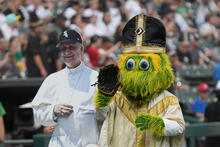
The White Sox beating the Cincinnati Reds this week in Chicago? There isn’t a bigger sure thing in sports, right?
Come on. Is the pope Catholic?
More to the point, is the pope a White Sox fan from Chicago?
As if that kind of divine firepower doesn’t already suggest some kind of winged assist from above for the White Sox’s sudden ascent into playoff contention this year after averaging 108 losses the past three, the White Sox promotions department rubbed it in with the Reds’ arrival to town for a series.
They brought out a nun for the ceremonial first pitch of the series and gave away “pope hats” to fans who shrugged off inclement weather forecasts to produce only the ninth sellout of the season at the Sox ballpark with 38,000 Pope Leo impersonators wearing their new hats for the beer-boosted, fun-loving – if perhaps a tad sacrilegious – promotion.

DURING MOST RECENT winters, my sister has heard me declare, excitedly, “Baseball is almost back!”
This may be surprising. Perhaps that’s because I am a Black man in my early 30s. (There aren’t that many of us longing for baseball anymore.) But it also may be surprising because my favorite team is the New York Mets. And if you know anything about the Mets, you know that to be a Mets fan is to be a friend to frustration, not to excitement.
I guess I was saved from some frustration because school and the lack of the necessary cable TV bundles made it hard for me to follow the team as closely as I would’ve liked during the 2010s and much of the early 2020s. Most of those years ended with the team losing more games than they won. And yet last year, with the blessing of a full-time job, I was glad to purchase a streaming service that allowed me to regularly watch my favorite team again.
Being a baseball fan — if you let it — can train your spiritual muscles in a way that few other activities can. Do you care about daily rituals like prayer? Baseball, unlike most professional sports, is typically played six or seven days a week. Are you working toward a cause, like human rights, that is mostly out of your control? Baseball reminds us that no one player, no matter how good they are, can single-handedly make their team win a championship (shoutout to Mike Trout).

The promise of Field of Dreams is that when we give ourselves to serving the common good at the place where our “deep gladness and the world’s hunger meet,” as Frederick Buechner writes, we don’t just help advance the healing of the people we touch, we also begin to heal our pain.

WITH THE COMING of spring and warm weather, my thoughts turned, as they always do, to the importance of the game of baseball in my family and the valuable lessons I’ve taken from it. We have a sign outside our home: “We interrupt this family for baseball season.” It reflects how much baseball means to our whole family and how much time and space it takes up in our day-to-day lives for much of the year.
Some of my most rewarding years as a father were the 11 years (and 22 seasons) that I coached my sons, Luke and Jack, in Little League Baseball. Though that time is past, baseball still very much connects our family as my sons have moved through school, with my oldest continuing to play baseball at Haverford College.

Jim Wallis and I were talking about baseball recently. He claimed that baseball is great because at the start of every season, 10 to 15 teams genuinely believe in their chances of advancing to the World Series. How does baseball do that? How does the league ensure strong competition and parity?

For decades, people have milked metaphors of baseball and religion beyond what they are worth. It’s not illegal, though there should probably be a special place in hell for those who claim to see the Trinity in baseball’s rule that three outs end an inning, or that the ballpark is a “cathedral.”
The truth is, we can go deeper.

WE ARE A baseball family, with our two boys playing on many teams over the years with multiracial teammates, coaches, and leadership in the organizations shaping those programs. I have long been a Little League baseball coach, and my wife, Joy, has been commissioner at every level too.
In baseball, talent and teamwork are the metrics and measuring sticks, not the race of one’s teammates. For both of my boys, their teammates are their closest friends.
Being a Little League coach (for 11 years and 22 seasons!) has given me a place to reflect on our nation’s racial issues. Playing baseball brings you closer together. My son Luke often says his high school teammates are the best friends he’s ever had, and at every level of Little League, my players always testify in our final team meeting of the season how they have become such close friends. Being teammates really does help overcome racial bias and prejudice, because it is the issue of proximity that finally helps human beings understand one another and learn empathy. On Little League teams we are all cheering for one another, looking out for one another, picking one another up when we fall down or make a mistake, and learning to be positive as we work together for our common goals.
One of the best things to watch over the course of a season is how, across racial lines, the parents of players become friends as well. It is especially interesting to see how the conversation topics develop over time, moving from “just baseball” to school and future, to work and family, to sharing of life experiences, and even to national events, which sometimes includes race. What becomes clear is that we all care more about our children and their future than anything else, and beginning to talk about our kids’ futures together can be a very powerful moment.

I am a big believer in shaking things up and approaching ideas through an unexpected perspective. Like the billboard I saw in Minnesota: It read, at the top, “Minnesota Cremation Society.” In the middle was a photo of a casket, and underneath, it read, “Think outside the box.”
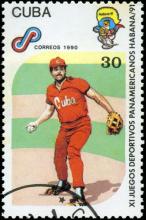
AS THIS IS written, the U.S. and Cuba are in the final stages of the haggling that will likely lead to the opening of embassies in Havana and Washington, and peace, love, and understanding seem to be breaking out all over. Pope Francis, who helped broker the U.S.-Cuba thaw, will visit the island in September on his way to the U.S. After a recent meeting with the pope, Cuban President Raul Castro said, “if the pope continues to talk as he does, sooner or later I will start praying again and return to the Catholic Church.” And Major League Baseball is already working on bringing at least spring training games back to baseball-crazy Cuba.
In the U.S. media, discussion of the new détente with Cuba has focused almost entirely on the past 55 years of Cold War-inspired confrontation. However, the U.S. and Cuba had a close and troubled relationship for a full 60 years before Fidel Castro took power, and as hostilities wane and the U.S. economic embargo against Cuba is eventually dropped, the patterns of this U.S.-Cuban “prehistory” may become important again.
That story begins in 1898, when the U.S. empire first extended beyond our North American shores as the U.S. took control of Cuba, Puerto Rico, and the Philippines at the end of the Spanish-American War. Puerto Rico we still hold.


A bunch of us writers were in Florida covering spring training a few years ago. Our sports editor took us out to dinner. During the conversation, she asked if we ever found ourselves pulling for a favorite player to do well — say, in the ninth inning of a dramatic comeback.
The response was unequivocal and unanimous. No! Never! Not in the ninth inning!
By the bottom of the ninth, the story is written. Ready to be sent out as soon as the game ends. A lot of hard work has gone into those sentences. The home team had eight entire innings to take the lead. Sorry. They had their chances. Now they should just lose quietly. Don’t mess up my story!
For the most part, sports writers hate dramatic comebacks. You have to hit the “delete” key on a lot of hard work. And then you frantically rewrite on deadline, which is the toughest type of writing.
Some time later, though — and this may not come until you’re driving home at 3 a.m. — you let your brain throttle back from hyper drive and say: Wow, that was pretty cool. Even though it drove my typing fingers crazy.
One of the best things about sports is that there’s always a chance for something grand at the end. Something that can take your prose away — and your breath away — in one unexpected moment.
Maybe that’s why fans — OK, and yeah, even sports writers — revel in those incredible finishes. They remind us of the sweetly unpredictable nature of our lives. And how in each of our lives, as Anne Lamott puts it: “Grace bats last.”
It’s true.
I’ve seen that ninth-inning comeback play out many times.
How do you get your Little League team to get their hitting going? Get a surprise visit before your game from President Barack Obama! Our excited kids won 12-1.
I’m been a Little League baseball coach for 10 years and 20 seasons; first with my 15 year-old sophomore son Luke who has graduated way beyond his Dad coach to high school varsity baseball, and now with my 11 year old son Jack—who got to meet the President of the United States at his game on Monday night. The expressions on the kid’s faces when Obama walked on to their field were magical and priceless.

This Holy Week, I realized God's hope in a place other than church.
Proclaiming that the tomb is empty – that Jesus has risen from the grave – is the most powerful witness any Christian can offer. But if our Easter celebration stops at proclamation then we’ve shortchanged the world of the hope and joy it sorely needs. The resurrection must also be about embodiment. It should change the way we live and move and have our being. Easter should transform and strengthen us to participate in God’s reconciling work in the world.
That’s why I chose to spend this Easter worshipping in a very different way and in a very different place. There was no midnight watch service or large family dinner, but there were countless moments of hope and an abiding trust in the possibility of new life.
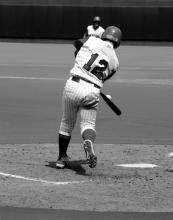
When I was growing up, I had three older cousins who were my models for being awesome. They were funny, smart, athletic, and they loved baseball.
And so I wanted to be all of those things, but the one thing I could do without any effort was love baseball.
But I had one major problem. I’m missing the athletic gene of the Ericksen family. While I could share in the love my cousins had for baseball, I couldn’t share in their athletic ability. I lack coordination, which creates problems in every aspect of baseball. I once tripped while running to first base. Embarrassed, I ran back to the dugout and insisted to my teammates that I didn’t trip – I dove. But by the fourth grade, every baseball player knows that you never dive into first base. You run through it.
In sixth grade I played third base. I fielded a grounder that took a bad hop – right to my forehead. I laid on the dirt, crying, and thinking that I never wanted to play again. I finished that game, but never replay organized baseball again.
So, my baseball career was a failure, but I still love the game. The smell of the grass, the crack of the bat, a diving catch – my total lack of athletic ability allows me to appreciate those who have honed their athleticism.